A successful Q4 holiday corporate gifting program starts with the recipient, the objective, the budget, the gift format, and the delivery deadline. U.S. companies should plan separately for employees, clients, partners, prospects, and international recipients rather than sending one generic holiday item to everyone. Production, address collection, fulfillment, shipping, cultural relevance, and recipient choice should be resolved before orders are approved.
Corporate holiday gifting is no longer limited to sending the same branded box to every employee or customer in December. Companies now use physical gifts, recipient-choice links, gift cards, reward points, branded stores, charitable campaigns, curated kits, and locally available products.
The correct model depends on:
- Who will receive the gift
- Why is the gift being sent
- How well the company knows the recipient
- Where the recipient is located
- Whether branding is necessary
- How much choice should be offered
- When the gift must arrive
- How the complete delivered cost will be calculated
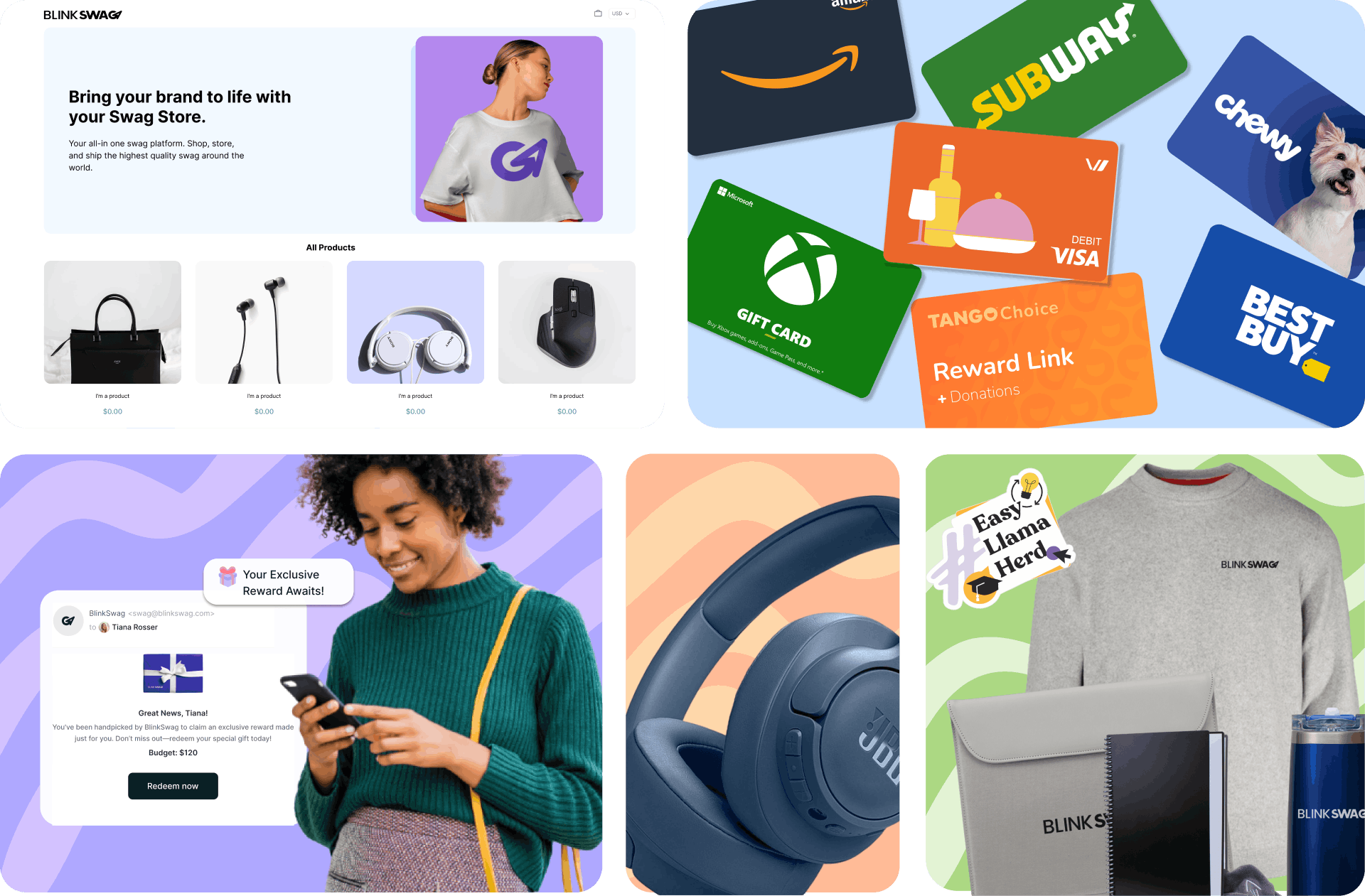
BlinkSwag supports preselected physical gifts, recipient-choice rewards, custom digital cards, branded stores, gift cards, inventory-backed fulfillment, and bulk reward links. Recipients can receive a secure email link, accept a gift, and provide their own shipping information, eliminating the need for the company to manage every residential address manually.
Planning principle: The best holiday gift is not necessarily the most expensive product. It is the gift that is appropriate for the recipient, arrives at the right time, complies with company policy, and creates the intended experience without unnecessary inventory or delivery problems.
How should companies plan Q4 corporate gifting?
Companies should plan Q4 gifting as a complete program rather than a product purchase. Begin by defining the audiences, business objective, budget, gift model, delivery locations, approval requirements, and success measures. Product selection should happen only after the company understands how gifts will be personalized, accepted, fulfilled, shipped, and measured.
Use the following planning sequence.
Step 1: Define the objective
A holiday gift may be intended to:
- Thank employees for their contribution
- Recognize an important client relationship
- Support a renewal or customer milestone
- Strengthen a partner relationship
- Welcome a new employee
- Re-engage a prospect
- Celebrate a team achievement
- Support a charitable cause
- Reinforce company culture
- Close the year with appreciation
Do not combine unrelated objectives into one campaign without explaining why each audience is receiving the gift.
Step 2: Segment the recipients
Separate:
- Employees
- Managers
- Remote employees
- International employees
- Clients
- Strategic accounts
- Prospects
- Partners
- Vendors
- Donors
- Volunteers
- Executives
- Event attendees
Segmentation enables the company to tailor the message, value, gift model, and delivery process without creating an entirely separate program for each recipient.
Step 3: Select the gift model
Choose among:
- One standardized physical gift
- A curated gift box
- Recipient choice
- A branded store credit
- A gift card
- Reward points
- A charitable donation
- A shared office gift
- A digital experience
- A hybrid program
Step 4: Confirm the operating requirements
Before approving a product, determine:
- Production lead time
- Minimum order quantity
- Decoration requirements
- Packaging
- Address collection
- Warehousing
- Kit assembly
- Domestic and international shipping
- Customs and duties
- Return handling
- Replacement policy
Step 5: Define success
A Q4 program may be measured through:
- Gift-acceptance rate
- Redemption rate
- Successful delivery rate
- Cost per delivered recipient
- Recipient feedback
- Remaining inventory
- Return rate
- Replacement rate
- Employee participation
- Client response
- Renewal or engagement influence
What are the main Q4 gifting dates in 2026?
The principal 2026 U.S. Q4 gifting moments include Diwali on November 8, Veterans Day on November 11, Thanksgiving on November 26, GivingTuesday on December 1, Hanukkah from December 4 through December 12, Christmas on December 25, Kwanzaa from December 26 through January 1, and year-end appreciation on December 31.
Diwali falls on November 8 in 2026, based on the Hindu American Foundation’s New York calendar. Hanukkah begins at sunset on December 4 and continues through December 12. Thanksgiving is November 26, while GivingTuesday is December 1. Kwanzaa is observed annually from December 26 through January 1.
| Date | Occasion | Appropriate corporate use |
| October 1 | Q4 program launch | Final approvals, product selection, creative, and recipient validation |
| October 31 | Halloween | Informal employee, event, and customer engagement |
| November 8 | Diwali | Relevant employee, client, and community recognition |
| November 11 | Veterans Day | Respectful recognition of veterans and military communities |
| November 26 | Thanksgiving | Employee, partner, client, and community appreciation |
| December 1 | GivingTuesday | Donations, volunteering, and community campaigns |
| December 4–12 | Hanukkah | Relevant seasonal recognition for Jewish recipients |
| December 25 | Christmas | Employee, customer, and partner gifting |
| December 26–January 1 | Kwanzaa | Relevant cultural and community recognition |
| December 31 | New Year’s Eve | Year-end thanks and relationship building |
| January 1, 2027 | New Year’s Day | Delayed appreciation and fresh-start campaigns |
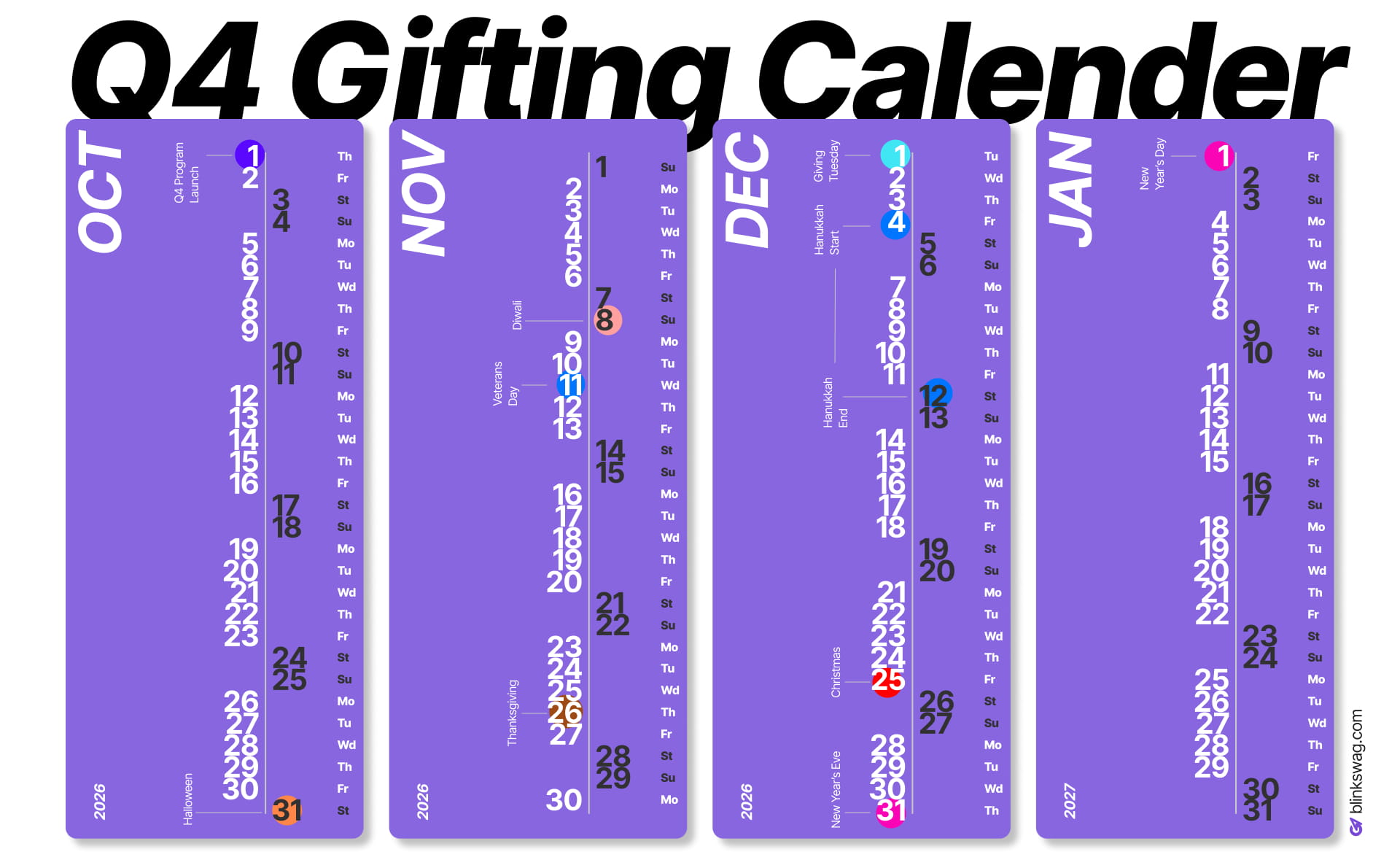
Download the free Q4 holiday gifting Calendar in pdf⟶
How should the calendar be used?
The calendar should not be treated as a requirement to send a gift for every occasion.
Use it to:
- Identify the dates relevant to the workforce and customers
- Avoid scheduling conflicts
- Build culturally appropriate campaigns
- Establish order and shipping deadlines
- Coordinate messages across departments
- Prepare alternatives for recipients who do not observe a specific holiday
A holiday may be a religious observance, a cultural celebration, a federal holiday, a retail event, a fundraising movement, or an internal business milestone. These categories should not be treated as interchangeable.
When should companies order corporate holiday gifts?
Companies should begin Q4 gifting strategy during July or August, complete recipient and budget planning in September, approve products and creative in October, and begin fulfillment preparation in November. Premium products, custom packaging, large quantities, and international shipments require earlier decisions than digital rewards, stored inventory, or recipient-choice links.
The following is a BlinkSwag planning framework, not a universal carrier guarantee.
July and August: strategy
Complete:
- Program objectives
- Audience definitions
- Estimated recipient counts
- Preliminary budget
- Country list
- Corporate gift-policy review
- Initial vendor evaluation
- Bulk, on-demand, or hybrid decision
This period is especially important for:
- Premium retail brands
- Custom-manufactured products
- International programs
- Large employee populations
- Custom boxes
- Multi-product kits
September: program design
Complete:
- Recipient segmentation
- Budget bands
- Product shortlist
- Mockups and samples
- Gift-message strategy
- Packaging requirements
- Address-collection method
- Internal approvals
September should end with a clear decision about whether recipients will receive:
- The same product
- A curated kit
- A choice link
- Store credit
- A gift card
- A charitable option
October: production and platform setup
Complete:
- Final product approval
- Artwork approval
- Quantity confirmation
- Decoration
- Packaging
- Store configuration
- Reward-link setup
- Digital-card design
- International delivery review
BlinkSwag offers branded digital mockups and supports individual reward links with assigned budgets, one-to-one email delivery, and bulk link generation.
November: fulfillment preparation
Complete:
- Recipient-list validation
- Address collection
- Inventory receiving
- Kit assembly
- Early shipments
- International dispatch
- Carrier review
- Failed delivery planning
Carrier cutoff dates should be refreshed from official USPS, UPS, FedEx, and international carrier sources immediately before the campaign. Do not publish a delivery guarantee based only on a general seasonal timeline.
December: delivery and contingency
Use December for:
- Hanukkah, Christmas, Kwanzaa, and year-end sends
- Shipment monitoring
- Address corrections
- Replacement handling
- Late recipient additions
- Digital fallback gifts
- New Year campaigns
Last-minute additions should usually use:
- Gift cards
- Recipient-choice reward links
- Store credit
- Digital experiences
- Charitable options
- Products already held in inventory
Who should receive corporate holiday gifts?
Corporate holiday gifts should be sent to recipients whose contribution, relationship, support, or business value the company can explain. Employees, clients, partners, vendors, donors, volunteers, and selected prospects may require different messages and gift values. A large, undifferentiated list often leads to higher costs while providing a less personal experience.
Employees
Employee gifting may be recognized:
- Annual contribution
- Team performance
- Work anniversaries
- Remote-work support
- Successful launches
- Company milestones
- Leadership contribution
- Year-end appreciation
Employee gifts should be consistent enough to feel fair while allowing reasonable adjustments for location, preference, dietary requirements, or role-specific recognition.
Clients
Client lists should be segmented by:
- Relationship length
- Account importance
- Project history
- Renewal stage
- Recent business outcome
- Number of people involved
- Corporate gift policy
A long-term strategic client may justify a different gift from a new or inactive account.
Prospects
Prospect gifts should be controlled carefully.
Avoid:
- Expensive gifts to unqualified lists
- Gifts that create pressure to respond
- Items prohibited by the recipient’s employer
- Gifts sent before confirming a legitimate business context
Consider:
- Meeting follow-up gifts
- Event-related sends
- Modest recipient-choice rewards
- Campaign kits
- Charitable actions
- Useful digital resources
Partners and vendors
The gift message should identify the contribution being recognized, such as:
- Reliable service
- Joint campaign performance
- Product launch support
- Long-term partnership
- Customer service
- Community contribution
Executives and VIP recipients
Executive gifts require stronger attention to:
- Quality
- Packaging
- Subtle branding
- Personalization
- Delivery confirmation
- Corporate policy
- Alcohol restrictions
- Recipient availability
How should employee and client gifts differ?
Employee holiday gifts should emphasize appreciation, fairness, usability, and inclusion of recipients. Client gifts should reflect the business relationship, account context, recipient policy, and level of personalization. The same product may work for both audiences, but the message, packaging, gift value, branding, and delivery experience should usually be adapted.
| Decision area | Employee gifting | Client gifting |
| Primary objective | Appreciation and recognition | Relationship strengthening |
| Recipient knowledge | HR and manager data | Account and stakeholder data |
| Fairness | High importance | Varies by account value and policy |
| Branding | Moderate and useful | Often subtle |
| Personalization | Name, team, milestone | Relationship, project, or business outcome |
| Gift choice | Valuable for diverse teams | Valuable when preferences are unknown |
| Budget | Often standardized by group | May vary by account segment |
| Delivery | Home, office, or event | Office, home, or shared team location |
| Measurement | Acceptance, feedback, retention signals | Response, relationship, and account activity |
Employee-gift principle
Employees should not feel that the holiday gift is:
- Required company apparel
- A replacement for compensation
- A promotional giveaway
- A product selected only for brand visibility
The message should state what contribution or milestone is being appreciated.
Client-gift principle
Client gifts should avoid looking like mass marketing.
Improve relevance through:
- A relationship-specific message
- Appropriate product quality
- Subtle decoration
- Team-sharing options
- Recipient choice
- Timing is connected to the relationship
- Confirmation of corporate policy
Which corporate gift model should a company use?
Companies should select a gift model according to recipient knowledge, audience size, location, deadline, branding needs, inventory tolerance, and budget. Standardized products simplify purchasing, while recipient-choice links reduce preference risk. Gift cards support last-minute delivery, and curated kits create a stronger presentation but add packaging, assembly, and shipping costs.
| Gift model | Best for | Main advantage | Main risk |
| Standard physical product | Large, consistent audience | Simple sourcing and branding | Preference mismatch |
| Curated gift box | Employees, clients, and VIPs | Strong presentation | Higher assembly and shipping cost |
| Recipient-choice link | Distributed or diverse audience | Personal relevance | Unclaimed rewards |
| Gift card | Last-minute and flexible programs | Speed and choice | May feel generic without a message |
| Reward points | Ongoing employee programs | Repeated engagement | Requires program management |
| Store credit | Employee or partner stores | Controlled product choice | Catalog must remain relevant |
| Charitable gift | Values-led and GivingTuesday campaigns | Mission alignment | The cause may not suit every recipient |
| Shared office gift | Client or partner teams | Reaches several recipients | Office attendance and dietary issues |
| Digital experience | Global and remote recipients | No physical delivery | Regional availability may differ |
| Hybrid campaign | Mixed audiences | Flexible by recipient | More program complexity |
Choose a standardized physical gift when:
- The audience has similar needs
- The quantity is predictable
- Branding is important
- Products can be ordered early
- Inventory risk is acceptable
Choose the recipient when:
- Apparel sizes are unknown
- Preferences differ
- Recipients live in several regions
- The company does not want to store addresses
- The program includes several budget bands
BlinkSwag reward links can be assigned to individual recipients, given specific spending limits, generated in bulk, and used for merchandise, physical gifts, or gift cards.
Choose gift cards when:
- The deadline is approaching
- Product preference is unknown
- Physical shipping is difficult
- Recipients are distributed
- A digital fallback is needed
Choose a curated kit when:
- Presentation is central
- Several products support one story
- The campaign is high value
- The recipient count is controlled
- Packaging and fulfillment have been budgeted
How much should companies budget for holiday gifting?
A Q4 gifting budget should include the gift, decorations, packaging, assembly, storage, fulfillment, shipping, duties and taxes, and a replacement allowance. Companies should not compare a product-only price with a delivered gift program. Budget bands can guide product selection, but they should not be presented as universal market averages or mandatory spending levels.
Use the following planning bands as an editorial framework.
| Planned gift value | Appropriate use |
| Under $25 | Broad appreciation, simple products, digital rewards |
| $25–$50 | Standard employee gifts, remote-team rewards, modest client gestures |
| $50–$100 | Premium employee gifts, client appreciation, and branded kits |
| $100–$200 | Strategic clients, executives, milestones, and personalized kits |
| More than $200 | VIP relationships and carefully approved executive gifting |
These bands represent the intended value of the gift, not the completed delivered cost.
Total Q4 gifting cost
Total Q4 Gifting Cost = Gifts + Decoration + Packaging + Assembly + Storage + Fulfillment + Shipping + Duties + Taxes + Replacements
For individual delivery programs:
Delivered Cost per Recipient = Total Q4 Gifting Cost ÷ Successful Recipient Deliveries
A successful delivery should not include:
- Unclaimed gifts
- Returned packages
- Damaged products
- Unused stored inventory
- Failed address submissions
- Replacement shipments counted twice
BlinkSwag public fulfillment charges
BlinkSwag currently publishes:
- $2.65 fulfillment per order containing a warehouse product
- $1 per warehouse product picked
- Free pack-in fulfillment
- Free receiving and processing
These fees do not include the product, decoration, storage, shipping, duties, taxes, or special handling.
Why is the product price alone misleading
Two $50 gifts may have very different delivery costs.
A digital reward may require:
- Reward value
- Platform or redemption charges, when applicable
- Tax treatment
A physical gift kit may require:
- Products
- Decoration
- Box
- Printed card
- Filler
- Assembly
- Picking
- Fulfillment
- Parcel shipping
- Replacement allowance
The budget should therefore be approved at the program level rather than only at the product level.
What are the best holiday gifts for employees?
The best employee holiday gifts are useful, appropriate, easy to receive, and connected to a clear appreciation message. Strong formats include recipient-choice rewards, premium drinkware, winter essentials, home-office products, wellness items, apparel with confirmed sizing, practical technology, gift cards, charitable options, and curated kits designed for the employee’s location and preferences.
Recipient-choice rewards
Best for:
- Large distributed teams
- Unknown preferences
- International employees
- Mixed age groups
- Uncertain apparel sizes
Recipient choice allows the company to control the budget while giving the employee flexibility.
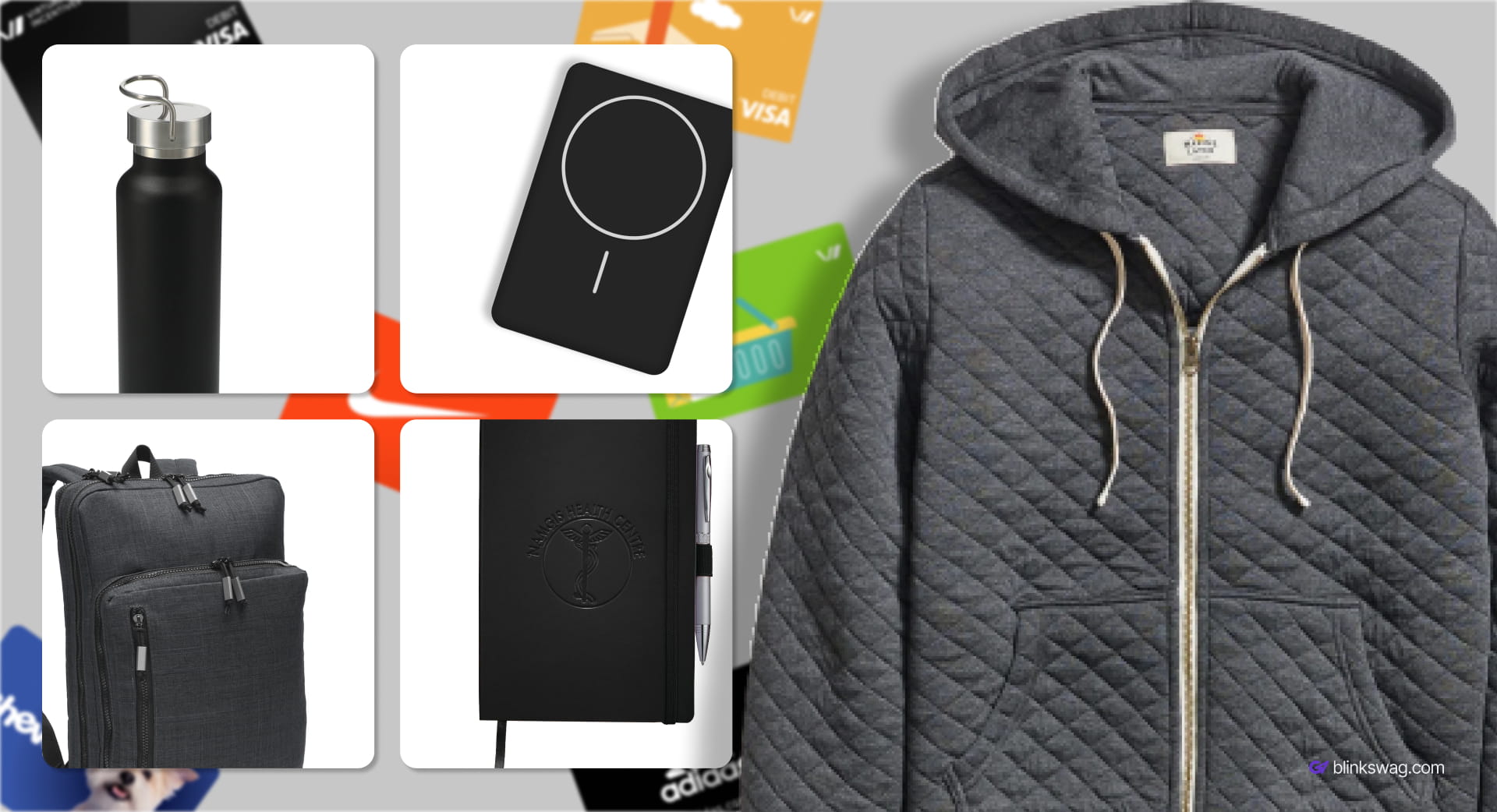
Practical branded products
Examples include:
- Insulated drinkware
- Quality backpacks
- Journals
- Desk accessories
- Portable chargers
- Travel items
- Winter apparel
- Home-office products
Branding should remain proportionate. A holiday gift should be useful to the employee, not just visible to others.
Apparel
Apparel works best when:
- Sizes are confirmed
- The item suits the climate
- The product quality is appropriate
- Employees are not expected to wear it as mandatory workwear
- Exchanges can be handled
Recipient-choice stores can reduce incorrect-size inventory.
Wellness gifts
Potential options include:
- Relaxation kits
- Fitness accessories
- Sleep products
- Self-care items
- Healthy food options
- Experience credits
Avoid assuming that every wellness product is suitable for every employee.
Gift cards and store credit
Gift cards can be appropriate when:
- Employees are geographically dispersed
- The deadline is short
- Personal preferences are unknown
- International product availability is inconsistent
A personalized message should explain the reason for the gift so the experience does not feel purely transactional.
What are the best holiday gifts for clients?
The best client holiday gifts reflect the relationship, recipient policy, account value, and number of people being recognized. Useful options include premium drinkware, quality technology, shared office gifts, gourmet products, executive accessories, recipient-choice rewards, charitable donations, and personalized kits. The message should explain the relationship being appreciated rather than deliver a generic sales promotion.
New clients
Focus on:
- Welcome
- Partnership potential
- Recent project progress
- Practical, moderate-value gifts
Avoid overly expensive gifts that may create discomfort.
Long-term clients
Consider:
- Premium product quality
- Relationship-specific personalization
- Shared milestones
- A product connected to the client’s work or interests
- A team gift was given when several stakeholders contributed
Strategic accounts
Strategic-account gifts may justify:
- Executive-quality products
- Personalized kits
- Premium packaging
- Multi-recipient campaigns
- Recipient choice
- Tracked delivery
The account’s gift policy should be confirmed before the item is purchased.
Shared office gifts
Shared gifts may work for:
- Project teams
- Customer-service departments
- Partner offices
- Agencies
- Vendors
Confirm:
- Office attendance
- Team size
- Dietary requirements
- Delivery contact
- Whether the package can be accepted securely
Branded versus unbranded client gifts
Use stronger branding when:
- The product is part of a campaign
- The recipient expects branded merchandise
- The item is designed for office or event use
Use subtle branding when:
- The relationship is executive-level
- The product is premium
- Personal use is expected
- The company wants the gift to feel less promotional
How should companies handle remote and international gifting?
Remote and international gifting should begin with destination, address, product availability, customs, duties, delivery time, and recipient preference. Worldwide shipping is not the same as local production or regional warehousing. Companies should confirm where the gift is produced, where inventory is stored, who pays import charges, and how failed deliveries are resolved.
Questions for every international campaign
- Is the product available in the destination country?
- Is it produced locally or shipped across a border?
- Which warehouse will fulfill the order?
- Who acts as the importer of record?
- Are duties prepaid?
- Which taxes apply?
- Is the recipient required to pay anything?
- Can the gift be returned locally?
- What happens after a failed delivery?
- Is a digital alternative available?
BlinkSwag supports worldwide delivery and describes its fulfillment service as including storage, packing, inventory control, and shipping. Its public materials do not establish that every product is locally produced in every destination, so country-specific arrangements should be confirmed before approval.
Address collection
A company should minimize the number of employees who handle residential addresses.
A recipient-managed process can:
- Send a secure link
- Allow the recipient to accept or decline
- Collect the preferred address
- Confirm product choice
- Reduce spreadsheet sharing
- Improve delivery accuracy
BlinkSwag’s gifting workflow lets recipients receive an email link, accept the gift, and enter their own shipping information.
Digital fallback options
Prepare a fallback for:
- Countries with import restrictions
- Missed physical shipping deadlines
- Unavailable products
- Employees who decline physical delivery
- Failed address collection
Fallbacks may include:
- Gift cards
- Reward links
- Store credit
- Charitable choice
- Digital experiences
- A New Year delivery
How can companies make holiday gifting more inclusive?
Inclusive corporate gifting gives recipients an appropriate choice without requiring them to disclose personal beliefs. Companies should review the occasion, message, product, dietary requirements, accessibility, location, and delivery method. A general workforce campaign should use inclusive appreciation language, while holiday-specific messages should be used only when the recipient’s connection to the occasion is known.
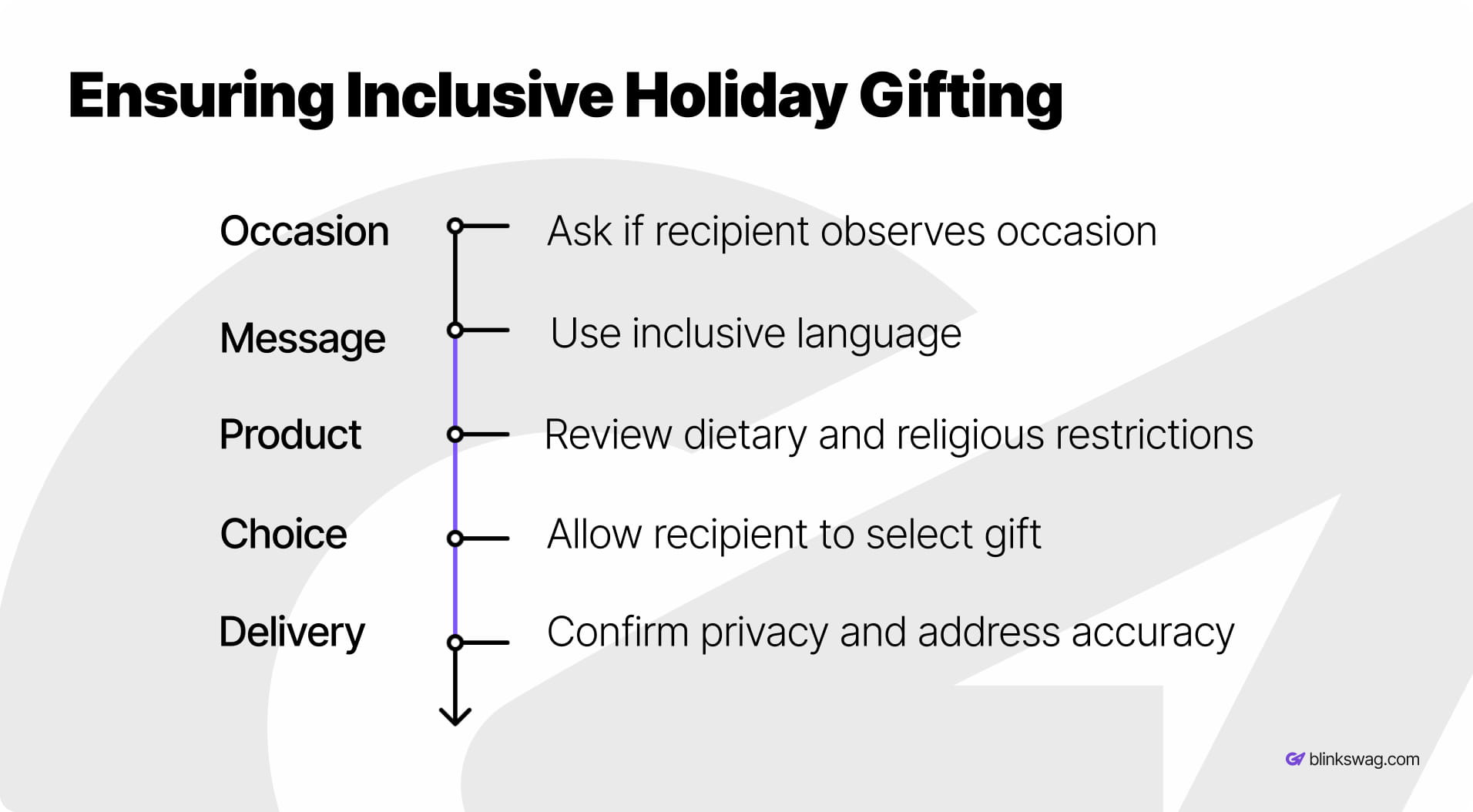
The Five Checks of Inclusive Holiday Gifting
1. Occasion
Ask:
- Does the recipient observe the occasion?
- Is the campaign voluntary?
- Would year-end appreciation be more appropriate?
- Is a cultural celebration being used respectfully?
2. Message
Use language such as:
- Thank you for your contribution.
- We appreciate your partnership.
- Wishing you a restful holiday season.
- Thank you for everything you helped accomplish this year.
- Please select a gift that works for you.
Avoid forcing religious language into a general workforce campaign.
3. Product
Review:
- Dietary requirements
- Alcohol
- Religious restrictions
- Allergies
- Accessibility
- Climate
- Product sizing
- Cultural appropriateness
4. Choice
Allow the recipient to:
- Select a product
- Choose a gift card
- Support a charity
- Decline the gift
- Select a delivery address
- Choose an appropriate size
5. Delivery
Confirm:
- Privacy
- Address accuracy
- Destination restrictions
- Customs
- Delivery timing
- Packaging
- Replacement process
What companies should avoid
- Assuming every employee celebrates Christmas
- Asking employees to declare a religion to qualify for a gift
- Sending alcohol without consent or policy review
- Using culturally specific symbols as generic decoration
- Sending food without checking dietary suitability
- Treating mandatory company apparel as a holiday reward
- Sending gifts to regulated recipients without approval
- Using the same message for employees, clients, and prospects
Inclusive gifting does not require a company to create a separate product for every holiday. It requires the program to respect the recipient context and offer a reasonable alternative when the default gift is unsuitable.
What Q4 corporate gifting campaigns can companies run?
Q4 corporate gifting campaigns should be organized around appreciation, business milestones, employee recognition, client relationships, community impact, and year-end reflection. Companies can run a single broad seasonal campaign or create separate programs for employees, clients, partners, prospects, and executives, provided each audience receives a relevant message and an appropriate gift experience.
Employee appreciation campaign
Use employee gifting to recognize:
- Contributions made during the year
- Team achievements
- Successful launches
- Operational improvements
- Customer-service performance
- Long-term service
- Leadership support
- Remote-work contributions
The message should focus on the employee’s contribution rather than on the product itself.
Client appreciation campaign
Client gifts can be recognized:
- A completed project
- A successful renewal
- A long-term relationship
- A shared business milestone
- Product adoption
- Referral support
- Partnership growth
The gift should match the relationship and remain within the client organization’s policy limits.
Partner and vendor campaign
Recognize partners and vendors for:
- Reliable service
- Consistent delivery
- Joint campaigns
- Operational support
- Product-launch assistance
- Customer-care contributions
- Long-term collaboration
Team milestone campaign
A team-specific gift may be appropriate after:
- Reaching an annual target
- Completing a major project
- Launching a new product
- Opening a new location
- Completing a rebrand
- Entering a new market
- Achieving an important certification
Community-impact campaign
A company may use Q4 gifting to support:
- Charitable donations
- Employee-selected causes
- Volunteer programs
- Local nonprofit partnerships
- Community service
- Donation matching
Participation should remain optional, and the company should avoid assuming that one cause represents every recipient.
New Year campaign
A New Year campaign can work well when:
- December shipping deadlines were missed
- The company wants to avoid seasonal delivery congestion
- The gift supports annual planning or productivity
- The message focuses on future collaboration
- International delivery requires additional time
How should companies build holiday gift boxes and swag kits?
A corporate gift box should follow one clear theme, contain products the recipient is likely to use, and remain practical to pack and ship. The complete swag kit cost includes merchandise, decoration, packaging, filler, printed inserts, assembly, picking, fulfillment, delivery, taxes, and replacements. More products do not automatically create a better recipient experience.
Strong gift-box themes
Year-end appreciation kit
Possible contents:
- Premium drinkware
- Journal
- Quality pen
- Thank-you card
- Small food item
- Desk accessory
Remote-work kit
Possible contents:
- Portable charger
- Cable organizer
- Notebook
- Desk mat
- Insulated mug
- Webcam or audio accessory
Winter comfort kit
Possible contents:
- Blanket
- Beanie
- Insulated drinkware
- Socks
- Hand-care product
- Seasonal snack
Climate should be considered before sending winter-specific products to every region.
Travel kit
Possible contents:
- Backpack
- Travel pouch
- Luggage tag
- Portable charger
- Reusable bottle
- Sleep accessory
Wellness kit
Possible contents:
- Fitness accessory
- Relaxation item
- Water bottle
- Journal
- Self-care product
- Healthy snack
Wellness products should be framed as optional support rather than a judgment about an employee’s habits.
Executive appreciation kit
Possible contents:
- Premium notebook
- Retail-brand drinkware
- Quality technology
- Travel accessory
- Personalized card
- Subtle packaging
Gift-box design principles
A strong corporate kit should:
- Have one clear purpose
- Avoid unnecessary filler products
- Use consistent decoration
- Protect fragile items
- Fit standard shipping dimensions where possible
- Include a personal message
- Remain easy to assemble
- Avoid excessive packaging
- Account for international restrictions
Standard box versus custom packaging
Use a standard mailer when:
- Budget efficiency matters
- Quantities are modest
- The deadline is approaching
- The product mix may change
- The brand experience does not require custom structural packaging
Use custom packaging when:
- Presentation is central
- The campaign is high value
- Quantities justify setup costs
- The box will be used for content or events
- The design supports a long-term program
Should companies send physical gifts, gift cards, or recipient choice?
Physical gifts create a tangible brand experience, gift cards provide speed and flexibility, and recipient-choice programs balance personalization with budget control. The correct format depends on the recipient’s knowledge, location, deadline, policy restrictions, branding requirements, and operational complexity. A hybrid program may use different formats for different recipient groups.
| Format | Best for | Main strength | Main limitation |
| Physical gift | Known audience and clear product fit | Tangible and memorable | Requires production and delivery |
| Gift card | Tight timelines and unknown preferences | Fast and flexible | Can feel impersonal |
| Recipient-choice link | Diverse or distributed audiences | Personal relevance | Some recipients may not redeem |
| Store credit | Ongoing employee programs | Controlled selection | Requires a maintained catalog |
| Curated kit | High-value appreciation | Strong presentation | Higher logistics cost |
| Charitable option | Values-led programs | Recipient participation | Cause preference varies |
| Digital experience | Remote and global teams | No physical shipping | Regional availability may differ |
Use physical gifts when:
- Branding matters
- Product fit is clear
- The audience is well understood
- Delivery time is available
- Packaging supports the campaign
- The item has lasting utility
Use gift cards when:
- Time is limited
- Preferences are unknown
- Product shipping is impractical
- Recipients are spread across several locations
- A flexible backup option is required
Use recipient choice when:
- Employees need different sizes
- The audience includes several countries
- The company wants to reduce unused inventory
- Multiple budget bands are required
- Dietary or product preferences are unknown
Use a hybrid campaign when:
- Executives receive physical gifts
- Employees receive store credit
- International recipients receive digital options
- Clients receive curated kits
- Late additions receive gift cards
How should companies collect recipient addresses securely?
Companies should collect only the address information required to complete delivery and should limit access to authorized personnel and service providers. Recipient-managed address collection is generally safer than circulating residential addresses through shared spreadsheets. The process should explain why the information is needed, how it will be used, and when it will expire.
Recommended address workflow
- Upload the recipient’s business email address.
- Send a secure acceptance or redemption link.
- Allow the recipient to enter a preferred delivery address.
- Validate the address before fulfillment.
- Restrict access to authorized users.
- Use the address only for the approved campaign.
- define how long the information will be retained.
- Remove or archive data in accordance with company policy.
Data-minimization principles
Collect only:
- Recipient name
- Business email
- Delivery address
- Product selection
- Size, when required
- Delivery phone number, when required by the carrier
Avoid collecting unrelated personal information.
Shared spreadsheet risks
Uncontrolled spreadsheets can create:
- Excessive access
- Duplicate records
- Incorrect addresses
- Version conflicts
- Accidental sharing
- Unclear retention
- Manual entry errors
Recipient communication
Tell recipients:
- Who is sending the gift
- Why is the address required
- Which provider will fulfill it
- The deadline for submitting information
- Whether a business or residential address may be used
- What happens if they decline
- How to request support
How should U.S. holiday gifting fulfillment be managed?
U.S. holiday fulfillment should be planned around inventory readiness, packaging, address validation, carrier capacity, delivery zones, weather disruption, and replacement procedures. Companies should avoid promising delivery dates until products are received, quality-checked, packed, and assigned to an appropriate carrier. Shipment tracking should continue until the shipment is successfully delivered.
Fulfillment stages
A complete fulfillment workflow includes:
- Product production
- Inventory receiving
- Quality inspection
- Storage
- Recipient data validation
- Picking
- Kit assembly
- Packing
- Label generation
- Carrier handoff
- Tracking
- Delivery confirmation
- Return or replacement handling
Bulk delivery
Bulk delivery works best for:
- Office events
- Team gatherings
- Conferences
- Customer locations
- Shared client gifts
- Manager-led distribution
Confirm:
- Delivery contact
- Receiving hours
- Loading requirements
- Box count
- Internal distribution responsibility
- Storage space
Individual delivery
Individual delivery works best for:
- Remote employees
- Distributed clients
- Executives
- Recipient-choice programs
- Personalized gifts
Individual delivery usually incurs higher shipping and administrative costs than a single bulk shipment.
Address validation
Before fulfillment:
- Remove duplicate recipients
- Confirm postal codes
- Standardize apartment and suite information
- Review incomplete addresses
- Identify international addresses
- Confirm business closures
- Verify recipient deadlines
Replacement policy
Define how the program will handle:
- Carrier loss
- Product damage
- Incorrect item
- Incorrect size
- Address error
- Recipient relocation
- Refused delivery
- Theft after delivery
The budget should include a reasonable replacement allowance.
How should international corporate gifting be planned?
International gifting requires destination-level planning because product availability, production location, shipping cost, customs rules, duties, taxes, and delivery times vary by country. Companies should confirm whether gifts are locally produced, regionally stocked, or shipped across borders and should avoid making recipients pay unexpected import charges whenever possible.
International planning checklist
For each destination, confirm:
- Product availability
- Production location
- Warehouse location
- Carrier service
- Delivery estimate
- Customs documentation
- Duties and taxes
- Import restrictions
- Recipient tax exposure
- Return process
- Replacement options
- Local digital alternatives
DDP versus DDU
Delivered Duty Paid
The sender or vendor handles duties and taxes before delivery.
Advantages:
- Fewer recipient surprises
- Better delivery experience
- Lower refusal risk
- Easier budgeting
Delivered Duty Unpaid
The recipient may be asked to pay duties or taxes before receiving the package.
Risks:
- Delivery refusal
- Delays
- Poor recipient experience
- Unexpected personal expense
Companies should ask how every international destination will be handled.
Product restrictions
International restrictions may affect:
- Food
- Alcohol
- Batteries
- Electronics
- Cosmetics
- Plant materials
- Wood products
- Textiles
- Liquids
- Medical or wellness products
A product suitable for U.S. shipping may not be appropriate for every international destination.
Regional alternatives
A global program may use:
- Different physical products by region
- Local gift cards
- Digital experiences
- Charitable options
- Region-specific stores
- Local vendors
- New Year delivery for slower destinations
The experience should remain reasonably consistent even when the exact product differs.
What corporate gift policies should companies review?
Corporate gift policies should be reviewed before products are selected or recipients are contacted. Restrictions may apply to gift value, recipient role, government relationships, regulated industries, alcohol, charitable donations, vendor relationships, and reporting. The sender should confirm both its own internal policy and the recipient organization’s rules.
Internal policy questions
- Who can approve gifts?
- What is the maximum value per recipient?
- Which departments fund the program?
- Are gift cards permitted?
- Is alcohol permitted?
- Are charitable donations permitted?
- Are personal addresses allowed?
- Which vendors are approved?
- How should expenses be documented?
- Are employees allowed to accept gifts from suppliers?
Recipient-policy questions
Confirm whether the recipient:
- Works for a government entity
- Works in healthcare
- Works in financial services
- Participates in procurement
- Is evaluating an active contract
- Has a published gift limit
- Requires manager approval
- Must disclose gifts
- Cannot accept cash equivalents
Government recipients
Government-related gifting can involve strict limitations.
Do not send a gift solely because the recipient has a public-sector title. Obtain appropriate legal or compliance guidance where required.
Procurement and active negotiations
A gift should not create pressure, appear to influence a decision, or undermine a fair purchasing process.
During active procurement:
- Review legal guidance
- Confirm the recipient’s policy
- Consider delaying the gift
- Use a modest shared gesture
- Use a charitable alternative where appropriate
Alcohol
Alcohol should not be a default choice.
Check:
- Recipient preference
- Company policy
- Age requirements
- Destination laws
- Carrier restrictions
- Workplace suitability
What are the most common Q4 gifting mistakes?
The most common Q4 gifting mistakes are starting late, choosing products before understanding the audience, ignoring total delivered cost, using outdated addresses, overbranding, failing to check recipient policies, overlooking international restrictions, and treating the gift as a substitute for meaningful appreciation. Most failures begin during planning rather than during delivery.
Mistake 1: Starting with products
A visually appealing product is not automatically appropriate for the audience, deadline, or delivery model.
Better approach: Define the audience and operating requirements first.
Mistake 2: Using one gift for everyone
A single gift may create problems across sizes, locations, climates, preferences, and policies.
Better approach: Use controlled choice or a small number of audience-specific options.
Mistake 3: Ignoring total cost
A product-only budget can omit:
- Decoration
- Packaging
- Kitting
- Storage
- Fulfillment
- Shipping
- Duties
- Tax
- Replacements
Better approach: Approve the total program cost.
Mistake 4: Ordering unnecessary inventory
Large quantity breaks can encourage overordering.
Better approach: Compare unit savings with storage and the risk of unused inventory.
Mistake 5: Overbranding
Large logos can reduce the perceived value and daily usefulness of a gift.
Better approach: Match branding visibility to the audience and product.
Mistake 6: Writing a generic message
A gift without context can feel automated.
Better approach: Explain what contribution, result, or relationship is being appreciated.
Mistake 7: Collecting addresses too late
Late or incomplete address collection creates missed deadlines and replacement costs.
Better approach: Set a clear submission deadline and provide reminders.
Mistake 8: Ignoring company policies
A gift may be rejected or create a compliance issue.
Better approach: Confirm recipient restrictions before shipping.
Mistake 9: Forgetting delivery failures
A shipment is not complete when a label is created.
Better approach: Monitor successful delivery, returns, and replacements.
Mistake 10: Having no fallback
Products may sell out, shipments may be delayed, and recipients may join late.
Better approach: Prepare digital rewards, store credit, or New Year delivery alternatives.
How should Q4 gifting performance be measured?
Q4 gifting performance should be measured through recipient acceptance, redemption, successful delivery, cost efficiency, inventory use, recipient feedback, and the intended business outcome. The shipment count alone does not indicate whether gifts were accepted, delivered, used, or appreciated. Each audience should have a defined success measure before the campaign begins.
Core operational metrics
| Metric | Calculation |
| Acceptance rate | Accepted gifts ÷ gifts offered |
| Redemption rate | Redeemed rewards ÷ rewards issued |
| Successful delivery rate | Delivered gifts ÷ shipments sent |
| Cost per successful delivery | Total program cost ÷ successful deliveries |
| Return rate | Returned shipments ÷ shipments sent |
| Replacement rate | Replacement shipments ÷ original shipments |
| Inventory-use rate | Distributed inventory ÷ inventory purchased |
| Unclaimed rate | Unclaimed rewards ÷ rewards issued |
Employee-program measures
Track:
- Participation
- Redemption
- Feedback
- Product preference
- Size-related problems
- Delivery success
- Manager participation
- Remaining store credit
- Repeat program use
Do not claim that a gift caused retention improvement without stronger evidence.
Client-program measures
Track:
- Gift acceptance
- Thank-you responses
- Meeting engagement
- Relationship feedback
- Account activity
- Renewal conversations
- Referral activity
A client gift should not be credited with revenue that cannot be reasonably connected to the campaign.
Qualitative feedback
Ask recipients:
- Was the gift useful?
- Was the selection process easy?
- Did the gift arrive successfully?
- Was the message clear?
- Would recipient choice be preferred next time?
- Was the product quality appropriate?
Post-campaign review
After Q4:
- Reconcile inventory.
- Review unclaimed gifts.
- Calculate the final program cost.
- Record delivery failures.
- Review product quality.
- Evaluate vendor performance.
- Identify audience preferences.
- Update the following year’s timeline.
What are the best last-minute corporate gift options?
The best last-minute corporate gifts require little or no physical production, inventory receiving, custom packaging, or cross-border shipping. Gift cards, recipient-choice links, store credit, digital experiences, charitable options, and products already held in inventory can preserve flexibility. The message should acknowledge appreciation directly rather than apologize excessively for timing.
Strong last-minute options
- Digital gift cards
- Recipient-choice rewards
- Company-store credit
- Digital experiences
- Charitable choice
- Locally available gifts
- Existing warehouse inventory
- New Year delivery
- Personalized digital message
Use stored inventory when:
- The product has already been received
- Decoration is complete
- Addresses are available
- Packaging is ready
- Carrier service can meet the deadline
Use a digital option when:
- Physical delivery is no longer reliable
- International destinations are involved
- Recipient preferences are unknown
- The list is still changing
- A new employee or client was added late
Avoid rushed physical gifting when:
- Product quality cannot be verified
- International duties are unclear
- The recipient’s address is incomplete
- Custom packaging cannot be completed
- Delivery dates cannot be supported
- Policy approval is missing
A well-presented New Year gift is usually better than a poorly executed package that arrives late or creates an unexpected charge.
Frequently asked questions
When should companies start planning Q4 corporate gifts?
Companies should begin strategic planning during July or August, complete recipient and budget decisions in September, finalize products and creative in October, and prepare fulfillment during November. Premium, custom, high-volume, and international programs should begin earlier than digital or inventory-backed campaigns.
How much should a company spend on employee gifts?
There is no universal amount. Companies should select a budget that is fair, appropriate to the workforce, and sustainable. The budget should include delivery and program costs rather than only the product value.
Should every employee receive the same gift?
Not necessarily. A consistent budget or level of recognition may be more important than sending the identical product. Recipient choice can provide fairness while accounting for sizes, preferences, climate, location, and accessibility.
Are gift cards appropriate for employees?
Yes, particularly when time is limited or preferences are unknown. A gift card should include a personalized appreciation message and be reviewed for payroll, tax, and company policy implications.
Should companies send branded client gifts?
Branding should reflect the relationship and product. Subtle branding is often more appropriate for premium or personal-use client gifts, while stronger branding may suit campaign merchandise, office items, or event-related products.
How can companies send gifts without collecting addresses in spreadsheets?
Companies can use secure recipient links that allow individuals to accept a gift and enter their preferred delivery information directly. Access, retention, consent, and vendor handling should be reviewed before launch.
What is the difference between gift value and delivered cost?
Gift value is the value of the product or reward. Delivered cost includes decoration, packaging, assembly, storage, fulfillment, shipping, duties, taxes, returns, and replacements.
What should companies do when a recipient cannot accept gifts?
Offer a compliant alternative, such as a modest shared item, a charitable option, a digital message, or no gift. Do not pressure the recipient to accept something that conflicts with employer policy.
Is international corporate gifting more expensive?
It can be. International programs may involve customs, duties, taxes, longer delivery times, regional product differences, and delivery failure risks. Local or digital alternatives may reduce complexity.
What should companies do with unused holiday inventory?
Review whether it can be used for onboarding, recognition, events, customer programs, or future campaigns. Products with dated messaging or obsolete branding may have limited reuse value.
Q4 corporate gifting checklist
Strategy
- Define the business objective.
- Identify each recipient audience.
- Confirm the total budget.
- Review internal gift policy.
- Select physical, digital, choice-based, or hybrid gifting.
Products and creative
- Confirm the product and SKU.
- Review decoration.
- Approve mockups.
- Confirm quantities and minimums.
- Review packaging.
- Finalize the appreciation message.
Recipients
- Validate names and email addresses.
- Confirm employee status.
- Check client gift policies.
- Collect addresses securely.
- Confirm product sizes or choices.
- Remove duplicates.
Fulfillment
- Confirm inventory receipt.
- Complete quality checks.
- Approve assembly.
- Validate addresses.
- Confirm carrier service.
- Review international requirements.
- Define replacement procedures.
Measurement
- Track acceptance.
- Track redemption.
- Track delivery.
- Record returns.
- Calculate the final program cost.
- Review inventory.
- Gather feedback.
- Document improvements for 2027.
Final recommendation
The strongest Q4 gifting programs begin with appreciation and operational planning rather than product volume. Companies should define each audience, choose an appropriate gift model, calculate the total delivered cost, securely collect addresses, confirm compliance with policy requirements, and track successful delivery. Recipient relevance and execution quality matter more than sending the same item to the largest possible list.
BlinkSwag can support Q4 programs through:
- Branded merchandise
- Recipient-choice gifting
- Reward links
- Gift cards
- Company stores
- Curated kits
- Inventory management
- Warehousing
- Fulfillment
- Domestic and international distribution
When those decisions are made early, Q4 gifting becomes a controlled appreciation program rather than a rushed seasonal purchase.