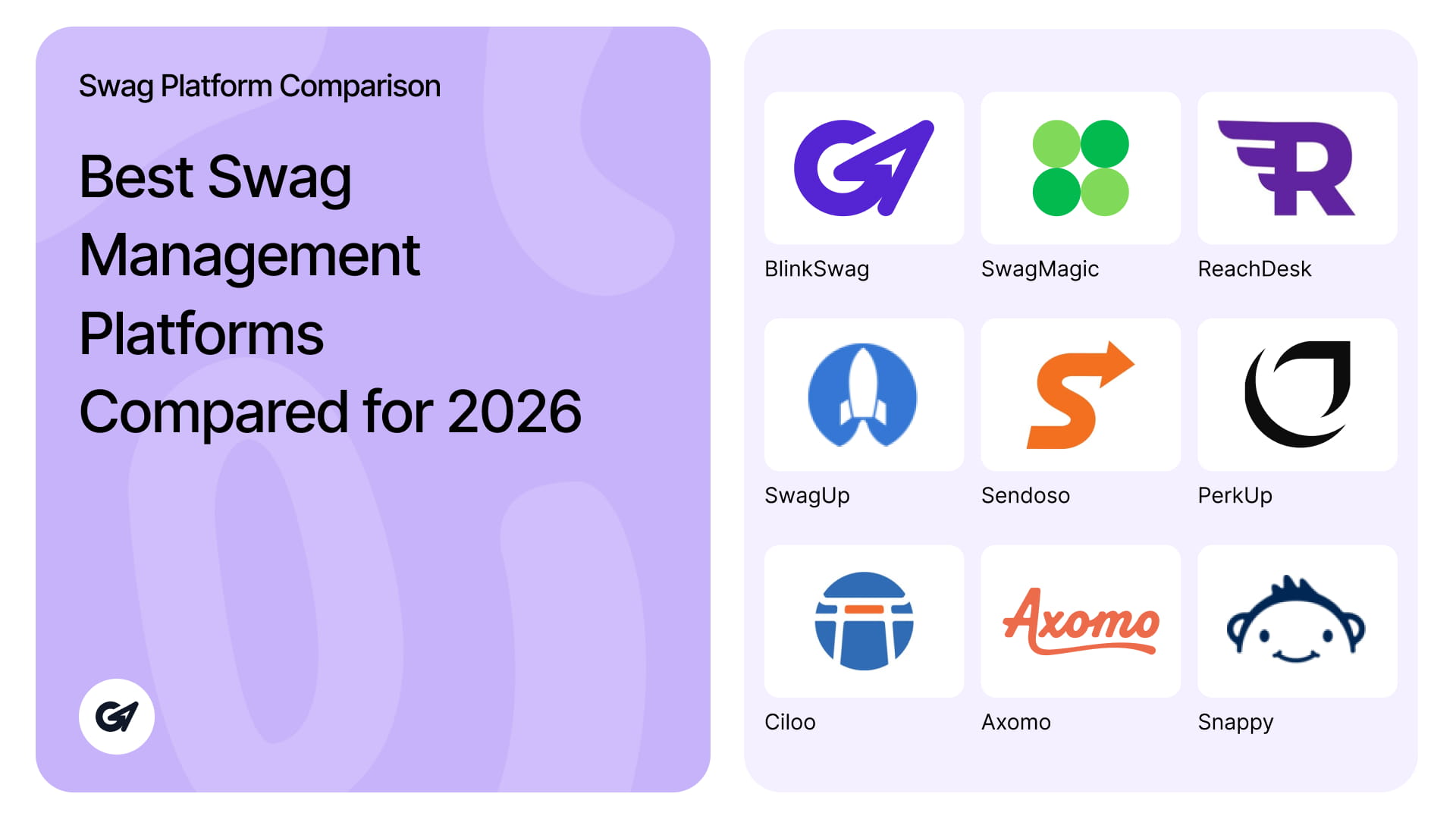
The best swag management platform in 2026 depends on what a company needs to manage: branded stores, employee gifting, inventory, fulfillment, campaigns, production, global distribution, or revenue-driven gifting. BlinkSwag stands out as an end-to-end swag management platform with free-to-use software, while SwagUp, SwagMagic, Sendoso, Reachdesk, PerkUp, and other platforms specialize in different operational and commercial requirements.
Swag management has expanded beyond ordering branded T-shirts and storing boxes in an office closet. Modern platforms can now manage product sourcing, online stores, employee ordering, inventory, fulfillment, gifting, international shipping, budget approvals, marketing automation, and reporting.
These capabilities are not offered through one standard platform model. Some vendors are built primarily for managing physical merchandise and warehouse inventory. Others began as corporate gifting or direct-mail platforms and added swag as part of a broader sales and marketing workflow.
This comparison evaluates the platforms based on the jobs they are designed to perform, rather than declaring one vendor universally better than all others.
Disclosure: BlinkSwag publishes this comparison and is included among the evaluated platforms.
Vendor capabilities, pricing, geographic reach, and production models were reviewed through
publicly available official sources. A feature is labeled “not publicly verified” when
sufficient evidence has not been found.
Best swag management platforms at a glance
BlinkSwag provides the strongest overall fit for U.S.-led teams managing recurring physical swag operations with it’s free platform. SwagUp is particularly suitable for curated packs; SwagMagic emphasizes global print-on-demand stores; Sendoso connects merchandise with revenue workflows; and Reachdesk is designed for enterprise gifting, global logistics, and measurable campaign attribution.
| Platform | Platform type | Provisional best fit | Production model | Public pricing position |
| BlinkSwag | Swag management and fulfillment | Transparent U.S.-led swag operations | Hybrid inventory and on-demand distribution | Core fulfillment and storage fees published |
| SwagUp | Swag packs and fulfillment | Standardized employee, event, and onboarding packs | Primarily pre-purchased inventory and warehousing | Storage and selected shipping fees are published |
| SwagMagic | Global company stores and gifting | Print-on-demand swag stores | Print on demand with optional bulk inventory | Setup and platform fees are published, but official pages conflict on setup pricing |
| Sendoso | Sending, gifting, direct mail, and merch | Revenue, ABM, sales, and customer-lifecycle programs | Hybrid inventory, fulfillment, and global print on demand | Plan-specific custom pricing |
| Reachdesk | Enterprise gifting and swag | Global gifting, warehousing, and revenue attribution | Marketplace, warehousing, and local-vendor network | Plans start at $20,000 per year |
The classifications are based on the platforms’ public capabilities rather than on how each vendor describes its category.
What is a swag management platform?
A swag management platform centralizes the sourcing, customization, storage, ordering, inventory tracking, fulfillment, and reporting of branded merchandise. Its purpose is to replace fragmented workflows involving promotional-product vendors, spreadsheets, office inventory, ecommerce tools, manual approvals, and separate domestic or international shipping providers.
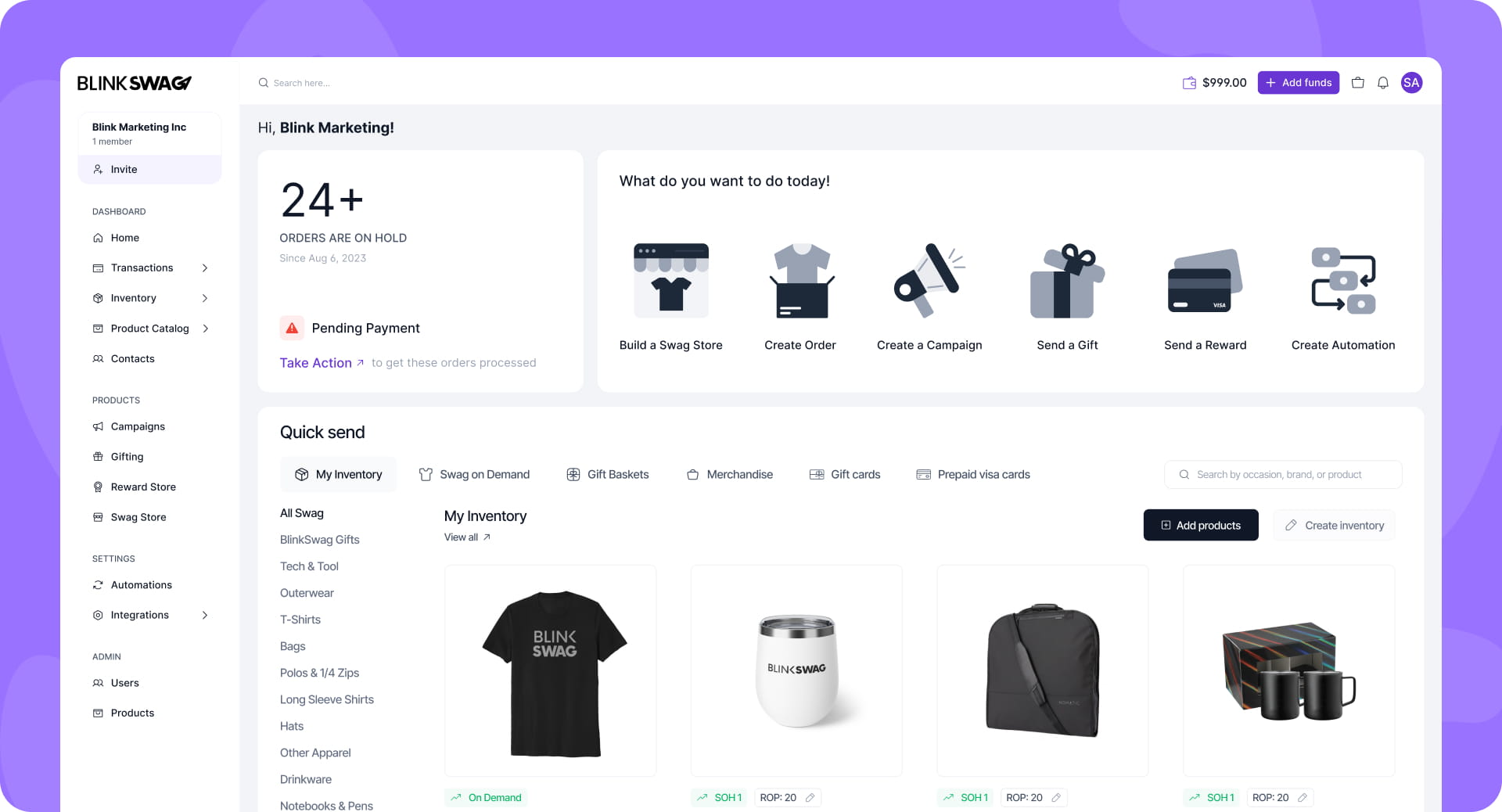
A full swag-management system may include:
- Product sourcing and decoration
- Branded employee or customer stores
- Inventory tracking
- Automated reorder alerts
- Warehousing
- Recipient address collection
- Reward links
- Budget controls
- Approval workflows
- Kitting and packing
- Domestic and international shipping
- Order history
- Reporting and analytics
- CRM or HRIS integrations
BlinkSwag, for example, supports bulk and on-demand ordering, real-time inventory tracking, reorder thresholds, branded stores, warehousing, and global shipping.
Swag management platform versus corporate gifting platform
A corporate gifting or sending platform may also offer branded merchandise, but its primary workflow is often different.
Sending platforms commonly emphasize:
- Sales and marketing campaigns
- Digital gifts and gift cards
- CRM-triggered sends
- Direct mail
- Account-based marketing
- Recipient engagement
- Pipeline attribution
- Campaign ROI
Sendoso and Reachdesk are examples of platforms that connect physical gifts and swag with sales, marketing, and customer lifecycle activities. Sendoso supports automated gifting campaigns and fulfillment to more than 165 countries, while Reachdesk promotes global warehousing, gifting automation, and campaign measurement across more than 180 countries.
Neither category is inherently better. The correct platform depends on whether the buyer’s central problem is managing merchandise operations or using physical sends to influence commercial outcomes.
How swag production models differ
Swag platforms use four main production models: bulk inventory, centralized print-on-demand, local print-on-demand, and hybrid production. The model affects minimum orders, unit prices, product quality, inventory risk, international shipping, delivery speed, customization, and the amount of unused merchandise a company may hold.
Bulk and warehoused inventory
Products are manufactured in advance and stored until they are ordered or distributed.
Advantages
- Lower unit prices at volume
- Greater control over products and decoration
- Faster delivery from available inventory
- Consistent branded presentation
- Suitable for recurring employee and event programs
Limitations
- Upfront purchasing
- Storage costs
- Obsolete products or branding
- Apparel-size risk
- Unused inventory
BlinkSwag is ideal for tracking stored inventory in real time with automated reorder thresholds
and zero-subscription platform fees. SwagUp is excellent for custom-built, warehoused swag packs
and automated kit distribution from centralized fulfillment hubs. SwagMagic & Sendoso offer secure
warehousing for pre-bought inventory, though primarily optimized alongside on-demand options.
Print on demand
A product is produced after a recipient orders or redeems it.
Advantages
- Lower inventory exposure
- Small or no minimum orders
- Easier recipient choice
- Reduced risk of unwanted sizes
- Suitable for distributed teams
Limitations
- Higher product costs in some categories
- Longer production time
- Potential variation across production facilities
- A more limited catalog than bulk sourcing
- Less control over premium packaging in some models
SwagMagic leads with dedicated POD storefronts offering over 100+ zero-inventory catalog items.
Sendoso offers robust on-demand merchandise backed by an extensive vendor fulfillment network.
BlinkSwag supports on-demand ordering alongside bulk catalog options.
Local print on demand
Products are produced near the recipient rather than being manufactured centrally and shipped internationally.
The model can reduce shipping distance, customs friction, and inventory requirements. However, local production can also make it more difficult to manage product consistency, color matching, decoration standards, and catalog parity across countries.
Sendoso operates a network of 100+ local production facilities to bypass customs and reduce
transit times. SwagMagic offers global on-demand printing and fulfillment across 170+ countries.
BlinkSwag & SwagUp feature regional fulfillment hubs (e.g., US and EU), but rely more on
centralized warehousing than distributed local print shops.
Hybrid production
A hybrid platform supports more than one operating model, such as:
- Bulk products stored for recurring demand
- Print-on-demand apparel for uncertain sizes
- Premium gifts sourced for specific campaigns
- Recipient-choice catalogs
- Locally sourced international gifts
- Pre-purchased products inserted into kits
BlinkSwag & SwagMagic strong software tools for seamlessly blending stored inventory with
on-demand catalog redemption in one storefront. Sendoso & SwagUp provide hybrid capabilities,
allowing pre-stored kit items to be combined with on-demand marketplace gifts.
But again BlinkSwag is free Software here!
Global shipping versus global infrastructure
Global shipping means a platform can deliver products across borders. Global infrastructure may also include regional warehouses, local production, destination-specific suppliers, customs support, address verification, and regional returns. Buyers should not assume that worldwide delivery automatically means products are stored or manufactured in every recipient market.
| Capability | What it means |
| International shipping | Products can be sent across national borders |
| Regional warehousing | Inventory is stored in more than one geographic region |
| Local production | Merchandise is manufactured near the recipient |
| Local marketplace | Products are sourced from suppliers within the destination market |
| Customs support | Documentation, duties, and import requirements are managed |
| Regional returns | Undelivered or unused items can be returned locally |
| Address confirmation | Recipients verify an address before shipment |
BlinkSwag publicly identifies warehouse locations across North America and Europe and states that it supports worldwide shipping.
SwagMagic states that its company stores can ship to more than 170 countries. Sendoso states that it ships to more than 165 countries, and Reachdesk says its warehouse and vendor network serves more than 180 countries.
These figures describe delivery reach. Buyers with complex international needs should also ask where products are produced, where inventory is stored, who acts as importer of record, and how duties and failed deliveries are handled.
How we evaluated the platforms
The platforms are evaluated using a weighted framework that covers stores, inventory, production, fulfillment, international infrastructure, pricing, integrations, budget controls, reporting, and product sourcing. Public evidence receives a higher score than a general marketing statement. Information that cannot be confirmed is labeled “not publicly verified” rather than treated as absent.
Evaluation categories
| Category | Weight |
| Swag store and recipient experience | 12% |
| Inventory and warehousing | 12% |
| Production model | 12% |
| U.S. fulfillment | 12% |
| Global shipping and infrastructure | 10% |
| Pricing transparency and operating cost | 14% |
| Integrations and automation | 10% |
| Budget controls and approvals | 7% |
| Reporting, ROI, and attribution | 7% |
| Product sourcing and customization | 4% |
| Total | 100% |
Scoring scale
| Score | Evidence standard |
| 5 | Capability and meaningful operational details are publicly verified |
| 4 | Capability is verified, but pricing or implementation details are limited |
| 3 | Capability is stated generally without sufficient operational detail |
| 2 | Capability appears limited or dependent on custom services |
| 1 | Minimal public evidence |
| 0 | The platform publicly confirms that the capability is unavailable |
| NPV | Not publicly verified |
The completed ranking will be assigned only after every platform has been evaluated through the same evidence standard.
1. BlinkSwag↗
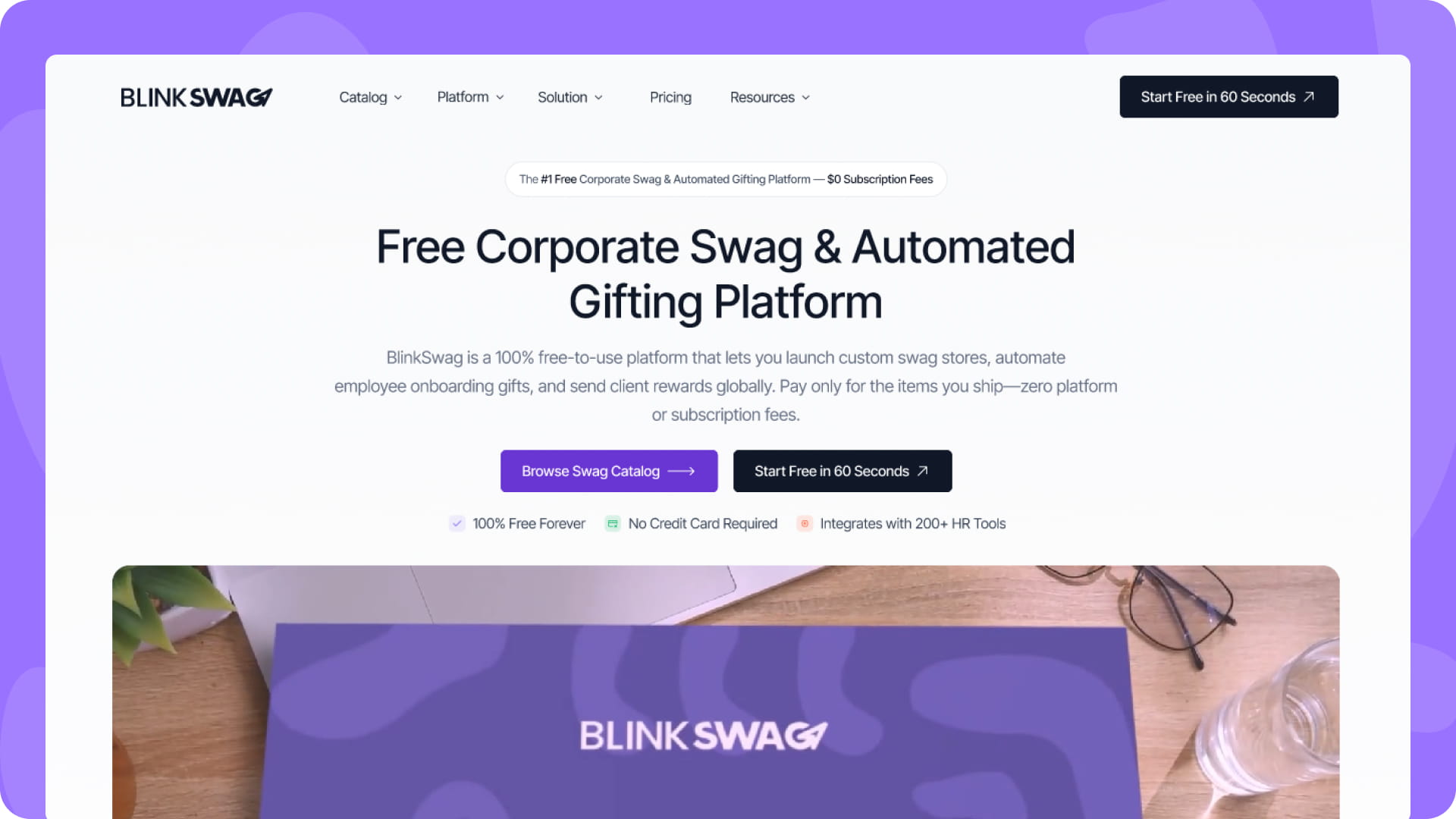
BlinkSwag is a free-to-use swag management platform built for companies that want to centralize branded company stores, merchandise, inventory, warehousing, fulfillment, and global distribution. Unlike many competitors, BlinkSwag does not charge platform fees for its core software. Companies only pay for merchandise, warehousing, fulfillment, and shipping. The platform is well suited for recurring employee, customer, marketing, sales, and event swag programs.
Best for
End-to-end swag management without a software subscription.
Platform type
Swag management, company stores, gifting, inventory, warehousing, and fulfillment.
What differentiates BlinkSwag
BlinkSwag’s differentiation is its combination of software breadth and operating-cost model. The platform brings company stores, campaigns, gifting, reward links, inventory, budgets, approvals, warehousing, fulfillment, and distribution into one swag-management workflow without charging a recurring software subscription for the core platform.
That makes BlinkSwag particularly relevant to companies that want to replace spreadsheets, disconnected suppliers, office inventory, manual shipping, and separate store tools with a centralized swag-management system.
Verified capabilities
BlinkSwag supports:
- Free branded company stores
- Swag campaigns
- Automated gifting
- Reward links and redemption stores
- Employee and customer gifting
- AI-powered email messaging
- 200+ HRIS integrations
- Approved merchandise catalogs
- Gift cards and physical gifts
- Budget management
- Role-based permissions
- Approval workflows
- Real-time inventory tracking
- Automated reorder thresholds
- Bulk ordering
- Warehousing
- Kitting and packing
- Inventory-backed fulfillment
- Worldwide delivery
- Order history and management
BlinkSwag allows companies to launch branded company stores without setup fees while managing merchandise, budgets, approvals, inventory, and global fulfillment from one platform.
Its inventory tools include real-time stock tracking, automated reordering, bulk purchasing, and warehouse management.
Production model
Hybrid inventory and distribution
BlinkSwag supports bulk-purchased inventory stored in warehouses and fulfilled on demand. Public documentation does not specify country-by-country local print-on-demand availability.
U.S. pricing transparency
BlinkSwag publicly lists:
- $2.65 fulfillment per order containing warehouse inventory
- $1 per warehouse product picked
- Free pack-in fulfillment
- Free receiving and processing
The company also publishes tiered storage pricing. Because the storage table labels its tiers by “Volume of Units” while charging per cubic foot, buyers should confirm how each tier is assigned before estimating a monthly total.
Global operations
BlinkSwag operates warehouses across North America and Europe and supports worldwide shipping.
Organizations with complex international logistics should confirm:
- Inventory location
- Production country
- Customs process
- Duty treatment
- Carrier options
- Delivery timelines
- Local returns
Key strengths
- Free-to-use swag management platform
- Free branded company stores
- Transparent fulfillment pricing
- Real-time inventory management
- Warehousing and kitting
- 200+ HRIS integrations
- Employee, customer, marketing, sales, and event programs
- Worldwide fulfillment
Limitations to consider
- Detailed public integration documentation is limited.
- Local print-on-demand availability is not documented by country.
- Complete warehouse locations are not publicly listed.
- Revenue attribution is not a primary product focus in the same way it is for Sendoso or Reachdesk.
Who should choose BlinkSwag?
BlinkSwag is a strong choice for companies that:
- Want a free-to-use swag management platform
- Need branded company stores
- Manage employee onboarding and appreciation
- Run events and conferences
- Manage recurring customer or client gifting
- Need swag campaigns and reward programs
- Require inventory and warehouse management
- Need approval workflows and budget controls
- Want to combine bulk inventory with on-demand ordering
- Want transparent fulfillment pricing
- Need to distribute swag globally
- Want one platform instead of separate store, inventory, and fulfillment workflows
Who may need another platform?
A different platform may fit better if your priority is:
- CRM-native ABM automation
- Advanced revenue attribution
- Sales-pipeline measurement
- An inventory-free swag model
- Gifting where revenue attribution is the central KPI
Provisional award
Best End-to-End Swag Management Platform Without a Software Subscription
2. SwagUp↗
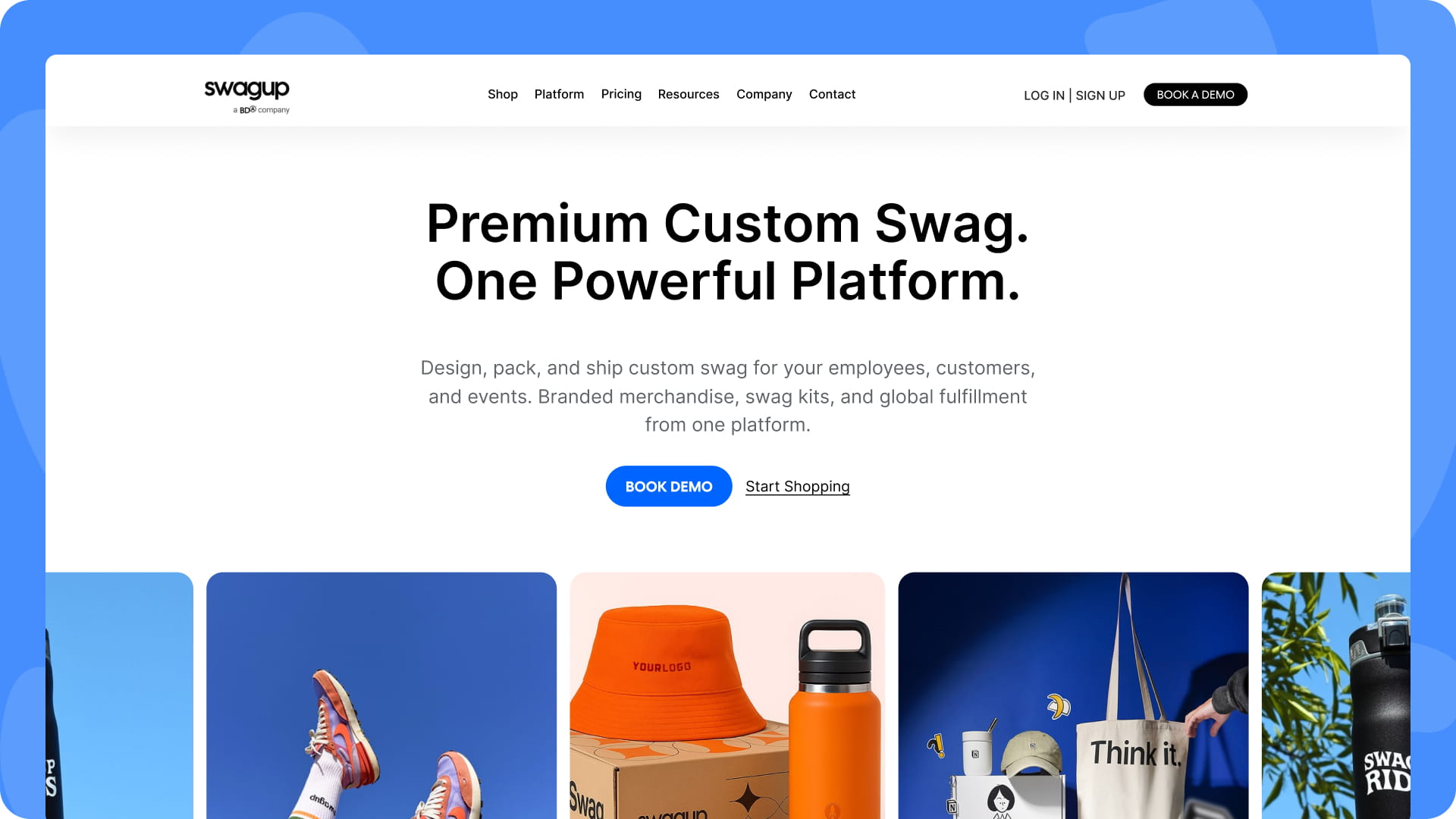
SwagUp is best suited to companies that organize branded merchandise around standardized packs, onboarding boxes, event kits, and pre-purchased inventory. Its strengths include product sourcing, in-house pack assembly, branded shops, warehouse fulfillment, and publicly visible storage and lightweight domestic shipping benchmarks.
Best for
Pack-based employee, onboarding, and event programs
Platform type
Swag sourcing, packs, shops, storage, and fulfillment.
Verified capabilities
SwagUp provides:
- Custom product sourcing
- Curated swag packs
- Pack assembly
- Branded company shops
- Recipient redemption
- Inventory storage
- Warehouse fulfillment
- Individual domestic and international shipping
- Inventory management
SwagUp says it assembles packs in-house and operates fulfillment warehouses to store and distribute branded inventory.
Its shops allow companies to make pre-purchased merchandise available to recipients, collect size and delivery details, and return shop-generated balances to the company’s SwagUp account.
Production model
Pre-purchased bulk inventory with on-demand distribution
SwagUp generally produces products or completed packs in advance, stores them, and releases them when a company requests a shipment or a recipient completes an order.
This differs from true print-on-demand, as the merchandise is typically in inventory before the recipient orders it.
Published pricing
SwagUp states that storage is billed every 6 months based on the inventory remaining at the start of the billing period.
Its Basic plan lists:
- $5 per completed pack
- $0.25 per small item
- $1 per medium item
- $3 per large item
Higher membership tiers receive discounted or included storage.
SwagUp also offers a $12 domestic shipping rate for a lightweight pack or mailer weighing less than 1 pound. The company notes that delivery dates are not guaranteed.
Key strengths
- Strong pack creation and assembly
- Clear pack-oriented workflow
- Branded shops
- Published inventory-storage pricing
- A useful lightweight U.S. shipping benchmark
- Warehouse-based recurring fulfillment
- Recipient redemption
Limitations to consider
- Pre-purchased inventory increases storage and obsolescence risk.
- The storage model is item-based and billed in six-month periods.
- The public $12 domestic shipping benchmark applies only to lightweight shipments under one pound.
- The production model may be less suitable for teams seeking local print-on-demand manufacturing in multiple countries.
Who should choose SwagUp?
SwagUp is a strong fit for:
- Standardized onboarding kits
- Employee welcome packs
- Conference boxes
- Customer kits
- Repeatable merchandise bundles
- Companies that prefer to pre-approve and hold inventory
Provisional award
Best for Custom Swag Packs
3. Swagmagic↗
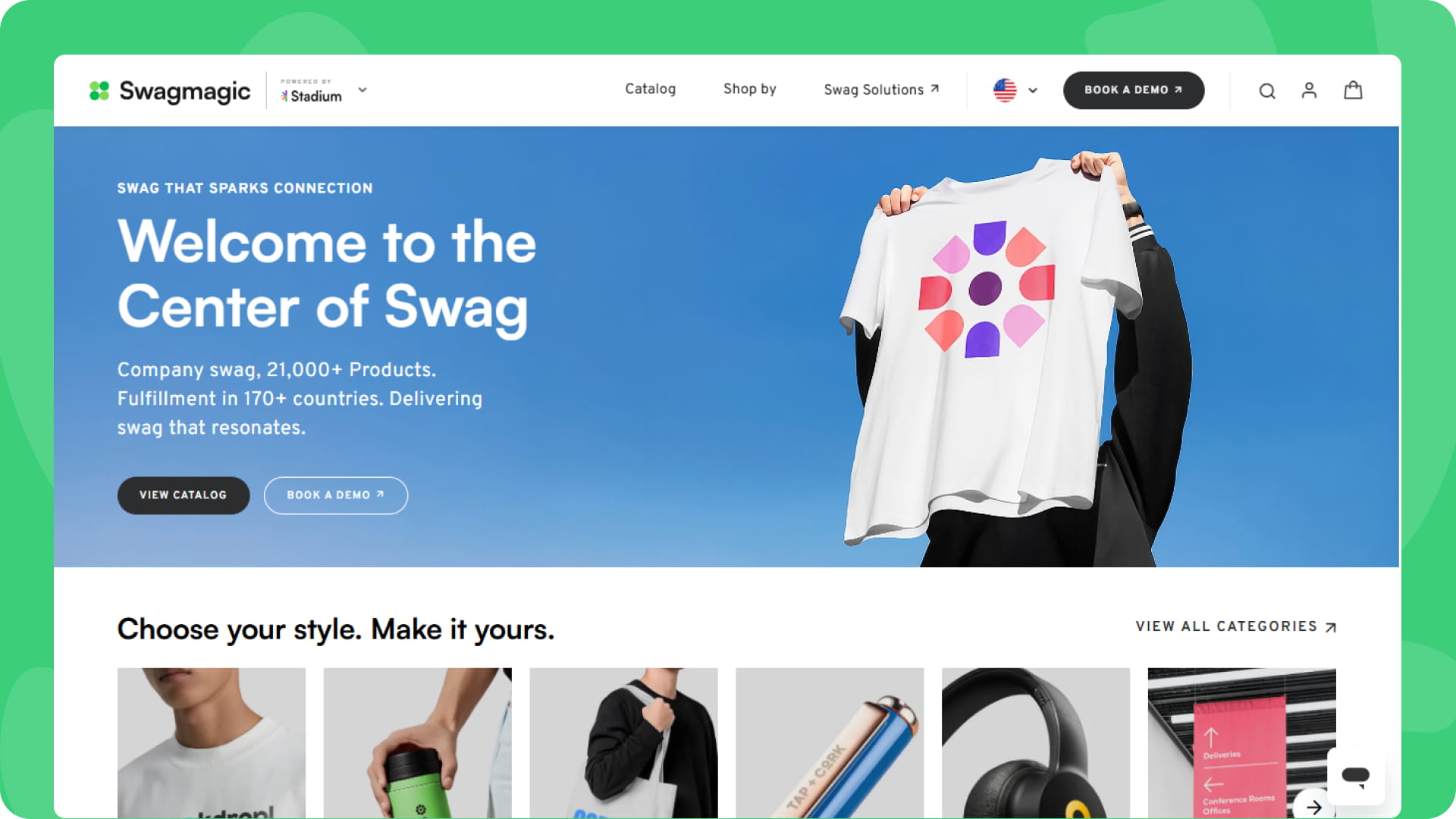
SwagMagic is best suited for companies that want a global print-on-demand store where recipients choose merchandise without the company having to purchase every item in advance. Its official pages promote more than 100 store products, global shipping, recipient stipends, bulk options, and a 15% platform fee, but its setup-fee pages currently conflict with those.
Best for
Global print-on-demand company stores
Platform type
Print-on-demand stores, gifting, swag boxes, and bulk merchandise.
Verified capabilities
SwagMagic provides:
- Branded company stores
- More than 100 print-on-demand products
- Recipient stipends
- Recipient address collection
- Global shipping
- E-commerce stores
- Bulk merchandise
- Pre-purchased product additions
- Gift cards and non-swag items
- A centralized order dashboard
Recipients can select their own merchandise and provide their own shipping addresses. SwagMagic states that stores can ship to more than 170 countries.
Production model
Print on demand with optional bulk and stored inventory
The platform can produce merchandise as recipients redeem it. It also allows companies to add pre-purchased products and purchase bulk merchandise for events or other campaigns.
Public pricing conflict
SwagMagic’s dedicated print-on-demand swag page lists:
- $3,000 one-time setup fee
- 15% platform fee
- Free fulfillment
- No monthly or annual commitment
- Seven to ten business days for design
- Fulfillment within 20 days or less
A separate official print-on-demand page says the one-time setup fee starts at zero, while also listing a 15% platform fee and free fulfillment.
Buyers should request written confirmation of:
- Applicable setup fee
- What the 15% fee is applied to
- Whether shipping is included
- Product pricing
- Currency conversion
- Duties and taxes
- Custom design charges
- Bulk inventory charges
Key strengths
- Print-on-demand recipient choice
- More than 100 store products
- International delivery
- No recurring monthly or annual commitment on the published plan
- Bulk and print-on-demand options
- Recipient-funded or company-funded stores
- Centralized dashboard
Limitations to consider
- Official setup-fee information is inconsistent.
- The 15% platform fee may increase the total program cost.
- Published fulfillment timing can be longer than shipping stocked inventory.
- Product consistency and production location should be confirmed for global programs.
Who should choose SwagMagic?
SwagMagic may fit companies that:
- Want to avoid purchasing large inventory quantities
- Need recipient choice
- Have distributed international teams
- Want a branded store
- Can accept print-on-demand lead times
- Prefer a percentage-based platform model
Provisional award
Best Global Print-on-Demand Swag Store
4. Sendoso↗
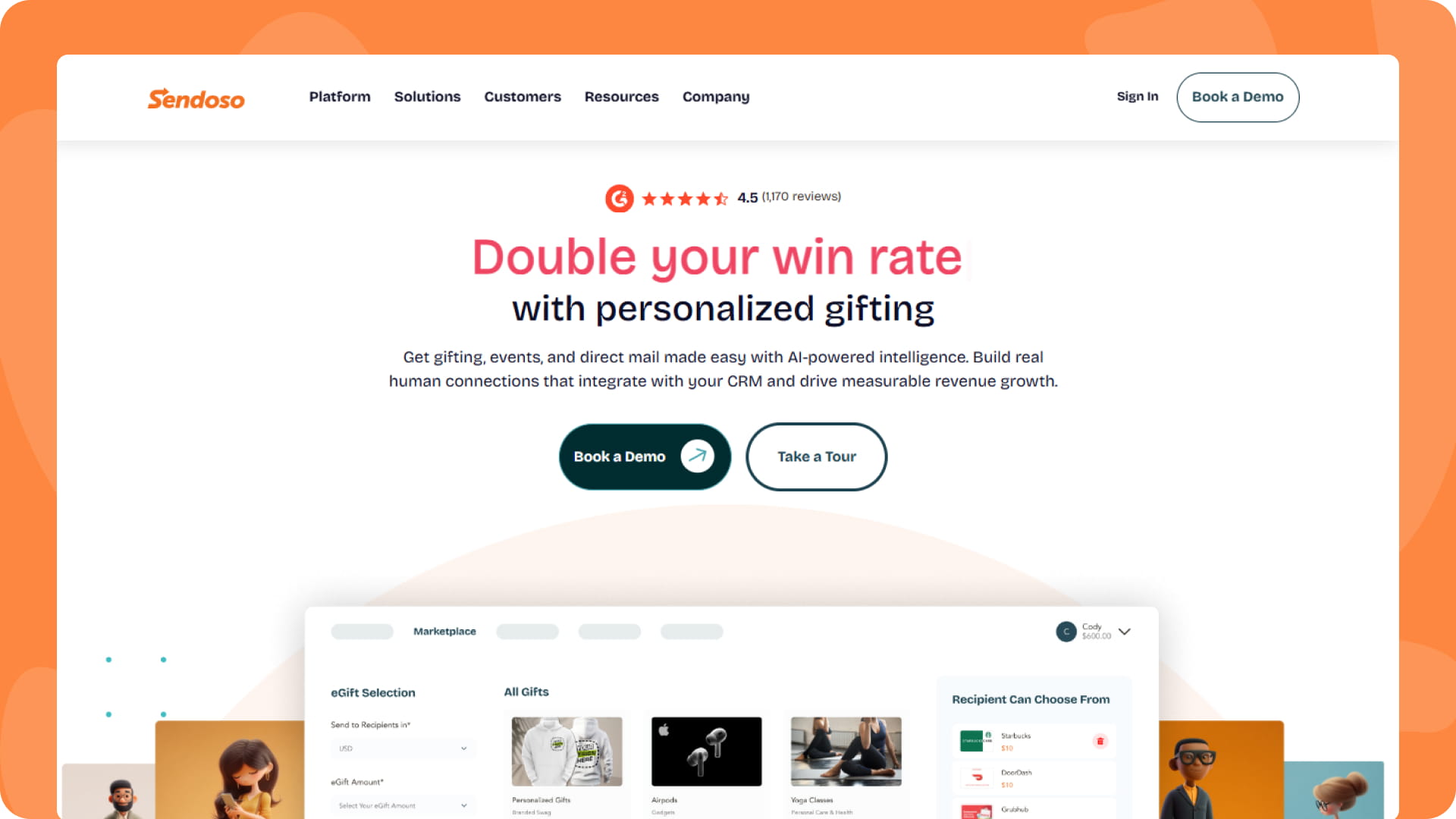
Sendoso is best suited for revenue, sales, marketing, customer success, and enterprise teams that want gifting, direct mail, and branded merchandise integrated with campaigns and CRM workflows. Its acquisitions of Postal in 2025 and Merch in 2026 expanded the platform into People Operations, company stores, swag production, global print-on-demand, storage, and fulfillment.
Best for
Revenue-team gifting and integrated merch
Platform type
Sending management, corporate gifting, direct mail, swag, and campaign automation.
Platform evolution
Sendoso acquired Postal on May 1, 2025. The acquisition combined Sendoso’s sales and marketing capabilities with Postal’s People Operations workflows, branded stores, and employee-focused gifting functionality.
Sendoso then acquired Merch in May 2026, adding a broader infrastructure for merchandise production, sourcing, decoration, storage, and shipping.
Postal should therefore not be treated as a fully independent platform in a 2026 vendor comparison. Its capabilities are becoming part of the broader Sendoso ecosystem.
Verified capabilities
Sendoso supports:
- Corporate gifting
- Digital gifts
- Direct mail
- Swag storefronts
- Swag on demand
- Custom merchandise
- Campaign automation
- Address confirmation
- CRM and marketing integrations
- Inventory tracking
- Fulfillment
- International shipping
- Revenue reporting
- People-team gifting
Its main platform states that Sendoso ships to more than 165 countries and manages procurement, storage, inventory, packing, shipping, and returns.
Production model
Hybrid global production, print on demand, inventory, and fulfillment
Merch by Sendoso promotes:
- More than 100 production facilities
- Thousands of products
- No-minimum and low-minimum options
- Orders from one to 10,000 units
- Print-on-demand production
- Global logistics
- Unified reporting
- Direct connection with Sendoso fulfillment
Sendoso also retains traditional inventory-backed fulfillment and warehousing, giving companies the choice between stored merchandise and on-demand products.
Integrations and automation
Sendoso’s public materials identify integrations with platforms, including:
- Salesforce
- HubSpot
- Marketo
- Outreach
- Salesloft
- Terminus
- 6sense
- Bombora
Its plan structure varies the number of integrations, fulfillment regions, licenses, event projects, storefront capabilities, HRIS access, and administrative controls.
Pricing
Sendoso publishes feature comparisons across Starter, Core, Advanced, and Enterprise plans, but public dollar pricing is not displayed. Buyers must request a quote.
A quote should be separated:
- Platform subscription
- Licenses
- Fulfillment regions
- Merchandise
- Campaign services
- Production
- Storage
- Kitting
- Shipping
- Integrations
- Professional services
Key strengths
- Strong CRM and revenue workflow alignment
- Gifting and direct mail in one platform
- Large global production network
- Print-on-demand merchandise
- Inventory-backed fulfillment
- AI-assisted gifting
- Unified campaign and merchandise reporting
- Extensive integration support
Limitations to consider
- Pricing requires a custom quote.
- The platform may be more complex than necessary for a basic employee store.
- Some advanced fulfillment, storefront, integration, and HRIS capabilities depend on the plan.
- The Postal and Merch integrations are still evolving following recent acquisitions.
Who should choose Sendoso?
Sendoso is particularly suitable for:
- Account-based marketing
- Demand generation
- Sales development
- Customer marketing
- Event follow-up
- Revenue teams requiring CRM attribution
- Enterprises consolidating gifting, direct mail, and swag
A company whose main requirement is straightforward employee merchandise and warehouse fulfillment may not need the full Sendoso feature set.
Provisional award
Best for Revenue-Team Gifting and Integrated Merchandise
5. Reachdesk↗
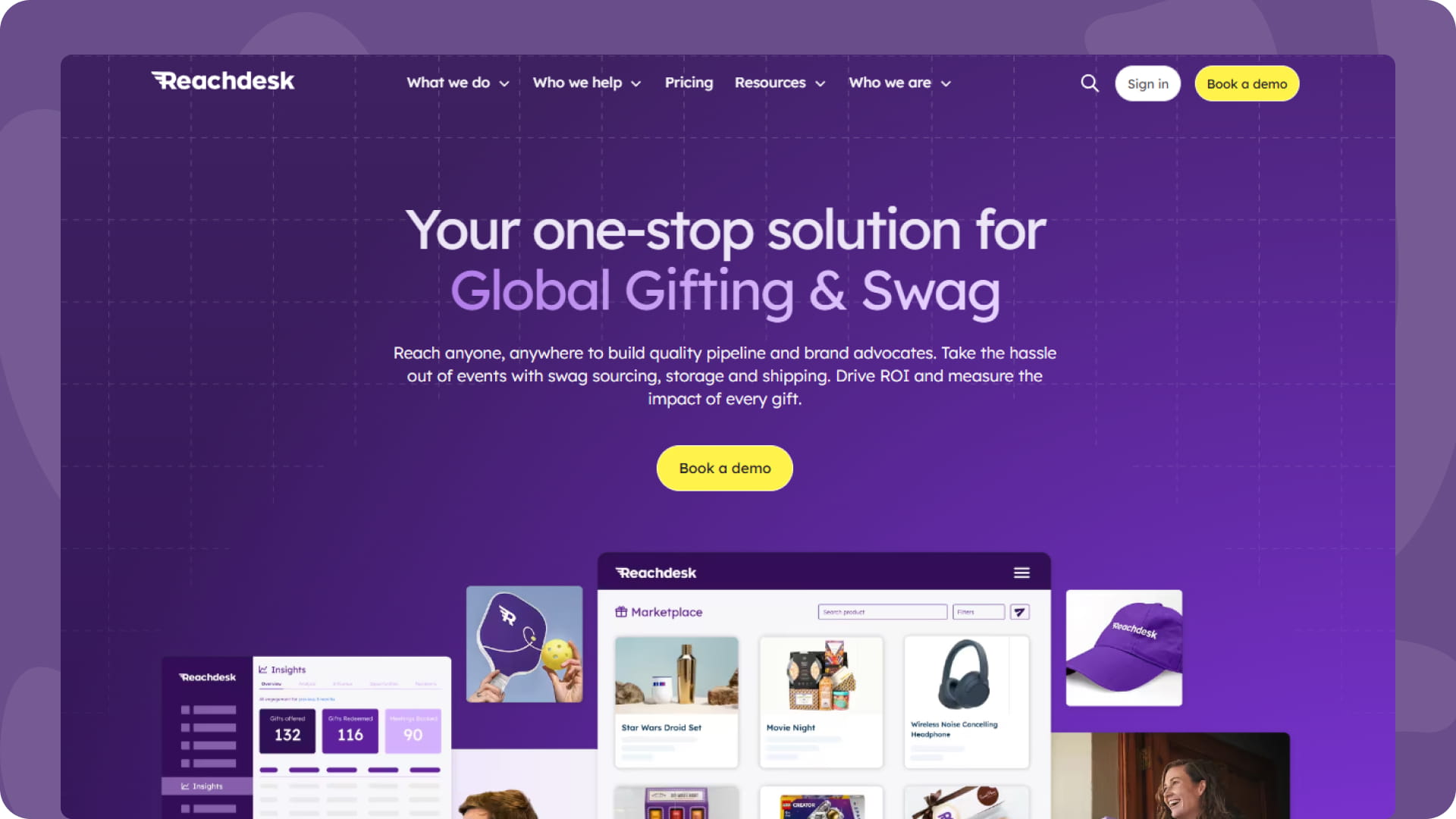
Reachdesk is best suited to enterprise companies that need global gifting, warehousing, marketing, and sales integrations, spend governance, address confirmation, and measurable revenue attribution. Its plans start at $20,000 per year, and the company offers a conditional 5x ROI guarantee, making it a higher-cost option focused on commercial outcomes.
Best for
Enterprise global gifting and revenue attribution
Platform type
Corporate gifting, swag management, global warehousing, ABM, and revenue engagement.
Verified capabilities
Reachdesk provides:
- Physical gifts
- Digital gifts
- Branded swag
- Global warehousing
- International fulfillment
- Address confirmation
- Returns and redistribution
- Inventory tracking
- Kitting
- Event logistics
- Budget controls
- Sales and marketing integrations
- Campaign reporting
- Revenue measurement
Reachdesk states that its warehouse and vendor network support delivery to more than 180 countries. It identifies facilities or infrastructure across the United States, Canada, the United Kingdom, Europe, and Australia.
Production and fulfillment model
Marketplace, global warehousing, and local vendor fulfillment
Reachdesk combines stored inventory with a broader marketplace and regional vendor network. Its public global-warehousing page emphasizes:
- Real-time inventory
- Address confirmation
- Returns and redistribution
- Event fulfillment
- Kitting and bundling
- International logistics
Pricing and ROI positioning
Reachdesk states that plans start at $20,000 per year and are customized according to team size, requirements, and gifting strategy. It also markets a 5x ROI guarantee, subject to its guarantee terms and customer eligibility requirements.
The guarantee should not be interpreted as a universal promise that every customer will automatically generate $5 in revenue for every $1 spent.
Buyers should ask:
- Which plans qualify?
- How is the attributed pipeline calculated?
- What implementation requirements apply?
- What happens if the target is not met?
- Which costs are included in the ROI calculation?
- Are merchandise, shipping, and campaign services included?
Key strengths
- Strong international infrastructure
- Enterprise governance
- Global warehousing and local vendors
- Address confirmation
- Returns and redistribution
- Revenue-team integrations
- Pipeline and ROI measurement
- Event logistics
- Inventory reporting
Limitations to consider
- Plans begin at $20,000 per year.
- The platform may be outside the budget of smaller organizations.
- Total cost may also include gifts, products, storage, fulfillment, and shipping.
- Its value is strongest when the company actively uses attribution and revenue workflows.
Who should choose Reachdesk?
Reachdesk may be the best fit for:
- Enterprise ABM teams
- Global marketing organizations
- Sales and customer-success programs
- Companies requiring revenue attribution
- International gifting programs
- Buyers who need address confirmation and redistribution
- Organizations can support a higher annual platform investment
Companies primarily seeking a basic employee merchandise store or transparent low-volume fulfillment may find a more operationally focused platform more suitable.
Provisional award
Best for Enterprise Attribution and Global Gifting
6. PerkUp↗
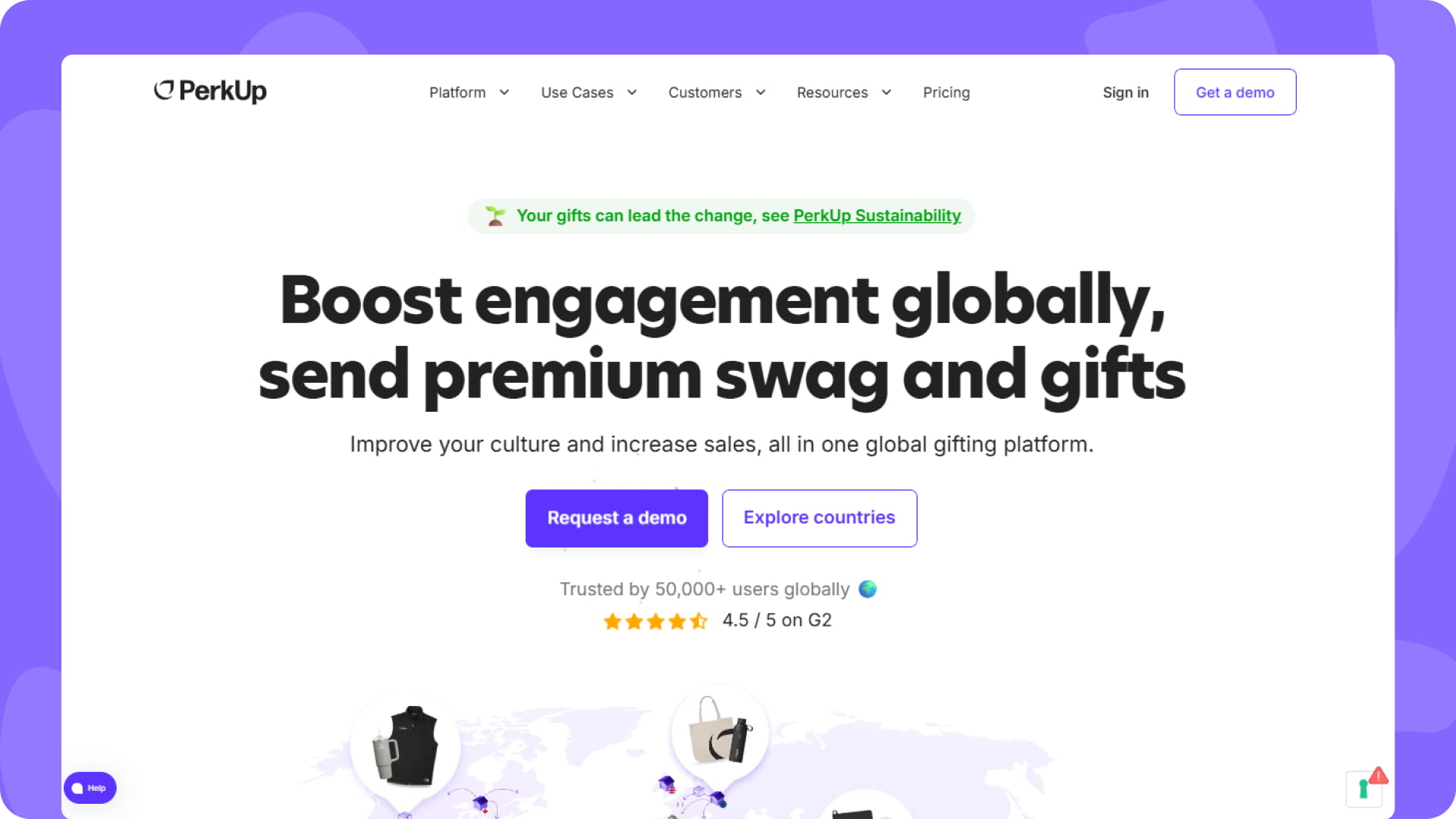
PerkUp is best suited to global HR, People Operations, and marketing teams that want employee gifting, branded swag, milestone automation, recipient choice, regional warehousing, and HRIS integrations within one platform. Its strongest differentiators are its hybrid production model, distributed warehouse network, automation capabilities, and broad integration ecosystem.
Best for
Global employee gifting and HR automation
Platform type
Employee gifting, swag management, recognition, automation, and global fulfillment.
Verified capabilities
PerkUp supports:
- Branded swag stores
- On-demand merchandise
- Bulk swag
- Employee gift cards
- Physical gifts
- Swag kits
- Global warehousing
- Prepaid-duty shipping
- HRIS integrations
- SSO
- Milestone automation
- Budget controls
- Reporting
- Dedicated customer success support
PerkUp describes itself as a global swag and gifting platform serving employees, customers, and partners. Its public materials position the platform around birthdays, anniversaries, onboarding, rewards, bulk campaigns, and international distribution.
Production model
Hybrid on-demand and bulk merchandise
PerkUp publicly supports both on-demand and bulk swag through branded stores. This allows companies to produce individual products after selection while also purchasing and storing merchandise for predictable campaigns.
The hybrid model can support:
- On-demand employee apparel
- Bulk event merchandise
- Preassembled onboarding kits
- Stored premium products
- Regional product catalogs
- Automated milestone gifts
Buyers should confirm which products are available through on-demand production and which require minimum bulk quantities.
Global infrastructure
PerkUp states that its warehouse network spans the United States, Canada, Mexico, the United Kingdom, Europe, India, China, and Australia. The company says its distribution network supports more than 65 countries and uses prepaid-duty shipping where available.
This public infrastructure is broader than a platform that ships inventory from a single U.S. warehouse. However, buyers should still confirm:
- The exact warehouse handling their program
- Whether a product is locally produced or imported
- Whether delivery duties are prepaid in each destination
- Storage charges by region
- Regional catalog differences
- Returns and failed-delivery procedures
Integrations and automation
PerkUp supports more than 200 integrations, including HRIS, SSO, Slack, and Amazon Business. Its public materials also name Workday, Rippling, UKG, BambooHR, ADP, HiBob, Paylocity, and Okta.
These integrations can automate:
- New-hire gifts
- Work anniversaries
- Birthdays
- Employee recognition
- Department budgets
- Manager notifications
- Employee data synchronization
Pricing
PerkUp provides a public pricing page but does not display a simple, standard platform price on the accessible page. The page directs buyers toward flexible pricing and acknowledges that website prices and formal quotes may differ.
A PerkUp quote should separate:
- Platform fee
- Merchandise
- On-demand product markup
- Warehousing
- Kitting
- Fulfillment
- Shipping
- Duties
- Taxes
- Integrations
- Automation
- Implementation support
Key strengths
- Broad global warehouse coverage
- Bulk and on-demand swag
- HRIS and SSO integrations
- Milestone automation
- Employee gifts and gift cards
- Regional fulfillment
- DDP shipping is available where available
- Budget and reporting capabilities
- Employee and marketing use cases
Limitations to consider
- Standard platform pricing is not publicly displayed.
- PerkUp publishes geographic claims and should be confirmed for the buyer’s exact countries.
- Buyers must confirm which products are locally sourced and which are imported.
- The broad platform may include more functionality than a small U.S.-only program needs.
- Its public comparison content is vendor-authored and should not be treated as independent research.
Who should choose PerkUp?
PerkUp is a strong option for companies that:
- Employ people across several regions
- Need HRIS-triggered employee gifting
- Want bulk and on-demand products
- Require global warehousing
- Need gift cards and merchandise in one program
- Want milestone automation
- Prefer regional fulfillment over U.S.-only distribution
Provisional award
Best for Global HR Automation and Swag
7. Snappy↗
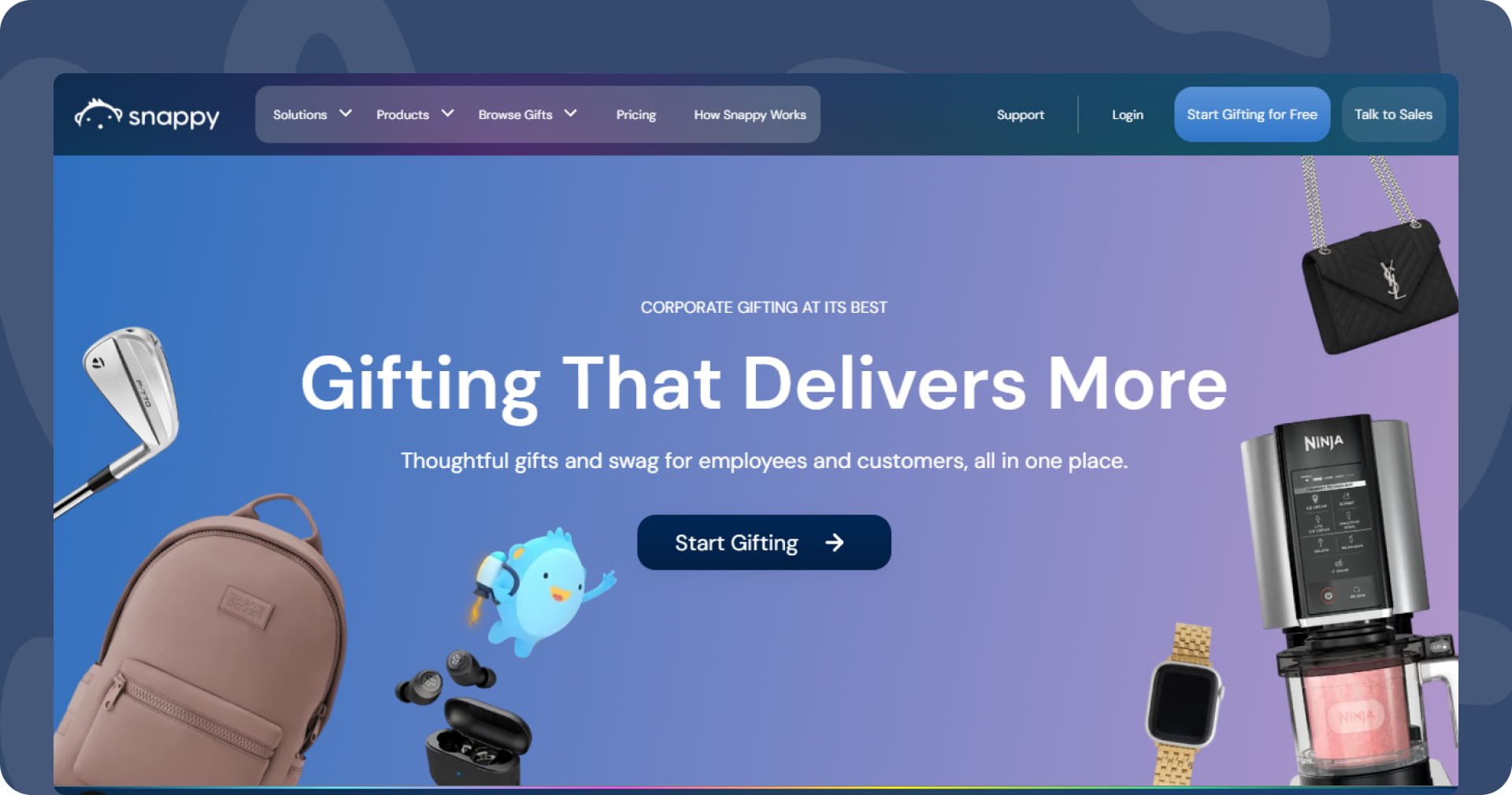
Snappy is best suited to employee-recognition and customer-gifting programs where recipient choice and the digital gift experience matter more than traditional inventory ownership. Its strengths include branded stores, on-demand swag, curated gift collections, global delivery, gift automation, APIs, and an experience that lets recipients select what they want.
Best for
Recipient-choice employee gifting
Platform type
Corporate gifting, employee recognition, recipient choice, branded stores, swag, and automation.
Verified capabilities
Snappy provides:
- Corporate gifting
- Branded swag stores
- On-demand merchandise
- Bulk swag orders
- Custom swag kits
- Curated gift collections
- Recipient choice
- Automated gifting
- Physical and digital gifts
- API access
- Salesforce integration
- SSO
- Custom creative services
- Inventory storage for selected bulk programs
Snappy’s main swag page says organizations can send one product or thousands, create stores, offer recipient selection, order bulk gifts, and distribute curated kits. Its pricing page also states that Snappy can manage storage and shipping for bulk merchandise programs.
Production and inventory model
On-demand recipient choice with optional bulk inventory
Snappy’s principal recipient-choice model does not require the company to own inventory before a person selects a gift. The platform also supports bulk orders and custom kits for campaigns that require pre-produced products.
This makes Snappy suitable for organizations that want to reduce:
- Unclaimed merchandise
- Apparel-size collection
- Unwanted gifts
- Upfront inventory
- Manual address collection
Swag stores
Snappy Stores allow companies to launch branded e-commerce experiences using either points or gift-based redemption.
The platform’s 2026 store documentation states that:
- One point equals one U.S. dollar.
- Store pricing includes products, shipping, handling, and taxes.
- Stores can use points-based or gift-based redemption.
- HRIS synchronization may be available through supported providers.
- Administrators can monitor awarded, spent, and remaining balances.
This all-inclusive store-price presentation can make recipient budgeting easier, though buyers should compare the total price with product and logistics costs from other providers.
Pricing and service fees
Snappy offers Essential, Elevated, and Enterprise plans, but the public pricing page does not display standard dollar subscription rates. It supports gift budgets from $5 to $15,000 and gives higher tiers access to additional creative, integration, security, and swag-management capabilities.
Snappy’s billing documentation says its gift estimates include:
- Selected gift budget
- Snappy service fee
- Estimated sales tax
The final charge is reconciled after the recipient chooses a product. The service fee covers platform usage, personalization, logistics, curation, and support, but the public help page does not disclose a universal service-fee percentage.
Integrations and reporting
Snappy publicly supports APIs, Salesforce integration, HRIS synchronization for stores, SSO, invoice reporting, and gift-activity reports.
Key strengths
- Strong recipient-choice experience
- On-demand swag without required inventory
- Branded company stores
- Curated physical and digital gifts
- Automated gifting
- Bulk products and custom kits
- APIs and Salesforce integration
- Budget tracking
- All-inclusive store pricing
- Strong employee-recognition fit
Limitations to consider
- Public subscription pricing is not displayed.
- The service fee amount is not standardized publicly.
- The platform is gift-led rather than inventory-management-led.
- Companies needing detailed warehouse pricing may require a custom proposal.
- The broad gift catalog may be more important than the deep sourcing of promotional products for some programs.
Who should choose Snappy?
Snappy is a strong fit for:
- Employee recognition
- Holiday gifts
- Milestone programs
- Recipient-choice campaigns
- Distributed teams
- Customer appreciation
- Companies that want to avoid inventory
- Organizations prioritizing the recipient experience
Provisional award
Best for Recipient-Choice Employee Gifting
8. AXOMO↗
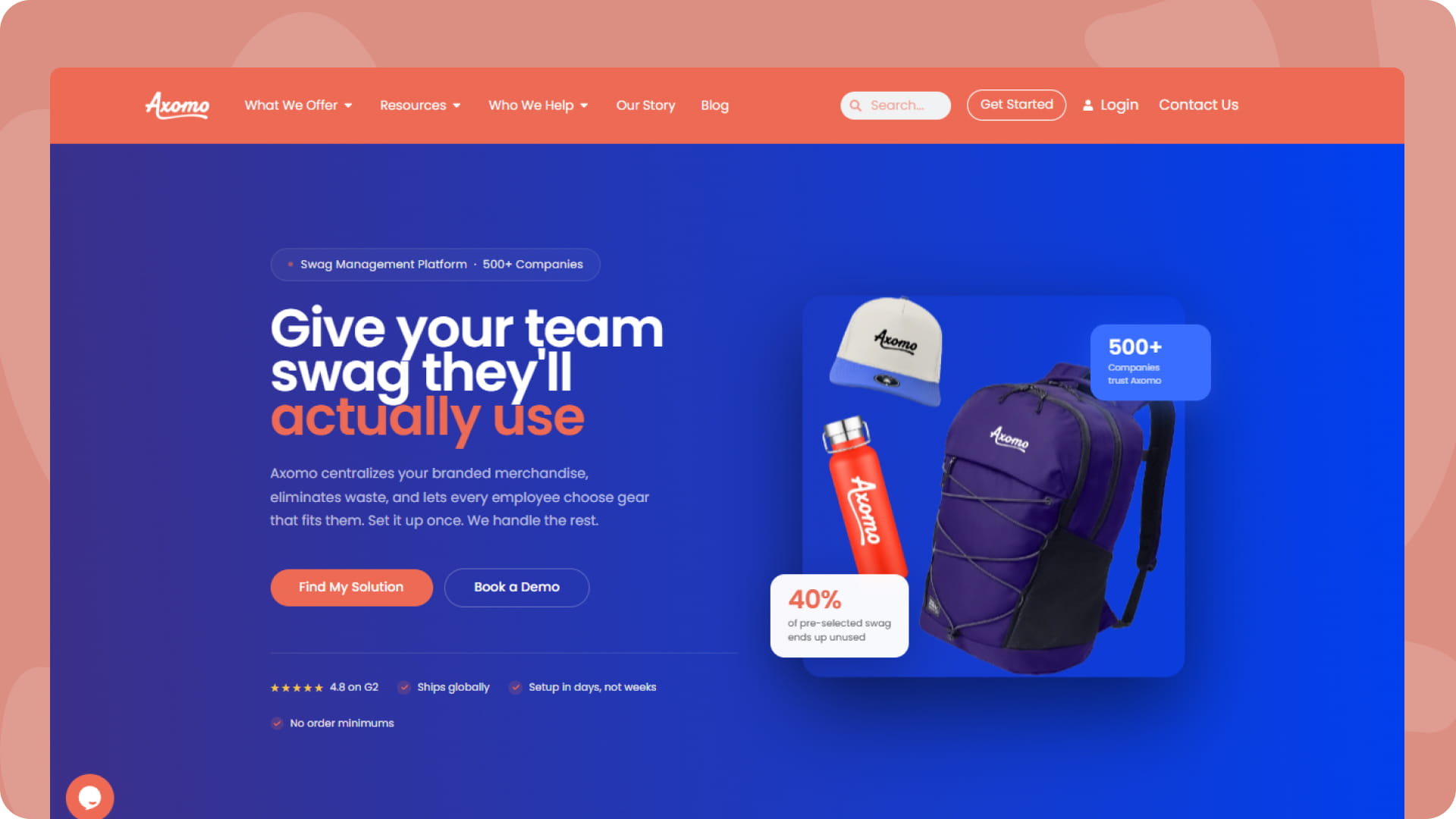
AXOMO is best suited to organizations that want employee-facing merchandise stores, real-time inventory visibility, department budgets, role-based permissions, international shipping, and automated distribution. Its strongest position is helping employees and distributed business units order approved branded merchandise while administrators control product selection, stock, spending, and reporting.
Best for
Employee merchandise stores and distributed organizations
Platform type
Company stores, employee merchandise, swag management, inventory, distribution, and rewards.
Verified capabilities
AXOMO provides:
- Branded company stores
- Thousands of customizable products
- No minimum product options
- Real-time inventory
- Warehousing
- Automated distribution
- Employee points and credits
- Department budgets
- Role-based permissions
- Reporting and analytics
- Company pickup and delivery
- International shipping
- Preorder campaigns
- Gift cards and promotions
- Product markup and resale
AXOMO defines swag management as sourcing, storing, tracking, and distributing merchandise. Its platform provides real-time stock visibility, automated logistics, usage reporting, and employee-choice rewards.
Production model
Hybrid no-minimum merchandise and warehoused inventory
AXOMO’s plans include unlimited items with no order minimum, while higher plans can add warehousing and live inventory counts. This supports both made-to-order merchandise and stored products.
The model may work well for:
- Employee apparel
- Franchise locations
- Distributed offices
- Internal rewards
- Department merchandise
- Products resold to employees
- Preorder-based campaigns
Pricing
AXOMO’s public pricing page lists:
- A specialized plan for qualifying schools, nonprofits, clubs, and very small startups
- An Essential plan with a $3,499 minimum, including 50 users
- Volume discounts for organizations with more than 500 employees
- Monthly or annual billing options
- Custom pricing for AXOMO+ enterprise programs
The public page does not clearly state whether the $3,499 minimum represents an annual platform commitment, an implementation cost, a merchandise credit, or a combination of these. Buyers should request a written breakdown.
Budget and reporting controls
AXOMO’s Essential plan includes:
- Gift cards
- Store credit
- Promotions
- Department budgets
- Warehousing options
- Livestock counts
- Markup and resale controls
- Account-management support
- International shipping options
The platform also provides tax-collection reporting by state, which may be relevant when employees purchase merchandise in-store.
Key strengths
- Employee-facing merchandise stores
- No minimum product options
- Inventory visibility
- Budget allocation
- Role permissions
- Reporting and analytics
- Warehousing
- Preorder collection
- International shipping
- Resale capabilities
- Multi-location and franchise suitability
Limitations to consider
- The $3,499 minimum requires clarification.
- Enterprise pricing requires a custom quote.
- Global local-production coverage is not described as clearly as Ciloo’s.
- Native CRM and revenue-attribution capabilities appear less central than they are for Sendoso or Reachdesk.
- Warehousing and live inventory may depend on the selected plan.
Who should choose AXOMO?
AXOMO may fit:
- Employee merchandise programs
- Franchise systems
- Schools and nonprofits
- Distributed business units
- Companies allowing employee purchases
- Programs using department budgets
- Organizations requiring pre-order campaigns
- Companies that need real-time inventory and international shipping
Provisional award
Best Employee Merchandise Store
9. Ciloo↗
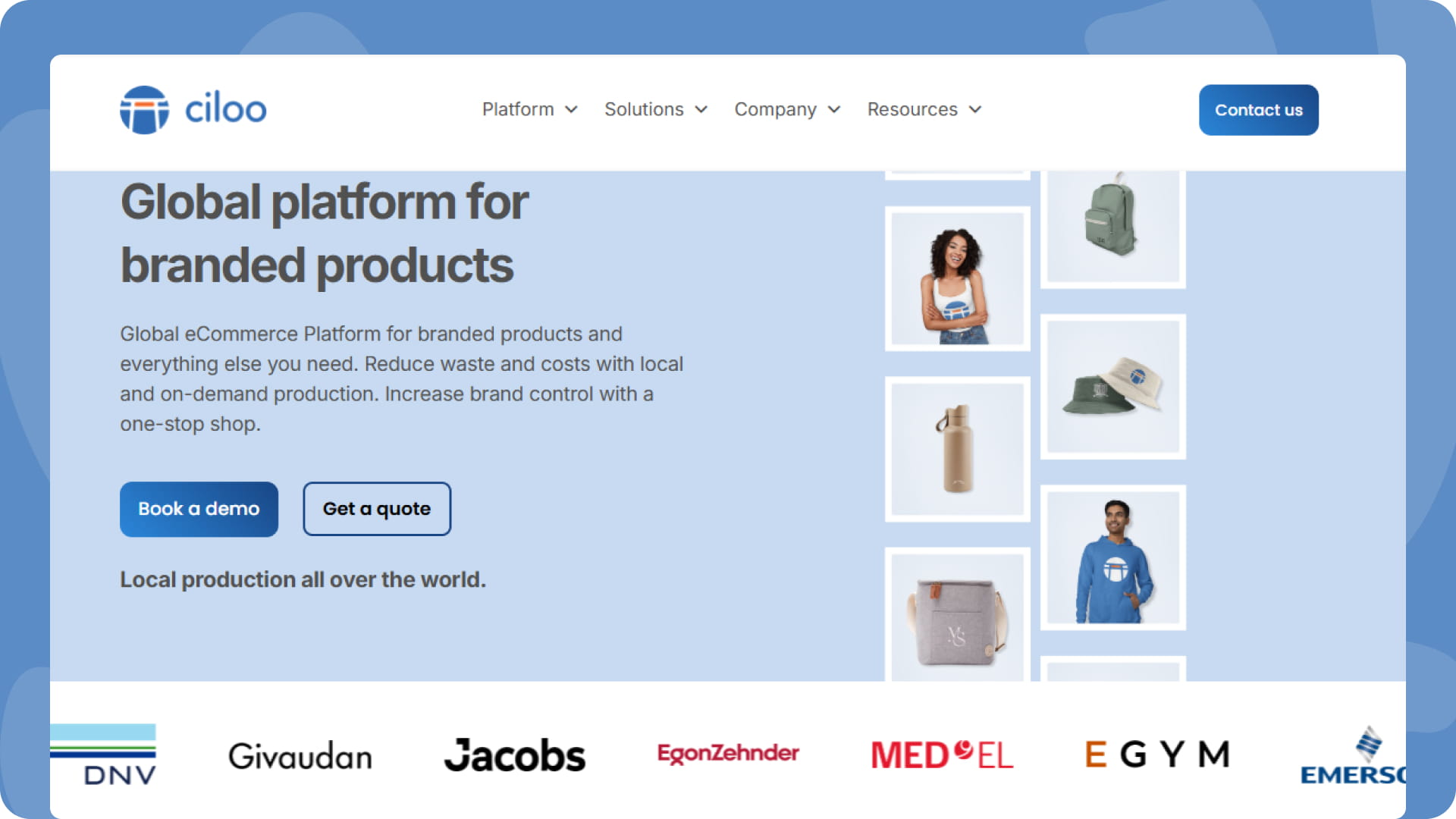
Ciloo is best suited to global companies that want branded merchandise, printed materials, apparel, and event collateral produced close to recipients or business locations. Its central differentiator is local on-demand production combined with company stores, brand governance, budget approvals, localized invoicing, and integrations with enterprise asset and procurement systems.
Best for
Localized on-demand branded product production
Platform type
Global brand store, local production network, branded merchandise, print management, and brand governance.
Verified capabilities
Ciloo provides:
- Branded company stores
- Local on-demand production
- Corporate gifts
- Apparel
- Printed materials
- Event collateral
- E-gift cards
- Approval workflows
- Team budgets
- Local invoicing
- Cost-center allocation
- ERP integrations
- Digital asset management integrations
- SSO
- Role-based access
- Reporting
- Brand-governance controls
Ciloo describes itself as a global platform for managing branded physical materials through local production partners and centralized ordering.
Production model
Local print on demand
Ciloo says products are manufactured near the recipient rather than produced centrally and shipped internationally. Its public production-location page lists countries across North America, Europe, Asia, the Middle East, Africa, Oceania, and South America.
Its platform overview states that local production is available in 30 countries and aims to reduce transportation costs, customs friction, excess inventory, and production waste.
This model can be valuable for:
- International events
- Global rebranding
- Distributed sales teams
- Franchises
- Local business units
- Printed sales materials
- Country-specific merchandise
- Organizations avoiding centralized inventory
Brand governance
Ciloo positions the platform as a governance system rather than only a company store.
Its public platform documentation includes:
- DAM integration
- ERP integration
- SSO
- Role-based access
- Cost-center accounting
- Local invoicing
- Approval controls
- Brand-compliant product templates
This can help global companies prevent:
- Unapproved logos
- Old brand assets
- Local supplier inconsistency
- Uncontrolled purchasing
- International freight duplication
- Manual invoice allocation
Pricing
Ciloo does not publish a standard platform subscription, product markup, or implementation fee on the reviewed official pages. Buyers must request a quote.
A Ciloo proposal should separate:
- Platform subscription
- Store implementation
- ERP, SSO, and DAM integration
- Product costs
- Local production
- Design setup
- Shipping
- Local taxes
- Professional services
- Account management
Key strengths
- Local production in multiple regions
- Reduced international shipping dependency
- No centralized inventory requirement for many products
- Strong enterprise brand governance
- ERP, DAM, and SSO integration
- Local invoicing and cost allocation
- Approval workflows
- Sustainability positioning
- Branded print and merchandise in one platform
Limitations to consider
- Public pricing is limited.
- Product selection may differ by production country.
- Local product consistency should be tested across regions.
- It is less focused on storing and distributing premium centralized inventory.
- Revenue attribution is not a central public positioning.
- Some unsupported countries may require existing suppliers to be integrated into the system.
Who should choose Ciloo?
Ciloo may be suitable for:
- Large international companies
- Global brand and procurement teams
- Companies running events in many countries
- Organizations managing printed and promotional materials together
- Businesses prioritizing local production
- Companies needing brand governance and cost-center allocation
- Programs designed to avoid centralized inventory
Provisional award
Best for Localized On-Demand Production
Weighted platform comparison
The scoring below measures publicly verified breadth of capability against the methodology defined earlier. It does not measure implementation quality, customer satisfaction, product quality, or negotiated pricing. A higher score indicates broader public evidence across the ten evaluated categories, not that the platform is automatically the best choice for every buyer.
Category scores
| Platform | Store | Inventory | Production | U.S. fulfillment | Global | Pricing | Integrations | Controls | Reporting | Sourcing |
| BlinkSwag | 5 | 5 | 4 | 5 | 3 | 5 | 4 | 4 | 3 | 5 |
| SwagUp | 4 | 5 | 3 | 5 | 3 | 4 | 2 | 3 | 3 | 5 |
| SwagMagic | 5 | 3 | 5 | 4 | 4 | 3 | 2 | 4 | 3 | 4 |
| Sendoso | 4 | 5 | 5 | 5 | 5 | 2 | 5 | 5 | 5 | 5 |
| Reachdesk | 4 | 5 | 4 | 5 | 5 | 3 | 5 | 5 | 5 | 4 |
| PerkUp | 5 | 5 | 5 | 5 | 5 | 3 | 5 | 5 | 4 | 5 |
| Snappy | 5 | 3 | 4 | 5 | 4 | 3 | 4 | 4 | 4 | 4 |
| AXOMO | 5 | 5 | 4 | 5 | 4 | 4 | 3 | 5 | 5 | 5 |
| Ciloo | 5 | 2 | 5 | 4 | 5 | 2 | 4 | 5 | 5 | 4 |
Weighted public-evidence scores
| Position | Platform | Weighted score | Interpretation |
| 1 | PerkUp | 93.0 | Broadest publicly documented combination of global warehousing, automation, integrations, stores, and production models |
| 2 | Sendoso | 89.2 | Strongest combined revenue, integration, production, and fulfillment ecosystem |
| 3 | Reachdesk | 88.8 | Strong enterprise governance, global gifting, and attribution |
| 4 | BlinkSwag | 88.8 | Strong end-to-end swag operations, free platform access, pricing transparency, inventory, stores, and fulfillment |
| 5 | AXOMO | 83.4 | Strong employee-store, inventory, budget, and distribution controls |
| 6 | Snappy | 79.6 | Strong recipient choice and gifting experience with less inventory emphasis |
| 7 | Ciloo | 79.2 | Strongest local production and governance model, with limited public pricing and inventory emphasis |
| 8 | SwagUp | 74.4 | Strong pack and inventory operations with narrower automation and integration evidence |
| 9 | SwagMagic | 74.2 | Strong print-on-demand store model with pricing inconsistency and limited integration evidence |
The public-evidence score should not be presented as a universal ranking.
A U.S. HR team needing inventory, a free store, and published fulfillment fees may reasonably choose BlinkSwag over a higher-scoring enterprise gifting platform. A global procurement team prioritizing local production may choose Ciloo, despite its lower aggregate score.
The correct decision depends on the use case.
Best swag platform by use case
No single platform leads every category. BlinkSwag is the strongest choice for transparent U.S. swag operations. At the same time, other platforms offer more specialized advantages in pack assembly, print-on-demand, global automation, employee choice, local production, or CRM-based revenue attribution.
| Business requirement | Recommended platform | Why |
| Transparent U.S. swag operations | BlinkSwag | Free stores, public fulfillment fees, inventory controls, and warehousing |
| Standardized onboarding or event packs | SwagUp | Pack design, assembly, inventory, shops, fulfillment |
| Global print-on-demand store | SwagMagic | Recipient choice and more than 100 print-on-demand products |
| Sales and marketing gifting | Sendoso | CRM integrations, direct mail, automation, attribution |
| Enterprise global gifting | Reachdesk | Global infrastructure, governance, address confirmation, and ROI reporting |
| Global HR automation | PerkUp | HRIS integrations, regional warehousing, bulk, and on-demand swag |
| Recipient-choice recognition | Snappy | Gift collections, on-demand swag, recipient experience |
| Employee merchandise store | AXOMO | Store budgets, inventory, employee ordering, and reporting |
| Local international production | Ciloo | Production near recipients, brand governance, and local invoicing |
Best overall for U.S. swag operations: BlinkSwag
BlinkSwag’s primary advantage is not the broadest possible feature set. It is the combination of:
- Free branded stores
- Public warehouse-order pricing
- Inventory management
- Warehousing
- Product sourcing
- Packing
- U.S. operational depth
- Worldwide distribution
This makes it particularly relevant to HR, marketing, event, and operations teams that need to control physical merchandise rather than build a revenue-gifting channel. BlinkSwag publicly lists a $2.65 warehouse-order fulfillment fee, a $1 product-picking fee, free receiving, and free pack-in fulfillment.
Swag platform pricing compared
Swag-platform pricing should be evaluated as a complete operating model rather than a single subscription fee. Buyers should compare platform charges, product costs, decoration, storage, receiving, picking, fulfillment, shipping, integrations, duties, taxes, minimum commitments, and professional services.
| Platform | Public platform pricing | Other publicly visible costs or terms |
| BlinkSwag | Core platform free to use; branded stores free to launch | $2.65 fulfillment, $1 picking, tiered storage, $25 monthly storage minimum |
| SwagUp | Plan-based pricing | Six-month item-based storage and $12 lightweight U.S. shipping benchmark |
| SwagMagic | 15% platform fee | Conflicting official setup fees of $3,000 and “starting at zero” |
| Sendoso | Custom quote | Plan-dependent integrations, regions, licenses, stores, and services |
| Reachdesk | Starts at $20,000 annually | Custom requirements, gifts, storage, shipping, and services may be additional |
| PerkUp | Custom or flexible quote | Product, regional fulfillment, warehousing, shipping, duties, and integrations require confirmation |
| Snappy | Plan pricing is not publicly quantified | Product value, service fee, tax, logistics, and plan-dependent services |
| AXOMO | The essential plan has a $3,499 minimum | Includes 50 users; enterprise pricing requires a quote |
| Ciloo | Custom quote | Platform, integrations, local production, products, and implementation require confirmation |
BlinkSwag, SwagUp, SwagMagic, Reachdesk, and AXOMO provide at least one meaningful public cost benchmark. Sendoso, PerkUp, Snappy, and Ciloo require more proposal-level pricing analysis.
What “free” usually excludes.
A free store or platform does not normally mean that the entire program is free.
Potential charges include:
- Products
- Decoration
- Custom packaging
- Warehousing
- Picking
- Fulfillment
- Domestic shipping
- International shipping
- Duties
- Taxes
- Rush production
- Custom integrations
- Professional services
Total annual cost formula
Total Annual Platform Cost = Subscription + Implementation + Merchandise + Decoration + Storage + Fulfillment + Shipping + Integrations + Taxes + Internal Administration
A platform with a higher subscription may reduce manual labor or shipping expenses. A free platform may result in a higher total cost due to product markups, fulfillment charges, or international shipping.
Every vendor should be evaluated against the same order volumes and recipient destinations.
Which integrations should a swag platform support?
The most valuable integrations depend on who owns the program. HR teams may need an HRIS and SSO; revenue teams may need CRM and sales engagement tools; while global brand teams may require ERP, procurement, digital asset management, and cost center systems. Integration count alone is less useful than workflow relevance.
HR and employee programs
Common requirements include:
- Workday
- BambooHR
- Rippling
- ADP
- UKG
- HiBob
- Paylocity
- Slack
- Microsoft Teams
- SSO
These systems can support onboarding, birthdays, anniversaries, recognition, employee status changes, and account security.
Sales and marketing
Common requirements include:
- Salesforce
- HubSpot
- Marketo
- Outreach
- Salesloft
- 6sense
- Terminus
- Zapier
- Marketing automation
Sendoso and Reachdesk are particularly strong in this category because sales and marketing automation are central to their product positioning.
Procurement and brand operations
Global enterprises may require:
- ERP
- Procurement platforms
- Digital asset management
- SSO
- Cost centers
- Approval workflows
- Local invoicing
Ciloo emphasizes ERP, DAM, SSO, cost-center accounting, and brand governance, while AXOMO focuses more heavily on store budgets, user permissions, inventory, and reporting.
Integration questions to ask
- Is the integration native or dependent on Zapier?
- Is it included in the selected plan?
- Does it support two-way synchronization?
- Can it automatically create and deactivate users?
- Which events can trigger a gift or product order?
- Can the department assign budgets?
- Does it support custom fields?
- Is SSO available?
- Is there an API?
- Are API calls or implementations charged separately?
Questions to ask during a platform demo
A swag-platform demo should evaluate the full operational workflow, not only the recipient storefront. Buyers should test sourcing, approvals, inventory, production, fulfillment, integrations, reporting, international delivery, and invoice transparency using a realistic campaign that reflects their expected order volume and recipient locations.
Platform and store
- How long does store implementation take?
- Is store setup included?
- Can the company control products by department or region?
- Can employees use points, credits, gift codes, or personal payment?
- Can administrators approve orders before fulfillment?
- Can recipients choose sizes and shipping addresses?
- Can different countries receive different catalogs?
Production and products
- Which products are bulk, on demand, or locally produced?
- What are the minimum order quantities?
- Can third-party products be added?
- Are decorations and setup included?
- How is product quality controlled?
- Can the platform support premium retail brands?
- How are substitutions approved?
Inventory and warehousing
- Where will the inventory be stored?
- How frequently is the stock updated?
- Are automated reorder alerts available?
- How are storage fees calculated?
- Are fees charged?
- Can slow-moving stock be identified?
- What happens to discontinued or obsolete products?
Fulfillment and shipping
- What are the picking and fulfillment fees?
- Can several products be assembled into a kit?
- How are shipping prices calculated?
- Which carriers are used?
- Is address confirmation included?
- Who manages customs and duties?
- Are international shipments sent DDP or DDU?
- How are failed deliveries and returns handled?
- Are replacement shipments charged separately?
Integrations and security
- Which integrations are native?
- Which plans include API access?
- Does the platform support SSO and role-based permissions?
- Is the platform SOC 2 certified?
- Can employee records be synchronized automatically?
- Can an HRIS event trigger a gift?
- Can CRM campaigns report pipeline influence?
Pricing and contract
- What is the platform subscription?
- Is there a minimum annual spend?
- What implementation charges apply?
- Are integrations priced separately?
- What merchandise markup is applied?
- Are fulfillment and shipping itemized?
- Is unused prepaid funding refundable?
- What happens at renewal?
- Can data and inventory be exported when the contract ends?
Frequently asked questions
What is the best swag management platform?
The best platform depends on the operating model. BlinkSwag is a strong choice for end-to-end swag management, particularly for companies that want branded stores, campaigns, gifting, inventory, warehousing, fulfillment, and budget controls without paying a recurring software subscription. SwagUp fits standardized packs, SwagMagic supports print-on-demand stores, Sendoso and Reachdesk support revenue-focused gifting, PerkUp supports global HR automation, and Ciloo emphasizes localized production.
Which swag platform has the most transparent pricing?
BlinkSwag publishes warehouse fulfillment, product picking, receiving, and storage fees. SwagUp publishes storage charges and a lightweight domestic shipping benchmark. AXOMO discloses a $3,499 minimum for its Essential plan. Most enterprise gifting platforms require custom quotes.
Which swag platform is best for employee recognition?
Snappy is particularly well-suited to recipient-choice recognition and curated gifts. PerkUp combines employee recognition with HRIS automation, gift cards, global warehousing, and milestone programs. BlinkSwag is stronger when recognition involves recurring physical inventory, branded stores, and fulfillment.
Which platform is best for international teams?
PerkUp provides regional warehousing and HR automation; Reachdesk supports enterprise gifting in more than 180 countries; Sendoso ships to more than 165 countries; SwagMagic promotes store shipping to more than 170 countries; and Ciloo uses local production in 30 countries. The best option depends on whether the buyer needs shipping, warehousing, or local production.
What is the difference between global shipping and local production?
Global shipping sends merchandise across national borders. Local production manufactures merchandise near the recipient. Local production can reduce customs and shipping distance, while centralized inventory may provide greater product and decoration consistency.
Do swag platforms require inventory?
Not always. BlinkSwag and SwagUp support stored inventory. SwagMagic and Snappy offer on-demand recipient selection. Sendoso and PerkUp provide hybrid models. Ciloo focuses on local on-demand production. The best model depends on product quality, volume, timing, and inventory risk.
How much does a swag management platform cost?
Costs may include a platform subscription, products, decoration, storage, picking, fulfillment, shipping, integrations, taxes, and implementation. Public examples range from free store setup through enterprise plans beginning at $20,000 annually, but the total operating cost depends on the program.
Is BlinkSwag better than Sendoso?
BlinkSwag and Sendoso overlap, but they are optimized around different operating problems. BlinkSwag is stronger for centralized swag management across stores, inventory, employee programs, events, gifting, warehousing, and fulfillment without a software subscription. Sendoso is stronger when physical gifts and merchandise need to connect directly with CRM, ABM, direct mail, and revenue attribution workflows.
Is BlinkSwag better than SwagUp?
BlinkSwag is broader as an ongoing swag-management system, while SwagUp is particularly strong in standardized packs and assembly. BlinkSwag provides free stores, public warehouse-order pricing, inventory management, and broader cross-functional use cases. SwagUp has a strong pack-building and assembly workflow with visible item-based storage pricing. The decision depends on whether the company prioritizes standardized packs or wider recurring swag operations.
Methodology, disclosure, and update policy
This comparison uses publicly available official vendor pages, help-center documentation, pricing pages, and product announcements reviewed in July 2026. Vendor-authored comparisons were used only to understand market claims and were not treated as independent evidence. Capabilities that could not be verified publicly were not assumed to be absent.
Inclusion criteria
A platform was included when it provided several of the following:
- Company stores
- Branded merchandise
- Inventory or production management
- Warehousing
- Fulfillment
- Recipient choice
- Global shipping
- Integrations
- Budget controls
- Reporting
Scoring limitations
The weighted scores measure publicly documented capabilities.
They do not measure:
- Customer satisfaction
- Implementation quality
- Support responsiveness
- Negotiated pricing
- Product quality
- Contract flexibility
- Platform uptime
- Actual delivery performance
- Security controls not publicly disclosed
A platform with limited public documentation may score lower even though it offers additional private or custom capabilities.
Conflict-of-interest disclosure
BlinkSwag publishes this comparison and is included among the platforms reviewed.
BlinkSwag was not awarded the highest aggregate score. It is recommended for a specific use case where its public pricing, inventory controls, stores, warehousing, and fulfillment model provide a strong fit.
Buyers should confirm all capabilities, costs, integrations, and service levels through current vendor proposals.
Acquisition and update policy
The platform market is changing rapidly.
Sendoso acquired Postal in May 2025 and Merch in May 2026, which materially expanded its employee-program, production, and fulfillment capabilities.
This article should be reviewed:
- Quarterly for ownership and product changes
- Quarterly for pricing changes
- Monthly for major acquisitions
- Annually, for a complete scoring update
The page’s dateModified should be updated whenever a platform profile, score, price, acquisition, or geographic claim changes.
Final recommendation
The right swag platform should match the company’s operational problem.
Choose BlinkSwag when the priority is end-to-end swag management, transparent U.S. swag operations, free branded stores, inventory management, warehousing, employee or event programs, and recurring fulfillment.
Choose SwagUp when standardized packs and assembly are central.
Choose SwagMagic when the company wants a global print-on-demand store.
Choose Sendoso when gifts and merchandise must connect with sales, marketing, direct mail, and CRM activity.
Choose Reachdesk when enterprise governance, international gifting, and revenue attribution justify a higher platform investment.
Choose PerkUp when global HR automation, regional warehousing, gift cards, and hybrid merchandise programs are required.
Choose Snappy when recipient choice and the gifting experience matter more than inventory ownership.
Choose AXOMO when the main requirement is an employee merchandise store with budgets, inventory, and multi-location controls.
Choose Ciloo when local production, brand governance, and reduced cross-border distribution are the primary requirements.
Why BlinkSwag stands out
BlinkSwag does not need to claim to be the best platform for every company.
Its strongest position is:
BlinkSwag is the transparent swag operations platform for U.S.-led teams that need to source, store, control, and distribute branded merchandise through free stores, real-time inventory management, publicly visible fulfillment charges, flexible warehousing, and worldwide delivery.
That combination makes BlinkSwag particularly suitable for companies replacing fragmented suppliers, office inventory, spreadsheets, and manual shipping with one controlled operating system for physical swag.