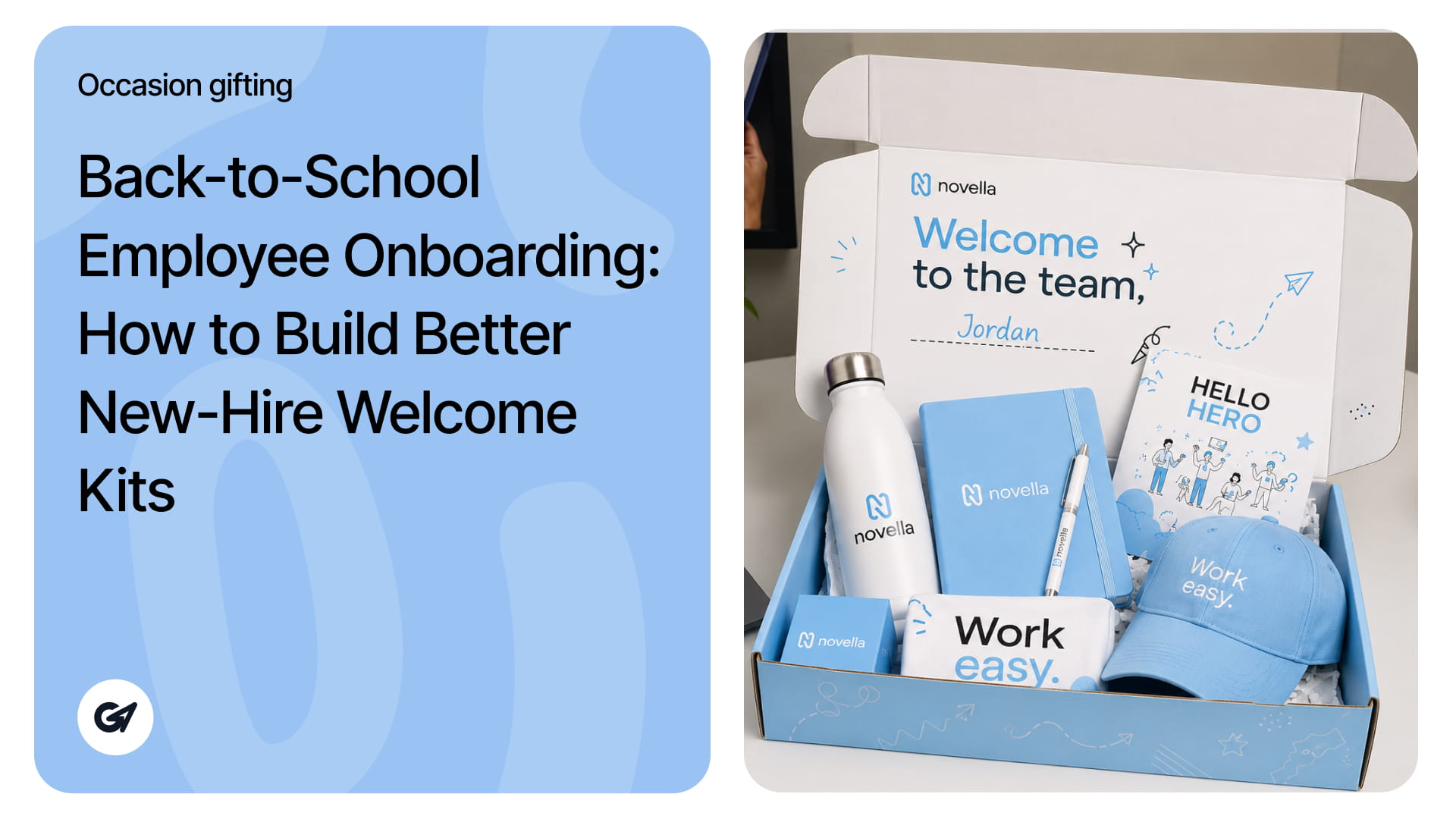
A back-to-school onboarding kit should help a new hire feel prepared before they try to feel seasonal. Start with the employee type, start date, work setup, and Day 1 needs, then select the appropriate merchandise and recipient. The strongest programs connect products, timing, fulfillment, and the welcome experience into a single coordinated onboarding workflow.
For employers, back-to-school season can be a natural planning period for interns, recent graduates, campus recruits, apprentices, rotational-program participants, and other employees beginning new roles.
But an employee onboarding kit is not a school supply box.
Its purpose is different.
A strong program connects:
employee segment → onboarding moment → work needs → useful merchandise → choice → fulfillment → Day 1
rather than:
back-to-school theme → promotional products → logo → shipment
BlinkSwag supports customized employee onboarding programs, merchandise, inventory, fulfillment, and distributed delivery through its employee onboarding platform.
What should a back-to-school onboarding kit include?
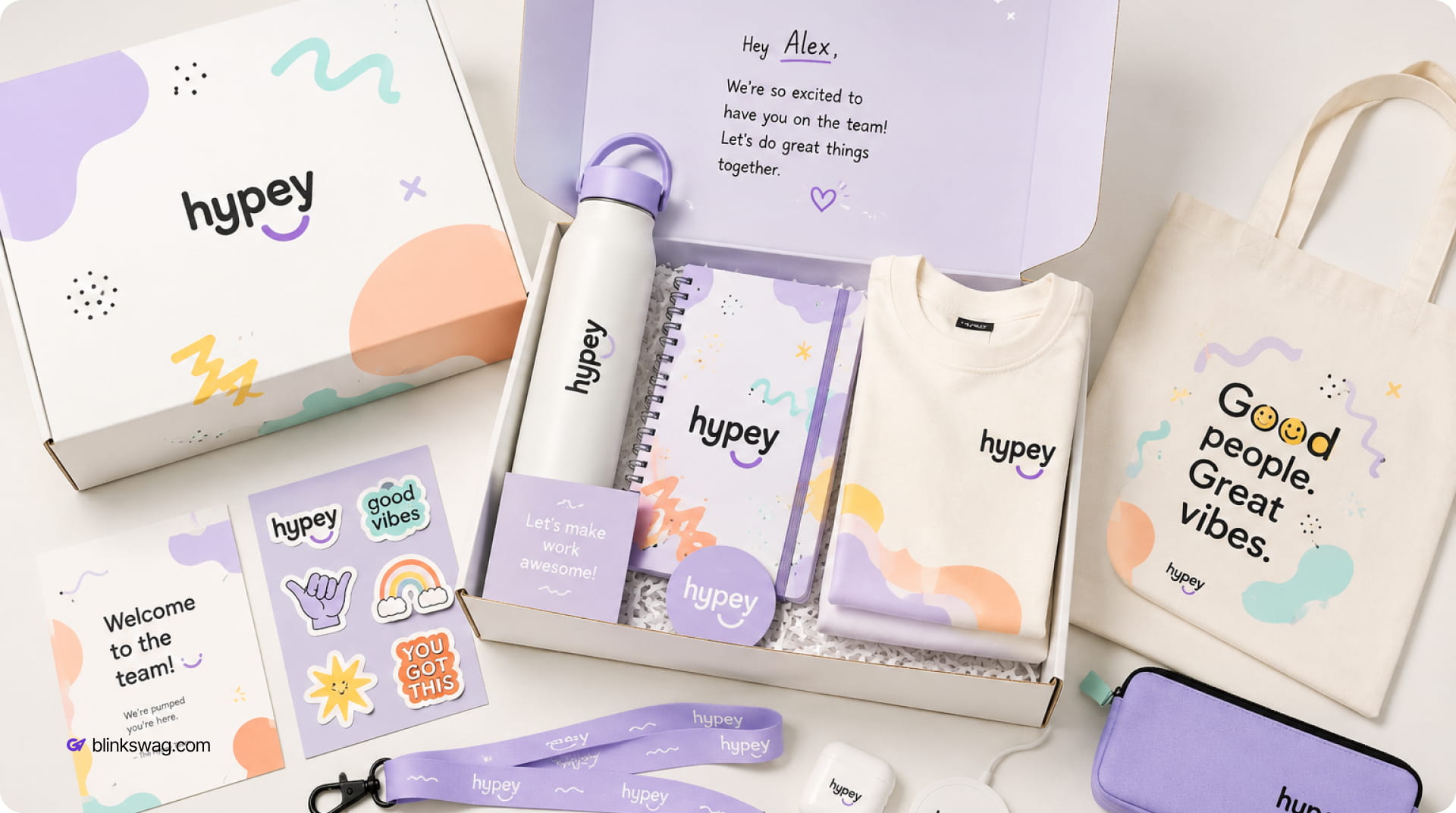
A useful back-to-school new-hire kit combines a small number of practical products, a personal welcome message, and a delivery plan connected to the employee’s start date. Drinkware, technology accessories, bags, notebooks, and optional apparel can work well, while recipient choice helps when sizes, locations, or preferences differ.
The important word is useful.
Every proposed item should pass a simple test:
- Will the employee realistically use it?
- Does it support the first-week experience?
- Does it fit the employee’s work environment?
- Is the quality appropriate?
- Is it worth storing and shipping?
- Would employee choice work better?
The goal is not to fill a box.
The goal is to design a better start.
What is a back-to-school employee onboarding kit?
A back-to-school employee onboarding kit is a seasonal new-hire welcome experience built around an employee’s transition into a new role. It can combine practical branded merchandise, welcome information, appropriate product choice, and role-relevant items while giving HR and People teams a repeatable way to prepare for seasonal hiring.
The concept is particularly useful for:
- Internship cohorts
- Recent graduates
- Campus recruits
- Apprentices
- Rotational programs
- Early-career employees
- New office cohorts
- Remote hires
- Employees converting from internships to full-time roles
The back-to-school theme should provide context.
It should not dictate the merchandise.
A new hire does not automatically need:
- School-themed graphics
- Several stationery items
- A backpack
- Heavy fall apparel
- Seasonal food
- Products are selected only because the start date falls in August or September
A more useful interpretation is:
A new beginning deserves preparation.
For a student, that might mean preparing for a semester.
For an employee, it means preparing for:
- A new role
- A new manager
- New colleagues
- New systems
- New expectations
- A different work environment
The welcome kit should support that transition.
Back-to-school onboarding is different from a school-supply campaign.
Companies may also run:
- Backpack donation drives
- School-supply collections
- Teacher-support campaigns
- Classroom donations
- Employee volunteer programs
Those serve community-impact or employee-engagement objectives.
This guide focuses specifically on:
back-to-school season as a corporate onboarding opportunity.
What makes a good new-hire welcome kit?
A good onboarding kit matches the employee, onboarding stage, location, and work environment. It contains a small number of useful products rather than generic promotional swag, separates required work equipment from welcome merchandise, allows choice when fit varies, and reaches the employee when it can support the onboarding experience.
Four criteria matter most.
Practicality
Start by asking what employees are likely to use.
Useful categories can include:
- Drinkware
- Technology accessories
- Notebook or writing tools
- Backpack or work bag
- Optional apparel
- Welcome message
A product should have a reason to exist inside the program.
Relevance
Different employees can justify different merchandise strategies.
| Employee context | Product logic |
| Intern or graduate | Portable, useful, moderate-complexity products |
| Hybrid employee | Technology organization, drinkware, flexible products |
| Commuter | Bag, hydration, portable accessories |
| Remote hire | Compact products and recipient choice |
| Executive | Fewer premium items |
| International hire | Regionally appropriate products or controlled choice |
Segmentation should happen only where it materially improves the experience.
Brand fit
New-hire merchandise should not feel like leftover event swag.
Review:
- Product quality
- Logo placement
- Brand colors
- Packaging
- Product count
- Welcome copy
Fewer, well-selected products can create a stronger experience than a box filled with low-value branded objects.
Timing
An excellent kit delivered weeks after the employee starts may miss its most important moment.
Decide whether the program is designed for:
- Preboarding
- Day 1
- First week
- A later milestone
before calculating production and fulfillment timing.
Use the START Onboarding Kit Framework
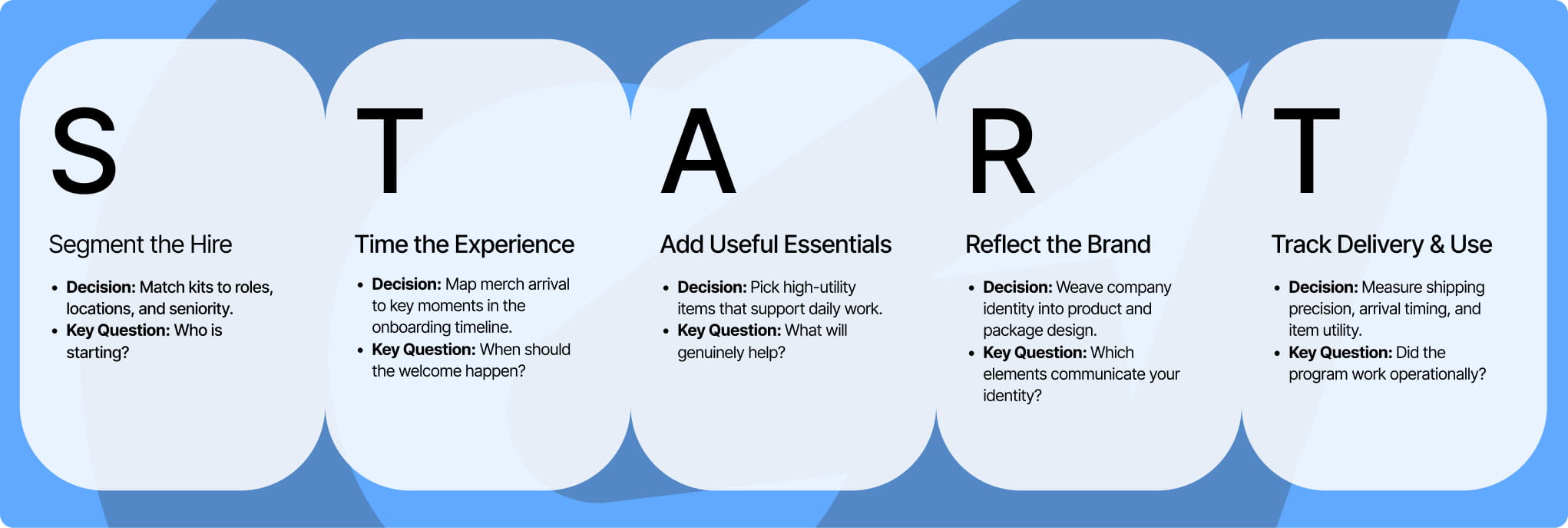
The START Onboarding Kit Framework organizes back-to-school onboarding around five decisions: segment the hire, time the experience, add useful essentials, reflect the brand selectively, and track delivery and use. It keeps merchandise subordinate to the actual employee journey instead of allowing a product list to define the onboarding program.
This is a BlinkSwag editorial planning framework, not an industry standard.
| Step | Decision |
| S: Segment the hire | Who is starting? |
| T: Time of the experience | When should the welcome happen? |
| A: Add useful essentials | What will genuinely help? |
| R: Reflect the brand | Which elements should communicate the company identity? |
| T: Track delivery and use | Did the program work operationally? |
S: Segment the hire
Do not begin with:
“We need 500 identical boxes.”
Begin with:
Who are the 500 employees?
Potential segments include:
- Interns
- Graduate hires
- Continuous new hires
- Remote employees
- International employees
- Executives
- Field employees
- Office employees
Not every difference requires a different kit.
Focus on differences that affect product fit or fulfillment.
| Difference | Likely program impact |
| Remote vs. office | High |
| Country | High |
| Apparel size | High |
| Executive vs. intern | High |
| Climate | Moderate to high |
| Department | Sometimes |
| Personal color preference | Usually low |
T: Time of the experience
Decide whether the welcome belongs in:
preboarding → Day 1 → first week → later milestone
before setting production and shipping deadlines.
A: Add useful essentials
Every product should answer:
What role does this item play in onboarding?
Possible roles include:
- Everyday utility
- Commuting
- Technology organization
- Brand connection
- Personal choice
- Seasonal relevance
If there is no meaningful answer, the product may not belong in the program.
R: Reflect the brand
Brand identity can be communicated through:
- Product quality
- Product selection
- Color
- Packaging
- Logo treatment
- Welcome message
The goal is brand coherence, not maximum logo coverage.
T: Track delivery and use
Track:
- Shipment status
- Target arrival
- Reward redemption
- Apparel exchanges
- Replacement shipments
- Remaining inventory
This turns onboarding merchandise into a recurring program rather than a one-time purchase.
START in one line
Segment → Time → Add → Reflect → Track
Which BlinkSwag products fit different onboarding needs?
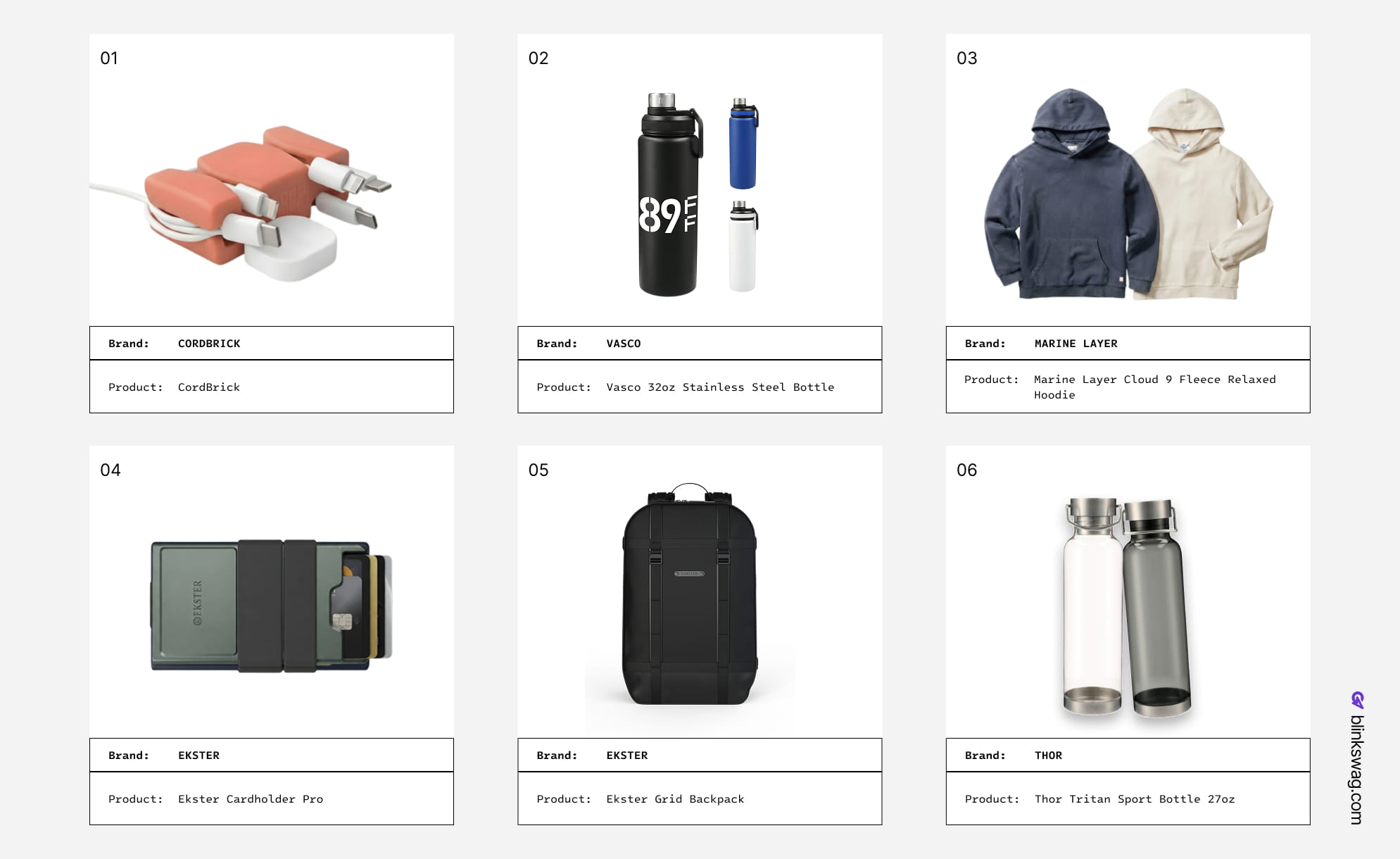
Products should be selected according to the onboarding problem they solve. Compact technology can support desk or hybrid employees, drinkware can provide broad everyday utility, apparel can reinforce belonging when sizing is known, and premium accessories can fit smaller or more selective programs. One product should not be forced across every employee segment.
The examples below illustrate different onboarding use cases. They are not fixed BlinkSwag kits.
| Product | Best fit | Why it belongs |
| CordBrick | Intern, desk, and hybrid kits | Compact technology and cable organization |
| Vasco 32oz Stainless Steel Bottle | All-day field, office, or remote employee kits | Durable high-capacity hydration for busy orientation schedules. |
| Marine Layer Cloud 9 Fleece Relaxed Hoodie | Casual culture, autumn onboarding, and remote welcome packs | Ultra-soft premium apparel providing immediate team identity and comfort. |
| Ekster Cardholder Pro | Premium or executive onboarding | Selective professional accessory |
| Ekster Grid Backpack | Premium commuter or leadership programs | Higher-value professional bag |
| Thor Tritan Sport Bottle 27oz | Active wellness programs, budget-conscious, or large-cohort onboarding | Lightweight, shatter-resistant drinkware ideal for daily commuting and large cohorts. |
Product availability, decoration options, inventory, and current pricing should be confirmed through the relevant product page when the program is planned.
Compact technology
CordBrick can fit:
- Intern programs
- Hybrid employees
- Desk-based hires
- Supplemental welcome kits
Its role is functional rather than decorative.
Everyday drinkware
The MiiR Camp Cup can fit:
- Office employees
- Hybrid hires
- General onboarding
- Back-to-school programs where insulated drinkware makes sense
The use case is a daily utility rather than a seasonal novelty.
Premium drinkware
The Hydro Flask can work for:
- Premium welcome kits
- Accepted campus recruits
- Specialist hires
- Programs built around fewer, better products
Brand recognition alone should not determine selection. It still needs to fit the audience and program budget.
Optional apparel
The Marine Layer hoodie illustrates where recipient choice becomes important.
Before including apparel, confirm:
- Size availability
- Climate
- Employee preference
- Inventory
- Decoration requirements
Apparel should rarely be guessed.
Premium professional merchandise
Products such as the Ekster Cardholder Pro or Grid Backpack are better suited to narrower, higher-value programs than to high-volume intern onboarding.
The larger SRO principle is:
Product suitability determines placement in the program, not price or catalog prominence.
What are practical back-to-school onboarding kit configurations?
The best onboarding-kit configuration depends on who is starting and how the employee will work. High-volume programs typically need a repeatable core; remote hires benefit from flexible fulfillment; interns need practical career-start products; and premium hires may justify fewer, higher-quality items with more personalization.
These are BlinkSwag editorial kit models, not fixed packages.
| Kit model | Best for | Suggested structure |
| Essential Day 1 | High-volume hires | Welcome note + writing item + compact technology + drinkware |
| Intern Launch | Internship cohorts | Notebook + technology accessory + drinkware + optional apparel |
| Campus Hire | Accepted graduate hires | Premium everyday product + welcome message + optional apparel |
| Remote Welcome | Distributed employees | Compact product + drinkware + recipient-selected reward |
| Premium New Hire | Smaller selective programs | One premium professional product + personal message |
| Executive Welcome | Leadership hires | Curated professional item + premium accessory |
Essential Day 1 Kit
Keep it deliberately simple.
The goal is not to maximize product count.
Use several items that serve different roles rather than several products that solve the same problem.
Intern Launch Kit
Prioritize:
- Portability
- Everyday utility
- Career relevance
- Moderate product complexity
An intern should be able to use the products after orientation ends.
Campus Hire Kit
An accepted candidate is no longer merely a career fair lead.
The merchandise should therefore feel different from recruiting-event giveaways.
Use the onboarding kit to mark the transition:
candidate → accepted hire → employee
Remote Welcome Kit
Avoid assuming the employee:
- Has a large desk
- Commutes
- Works in the same climate as headquarters
- Wants apparel
- Has a dedicated home office
Choice can be especially valuable in distributed programs.
Premium and executive programs
Use:
fewer, better-selected products
rather than:
the standard box plus more merchandise
The program should feel more intentional, not simply more expensive.
When should a back-to-school onboarding kit arrive?
The best arrival time depends on the job the kit is meant to perform. Preboarding kits prepare employees before they start; Day 1 kits support orientation; and first-week rewards work well for products that require size or preference selection. Define the target onboarding moment before calculating production, fulfillment, and shipping requirements.
Preboarding
Preboarding can work for:
- Remote employees
- Accepted campus recruits
- Executives
- International hires
- Employees who need preparation
Potential contents:
- Welcome message
- Compact merchandise
- Drinkware
- Non-sensitive information
Avoid including credentials or security-sensitive information in an ordinary merchandise shipment unless the company’s processes explicitly allow it.
Day 1
Day 1 works particularly well for:
- Office orientation
- Internship cohorts
- Graduate hiring
- Centralized onboarding
The kit can be:
- Placed at a workstation
- Distributed during orientation
- Delivered to a remote employee before the first morning
First week
The first week is often better for:
- Apparel
- Premium product choice
- Team merchandise
- Reward Link
- Store credit
This keeps a single sizing or preference decision from delaying the entire welcome experience.
Work backward from the target date
Use:
Recommended Order Date = Target Delivery Date − Shipping − Fulfillment − Kitting − Decoration or Production − Approval Buffer
This is a BlinkSwag editorial planning formula, not a service guarantee.
Actual requirements depend on:
- Product
- Quantity
- Inventory
- Decoration
- Packaging
- Destination
- Program complexity
No fixed lead time should be assumed without confirming the specific program.
What is the difference between required work equipment and a welcome kit?
Required work equipment is what an employee needs to perform the job, while a welcome kit is the employee-experience layer around that equipment. Laptops, security devices, mandatory uniforms, and safety equipment should not be presented as gifts simply because they arrive during the same onboarding period.
Required work equipment
Examples include:
- Laptop
- Monitor
- Security token
- ID badge
- Required headset
- Required uniform
- Safety equipment
- Job-specific device
Welcome merchandise
Examples include:
- Drinkware
- Technology accessory
- Notebook
- Optional apparel
- Backpack
- Branded accessory
- Welcome message
Optional recognition
Examples include:
- Recipient-selected product
- Reward Link
- Gift card
- Store credit
- Premium merchandise
These categories can coexist.
They should not be treated as financially or operationally identical.
A required laptop is a work-equipment expense.
A useful branded accessory may be a welcome-kit component.
A premium bag may be appropriate only for a selective onboarding program.
Keeping these categories separate makes the program easier for:
- HR
- People teams
- Procurement
- Finance
- IT
- Managers
to plan and approve.
Should companies use standardized kits or recipient choice?
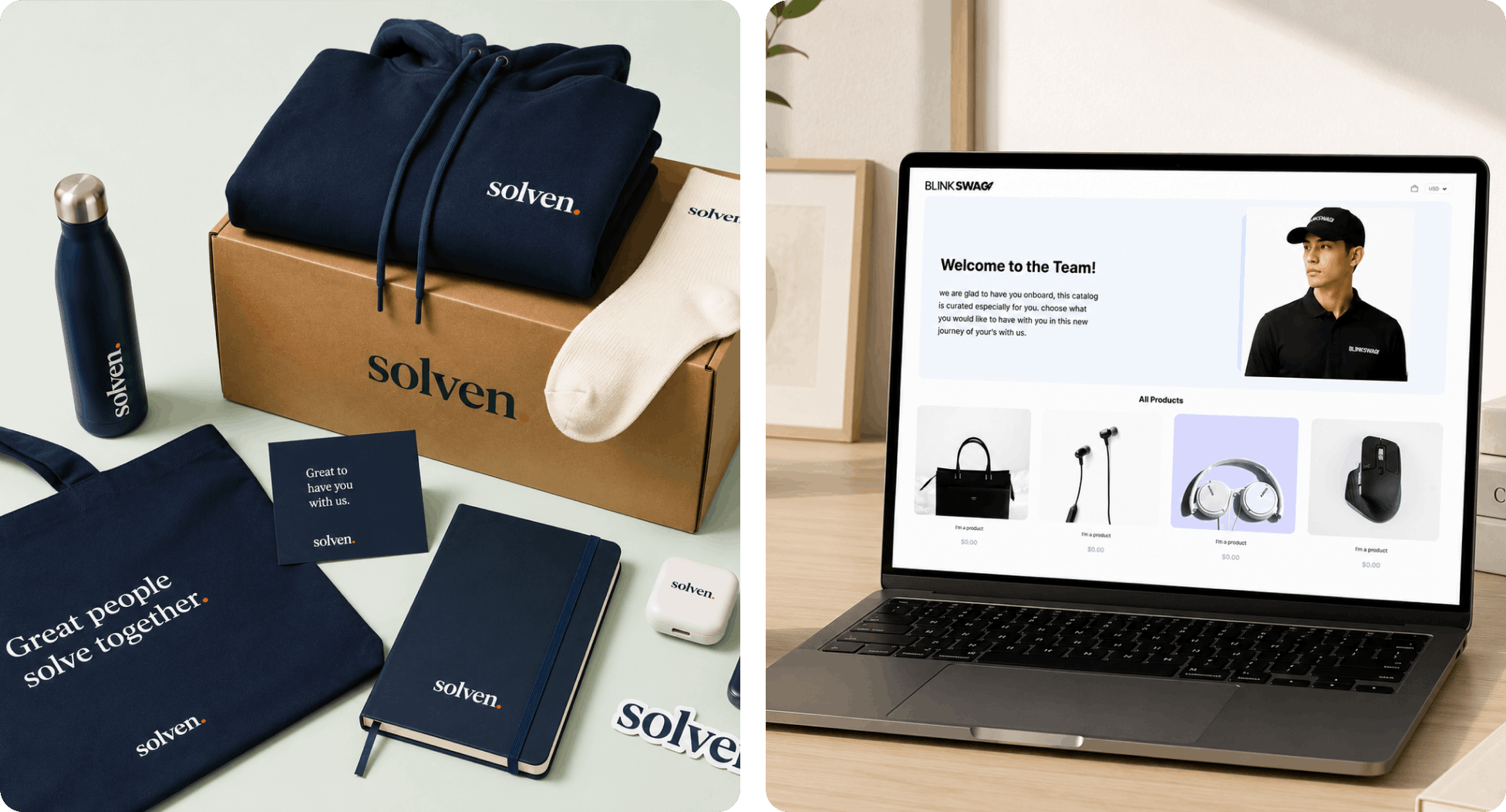
A standardized onboarding kit works best when employee needs are similar and operational repeatability matters. Recipient choice becomes more useful when apparel sizes, locations, climates, work setups, or preferences vary. Many back-to-school onboarding programs can combine a standardized core with controlled choice for the products most likely to create fit problems.
The decision does not have to be:
one identical kit
or:
Every employee chooses everything
A hybrid model often works better.
Standardized core
Everyone receives the same:
- Welcome message
- Notebook
- Small technology accessory
- Core brand item
Advantages include:
- Easier procurement
- Predictable inventory
- Faster kit assembly
- Consistent presentation
The main risk is assuming that one product fits every recipient.
Core kit + recipient choice
Everyone receives the standard welcome experience, while the employee chooses:
- Apparel size
- Apparel style
- Premium drinkware
- Optional reward
- Another approved product
BlinkSwag Reward Links allow administrators to set recipient-specific budgets, generate links in bulk, and let recipients choose from a curated set of rewards.
This model can be particularly useful for:
- Remote employees
- Distributed teams
- Apparel programs
- International hires
- Employees with different work environments
Reward-first onboarding
A choice-led model may work when:
- Employees start continuously
- Inventory requirements are uncertain
- Shipping locations vary significantly
- Personal preferences matter more than having one identical physical box
The company still controls:
- Budget
- Approved selection
- Branding
- Eligibility
The employee controls the final choice.
Decision matrix
| Program condition | Better starting model |
| Large intern cohort | Standardized core |
| Graduate intake | Standardized core + apparel choice |
| Continuous hiring | Inventory-backed core + choice |
| Remote team | Core + recipient choice |
| International hiring | Regional or choice-based model |
| Executive onboarding | Curated personalized kit |
| High sizing uncertainty | Choice-based apparel |
Standardize what benefits from consistency. Personalize what benefits from choice.
How should companies budget for back-to-school onboarding kits?
Companies should budget for the complete delivered onboarding experience rather than merchandise alone. Product cost is only one component. Decoration, packaging, kitting, storage, fulfillment, shipping, duties or taxes, replacements, and unused inventory can materially affect the final program cost, especially for distributed or international hiring.
Use this planning formula:
Total Onboarding Program Cost = Merchandise + Decoration + Packaging + Kitting + Storage + Fulfillment + Shipping + Taxes or Duties + Replacements
This is a BlinkSwag editorial planning formula, not an accounting standard or pricing guarantee.
Why is the merchandise price alone misleading
Two programs using the same product can have different delivered costs.
For example:
Program A
- One office
- Bulk delivery
- No apparel
- Simple packaging
Program B
- Individual home addresses
- Apparel sizing
- Multiple countries
- Custom packaging
- Replacement shipments
The merchandise may be identical.
The operating cost is not.
BlinkSwag publicly separates fulfillment and product-picking fees from merchandise pricing, reinforcing the distinction between the product itself and the operational cost of distributing it.
Budget by program design, not arbitrary industry averages
Rather than publishing unsupported “standard welcome-kit budgets,” define the scenario first.
| Program | Main budget drivers |
| Intern cohort | Volume, standardization, bulk kitting |
| Graduate intake | Product quality, apparel choice |
| Continuous hiring | Inventory, storage, individual fulfillment |
| Remote onboarding | Residential shipping |
| International hiring | Destination, customs, regional availability |
| Executive onboarding | Premium product selection and personalization |
Cost per completed onboarding
A useful internal metric is:
Cost per Completed Onboarding Kit = Total Program Cost ÷ Successfully Delivered Kits
This is also a BlinkSwag editorial measurement formula.
It is more operationally useful than:
merchandise spend ÷ employees hired
because unsuccessful deliveries and replacements still create costs.
Once HR has defined:
- Headcount
- Start dates
- Countries
- Product strategy
- Recipient choice
- Delivery model
The next step should be a program-specific estimate rather than relying on a generic per-person assumption.
How can back-to-school onboarding kits be more inclusive and lower-waste?
A more inclusive onboarding kit avoids assuming that every employee wants the same size, product, food, climate-specific item, or work accessory. A lower-waste program focuses on useful products, controlled inventory, recipient choice where fit varies, and periodic review of items that are no longer being selected or distributed.
These are related issues, but they should not be confused.
Recipient choice does not automatically make a program “sustainable.”
It can, however, reduce some forms of avoidable purchasing risk.
Inclusive product checks
Consider:
- Apparel size availability
- Gender-neutral fit options
- Climate
- Dietary restrictions
- Food allergies
- Fragrance sensitivity
- Accessibility
- Remote-work environment
- Field versus desk work
- Country availability
BlinkSwag’s current inclusive-swag guidance recommends broader size coverage, multiple fit options, and accessibility considerations when merchandise is distributed across diverse employee groups.
Equal onboarding does not require identical merchandise
A remote employee in Arizona and an office employee in Boston can receive a comparable welcome experience without receiving the same seasonal apparel.
Aim for consistency in:
- Intent
- Quality
- Approximate value
- Timing
- Brand experience
rather than forcing a single SKU across all employees.
Reduce unnecessary inventory
Useful controls include:
- Smaller initial buffers
- Reorder thresholds
- Recipient choice for apparel
- Periodic inventory review
- Product substitution rules
- Removal of outdated printed materials
- Reuse of still-current inventory
BlinkSwag’s inventory feature supports stock tracking and automated reorder thresholds, while its warehousing service is designed for stored merchandise and recurring fulfillment.
Avoid novelty for novelty’s sake.
Back-to-school merchandise should remain useful after the seasonal moment passes.
A good question is:
Would we still consider this a useful onboarding item if the employee started three months later?
If the answer is no, the product may be too dependent on the seasonal theme.
How should campus recruiting connect to Day 1?
Back-to-school hiring should be treated as a journey from candidate awareness to employee onboarding, not as a series of unrelated swag moments. Career fair merchandise should serve a different purpose than an accepted-offer welcome, while Day 1 merchandise should support the transition from candidate to employee.
Use the hiring funnel deliberately.
| Hiring stage | Merchandise role |
| Career fair | Awareness and portable utility |
| Qualified candidate | Selective follow-up |
| Finalist | Personalized touch where appropriate |
| Offer accepted | Preboarding welcome |
| Day 1 | Full onboarding experience |
| Internship cohort | Cohort identity and useful essentials |
| Full-time conversion | Milestone recognition |
Career fair
The goal is visibility and utility.
Do not spend the full onboarding budget on every person who visits a booth.
Offer accepted
The relationship has changed.
This is the moment to shift from:
recruiting swag
to:
employee welcome
A short note from the hiring manager can be more important here than adding several extra products.
Day 1
The employee should receive the most complete version of the onboarding experience.
Intern conversion
When an intern becomes a full-time employee, do not automatically resend the same kit.
Recognize the transition.
The person has moved from:
intern → returning hire → employee
The merchandise strategy can move with them.
Funnel principle
Increase personalization as the relationship becomes more committed.
This prevents the company from using the same merchandise strategy for a career-fair visitor and an employee beginning a full-time role.
How should fulfillment change for cohorts, continuous hiring, remote teams, and international employees?
The fulfillment model should follow the hiring model. Cohorts benefit from prebuilt standardized kits; continuous hiring requires inventory and repeatable ordering; remote employees need individual-address fulfillment; and international onboarding requires destination-specific planning for availability, customs, shipping, and replacement procedures.
One operational workflow will not fit every hiring program.
| Hiring model | Better fulfillment model | Main risk |
| Internship cohort | Prebuilt standardized kits | Late additions |
| Graduate cohort | Standard core + choice | Sizing and timing |
| Continuous hiring | Inventory-backed fulfillment | Stockouts or obsolete inventory |
| Remote hiring | Individual fulfillment | Address accuracy |
| International hiring | Regional/destination-specific fulfillment | Customs and availability |
| Executive hiring | Curated on-demand approach | Personalization complexity |
Cohort onboarding
Useful for:
- Intern classes
- Graduate programs
- Apprenticeships
- Seasonal hiring
- Office launches
Workflow:
- Estimate headcount.
- Confirm products.
- Collect sizes where needed.
- Approve artwork.
- Build kits.
- Validate destinations.
- Stage delivery.
- Maintain a late-hire process.
Continuous onboarding
Continuous hiring needs:
- Approved core products
- Inventory thresholds
- Reorder rules
- Substitution procedures
- Individual fulfillment
- Shipment tracking
BlinkSwag’s onboarding service supports inventory management and shipment tracking, while its inventory tooling supports real-time stock visibility and reorder thresholds.
Remote onboarding
Confirm:
- Residential address
- Start date
- Selection
- Apparel size
- Tracking
- Replacement process
Do not make remote employees an exception handled after the office program is designed.
Design them into the program from the beginning.
International onboarding
Confirm:
- Product availability
- Fulfillment origin
- Destination
- Import requirements
- Duties and taxes
- Local sizing
- Delivery method
- Replacement strategy
BlinkSwag states that it supports worldwide fulfillment and global shipping, including international logistics and customs management.
For U.S. imports, customs charges can depend on classification, country of origin, and other shipment factors, so companies should avoid assuming one universal international delivery model.
The objective is:
equivalent onboarding experience, not necessarily identical global merchandise.
How should companies plan lead times, recipient data, and internal approvals?
Back-to-school onboarding programs should work backward from the employee’s target delivery date, confirming product approval, recipient data, fulfillment, and internal sign-off before shipping begins. HR, brand, procurement, finance, IT, privacy, and legal teams may each own part of the workflow depending on the organization and program.
Build the timeline backward.
Use:
Recommended Order Date = Target Delivery Date − Shipping − Fulfillment − Kitting − Decoration or Production − Approval Buffer
Do not assign generic numbers to those stages unless the specific BlinkSwag program has been confirmed.
Internal approvals to identify early
Depending on the organization, confirm:
- HR program approval
- Budget ownership
- Procurement/vendor setup
- Brand guidelines
- Product approval
- Purchase order
- International shipping requirements
- IT/security requirements
- Privacy review
- Tax treatment where relevant
The goal is not to create unnecessary bureaucracy.
It is to avoid discovering an approval requirement after products have already been ordered.
Recipient information
An onboarding workflow may require:
- Employee name
- Business email
- Start date
- Shipping address
- Product choice
- Apparel size
- Delivery contact information
Collect only what fulfillment actually requires.
FTC business guidance recommends knowing what personal information a business holds, keeping only what is needed, protecting retained information, and disposing of information that is no longer necessary.
Home addresses deserve extra care.
Residential address data should not circulate unnecessarily through:
- Informal spreadsheets
- Group emails
- Shared documents
- Unapproved systems
Use approved workflows and limit access in accordance with company policy.
Where recipient-controlled redemption is appropriate, BlinkSwag Reward Links provide recipient-specific links and controlled reward budgets.
Peak back-to-school planning
The seasonal nature of the campaign should affect planning discipline, not create an invented universal deadline.
Confirm:
- Products
- Quantities
- Artwork
- Recipients
- Addresses
- Shipping destinations
early enough to calculate the real program-specific order date.
How should companies measure the success of a back-to-school onboarding program?
Onboarding merchandise should be measured by delivery, operational efficiency, inventory utilization, recipient choice, and feedback, rather than by unsupported claims that swag caused retention or productivity gains. A useful scorecard shows whether employees received the intended experience on time and whether the program can be repeated efficiently for future hires.
Core operational metrics
| Metric | Calculation |
| On-time kit rate | Kits arriving by target date ÷ kits sent |
| Day 1 availability rate | Employees with kits available by Day 1 ÷ employees in program |
| Delivery failure rate | Failed deliveries ÷ shipments |
| Replacement rate | Replacement shipments ÷ original shipments |
| Inventory-use rate | Products distributed ÷ products purchased |
| Reward redemption rate | Rewards redeemed ÷ rewards issued |
| Cost per completed kit | Total program cost ÷ successfully delivered kits |
These are BlinkSwag editorial measurement formulas, not HR or accounting standards.
Recipient feedback
Ask:
- Did the kit arrive when expected?
- Was the product useful?
- Was the selection process easy?
- Did apparel fit?
- Was the welcome message clear?
- Was anything unnecessary?
Inventory feedback
Review:
- Products that move quickly
- Products employees rarely choose
- Apparel sizes are repeatedly unavailable
- Products generating replacements
- Seasonal merchandise left after the campaign
- Old inserts or obsolete brand materials
Do not overclaim outcomes
A welcome kit may be one part of an onboarding experience.
Do not report that it caused:
- Higher retention
- Faster productivity
- Better performance
- Stronger culture
- Lower turnover
unless the organization has evidence designed to establish that relationship.
Measure what the onboarding merchandise program actually controls.
Back-to-School Onboarding Checklist
A scalable back-to-school onboarding program should confirm the employee group, onboarding moment, products, choice model, budget, inventory, recipient information, approvals, fulfillment, and measurement before the employee’s first day.
Program strategy
- Define the employee segment.
- Define the onboarding moment.
- Separate work equipment from welcome merchandise.
- Choose standardized, choice-based, or hybrid fulfillment.
- Confirm the program owner.
Merchandise
- Select products for usefulness.
- Check product quality.
- Confirm climate relevance for seasonal products.
- Confirm apparel sizing.
- Avoid unnecessary novelty items.
- Review branding and decoration.
Budget
- Calculate merchandise cost.
- Include decoration.
- Include packaging and kitting.
- Include fulfillment and storage.
- Include shipping.
- Include international duties or taxes where relevant.
- Define replacement handling.
Inclusion and waste control
- Review the size coverage.
- Offer choice where fit varies.
- Check dietary or sensitivity issues where applicable.
- Avoid assumptions about work setup.
- Set inventory thresholds.
- Review aging merchandise.
- Remove outdated inserts or collateral.
Recipient data
- Confirm employee name.
- Confirm start date.
- Confirm shipping destination.
- Collect only necessary information.
- Restrict unnecessary access to home addresses.
- Apply company retention and privacy policies.
Fulfillment
- Approve artwork.
- Confirm inventory.
- Assemble kits.
- Validate addresses.
- Ship against the target onboarding date.
- Track delivery.
- Define a replacement workflow.
Measurement
- Measure on-time delivery.
- Measure Day 1 availability.
- Track reward redemption.
- Track replacements.
- Review remaining inventory.
- Collect recipient feedback.
Frequently Asked Questions
What should be in a back-to-school employee onboarding kit?
A strong kit includes a small number of useful items tied to the employee’s first-week experience. Common categories include drinkware, technology accessories, notebooks, bags, optional apparel, and a welcome message. The right combination depends on role, location, work setup, budget, and delivery model.
Should every new hire receive the same welcome kit?
Not necessarily. Standardization works well for large, similar cohorts, while recipient choice can improve fit when apparel sizes, locations, climates, or preferences differ. A standardized core plus controlled choice often provides a useful balance.
Should onboarding kits arrive before Day 1?
They can. Preboarding works well when the kit is intended to prepare or welcome the employee before the start date. Day 1 delivery works well for orientation. Products requiring size or preference selection can be delivered during the first week.
How much should an employee onboarding kit cost?
There is no reliable universal amount. Companies should calculate the full delivered program cost, including merchandise, decoration, packaging, fulfillment, storage, shipping, applicable taxes or duties, and replacements.
Are laptops part of an onboarding gift?
Required laptops and other job equipment should be treated as work equipment rather than employee gifts. They may arrive during the same onboarding period, but the welcome merchandise and required equipment should remain distinct.
How can onboarding kits work for remote employees?
Design the program for residential delivery from the beginning. Confirm addresses, product choice, apparel sizing, shipment tracking, and replacement procedures rather than adapting an office-only program after it has already been approved.
How can companies reduce unused onboarding merchandise?
Use controlled inventory, reorder thresholds, recipient choice where product fit varies, periodic inventory reviews, and substitution rules. Avoid ordering large quantities of seasonal or highly size-dependent products without evidence that employees will use them.
How should companies handle employee home addresses?
Collect only the information needed for fulfillment, limit access in accordance with company policy, protect retained information, and avoid unnecessary sharing via informal systems. FTC business guidance recommends data minimization and appropriate protection for retained personal information.
Final Recommendation
A successful back-to-school onboarding program is not defined by how many products fit inside a box. It is defined by whether the employee receives a useful, relevant, and well-timed welcome experience that the organization can operate consistently across hiring types, locations, and future cohorts.
Use the START framework:
Segment the hire
Time the experience
Add useful essentials
Reflect the brand
Track delivery and use
Then manage the complete workflow:
employee segment → onboarding moment → merchandise → choice → approvals → fulfillment → Day 1 → measurement
Back-to-school gives the campaign its seasonal context.
The employee experience should still determine the program.
For teams comparing physical kits with flexible choice, BlinkSwag Reward Links can support recipient-specific budgets and curated reward selection, while inventory and fulfillment tools support recurring physical onboarding programs.
Planning a back-to-school onboarding program for interns, campus hires, remote employees, or an ongoing hiring pipeline? Start with your hire count, target start dates, delivery locations, and choice requirements. BlinkSwag can support the merchandise, inventory, fulfillment, rewards, and global distribution layers of the onboarding workflow. Request a demo now↗