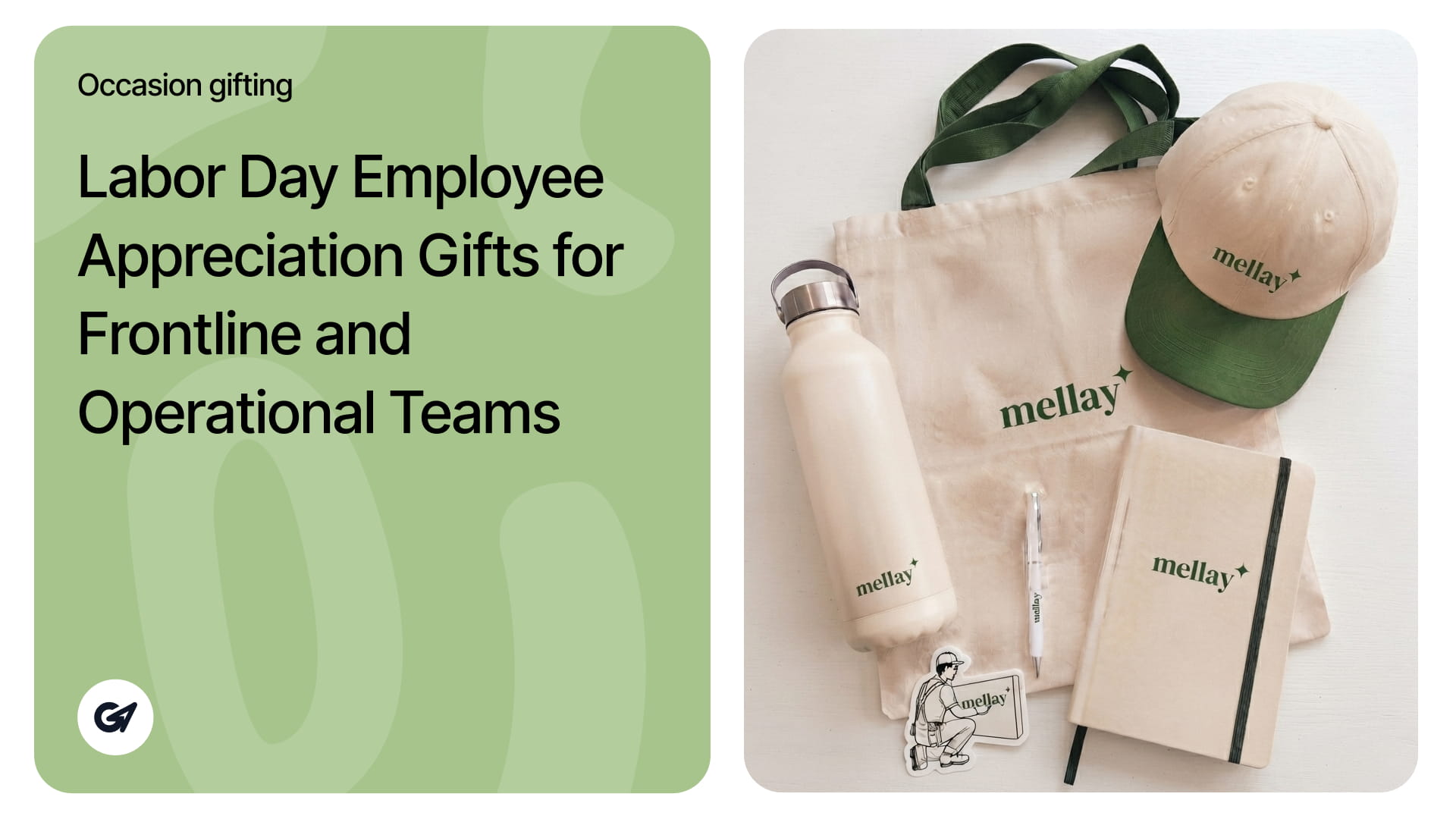
The best Labor Day gifts for employee appreciation in frontline and operational teams are useful, portable, appropriate for the employee’s environment, and accessible fairly across shifts and locations. Insulated drinkware, coolers, bags, portable technology, flexible rewards, and team meals can work well. Required PPE and mandatory work equipment should remain separate from appreciation gifts.
Labor Day is an especially relevant occasion for recognizing the employees who keep products moving, customers served, facilities functioning, locations operating, equipment maintained, and essential business processes running.
The U.S. Department of Labor describes Labor Day as an annual celebration of the social and economic achievements of American workers and their contributions to the country’s strength, prosperity, and well-being.
For employers, Labor Day is more than a reason to distribute branded merchandise.
It is an opportunity to recognize work that is often performed:
- Away from a corporate desk
- Across multiple shifts
- At warehouses, stores, plants, branches, or customer sites
- In vehicles or in the field
- During evenings, nights, and weekends
- Outside the normal visibility of corporate leadership
The strongest appreciation programs, therefore, connect:
work reality → contribution → shift access → useful gift → fair delivery
rather than:
Labor Day → generic swag → logo → handout
What makes a good Labor Day gift for frontline employees?
A good Labor Day gift fits how frontline employees actually work and live. Choose products with useful personal or off-task value, make recognition available across all eligible shifts and locations, provide choice when employees’ needs differ, and keep required PPE, mandatory uniforms, tools, and other job requirements separate from appreciation.
Before selecting a product, ask:
- Will employees realistically use it?
- Is it portable or easy to store?
- Does climate affect its usefulness?
- Does sizing create unnecessary friction?
- Is it suitable for employees who do not work at desks?
- Can employees across different shifts receive it fairly?
- Would employee choice work better?
- Does the workplace permit the item?
- Is it genuinely a gift, or something the employee already needs to perform the job?
That final distinction is especially important for operational teams.
Why Labor Day employee appreciation should focus on the work
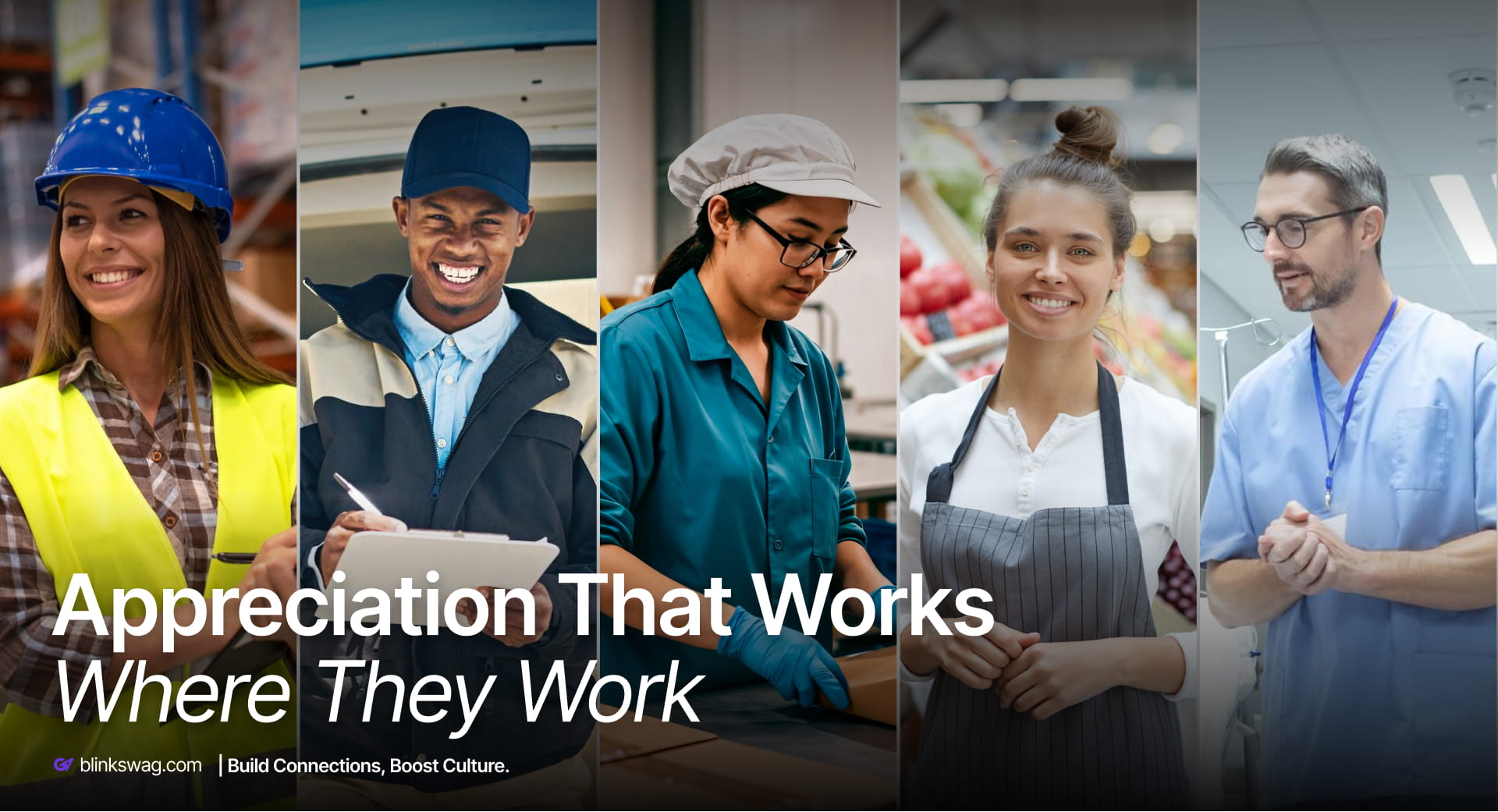
Labor Day recognition is more meaningful when employers name the contribution being recognized instead of relying on a generic thank-you message. The gift may convey appreciation, but the message should explain what the employee or team contributes and why their work matters.
Independent workplace research supports the broader importance of high-quality recognition. Gallup and Workhuman reported a longitudinal association in which well-recognized employees were 45% less likely to have changed organizations after two years. That research concerns recognition as an overall workplace practice and does not show that merchandise itself causes retention.
That distinction matters.
A branded bottle does not create meaningful recognition on its own.
Recognition starts with:
We see what you do, and we understand why it matters.
Manufacturing teams
Instead of:
Thanks for your hard work.
Try:
Thank you for the consistency, attention, and teamwork that help keep production moving and quality on track.
Warehouse and distribution teams
Thank you for the coordination and accuracy that keep inventory moving and customers supplied.
Facilities teams
Thank you for the behind-the-scenes work that keeps our locations functional, prepared, and supported.
Retail teams
Thank you for the service, problem-solving, and consistency you bring to customers and teammates throughout every shift.
Logistics teams
Thank you for helping products, materials, and commitments reach the right place at the right time.
The message should reflect the actual workplace rather than relying on generic assumptions about the role.
Who are frontline and operational employees?
Frontline and operational employees are workers whose roles are primarily performed at a physical location, in the field, in transit, on a production or service floor, or directly with customers, patients, equipment, facilities, or inventory rather than primarily at a corporate desk.
For appreciation planning, this can include:
- Manufacturing employees
- Warehouse and distribution teams
- Drivers and delivery teams
- Retail associates
- Hospitality employees
- Healthcare workers
- Field-service employees
- Facilities and maintenance teams
- Construction employees
- Food-service teams
- Security personnel
- Production workers
- Utility and field operations
- Branch employees
- Other shift-based or site-based roles
This is a planning definition, not a legal employment classification.
More importantly, frontline does not mean identical.
| Employee type | Typical work reality |
| Warehouse employee | Fixed site, shift schedule, frequent movement |
| Driver | Mobile, route-based, vehicle environment |
| Retail associate | Customer-facing, rotating schedules, limited storage |
| Maintenance technician | Mobile within facilities, job-specific equipment |
| Healthcare worker | Patient-facing, regulated environment |
| Field employee | Customer sites, outdoor exposure, regional travel |
| Hospitality employee | Guest-facing, variable shifts, and break schedules |
The correct question is not:
What gift do frontline workers like?
It is:
Which differences in work environment, shift, location, climate, and employee preference actually change what will be useful?
The SHIFT Appreciation Framework
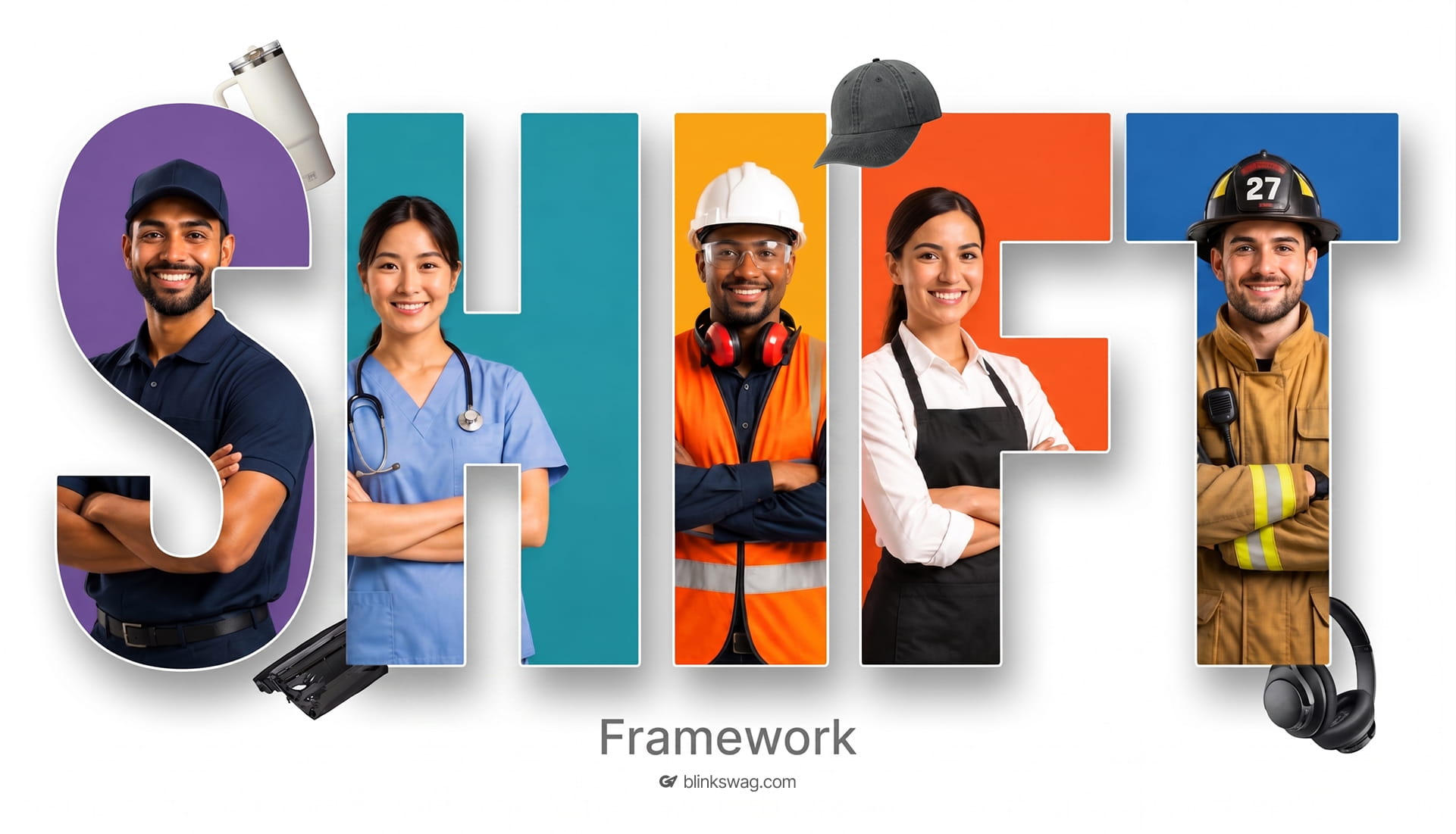
The SHIFT Appreciation Framework helps employers design Labor Day recognition around the employee rather than starting with merchandise. It asks organizations to understand the work, recognize the contribution, include every shift, fit the gift to the employee’s reality, and confirm that recognition actually reached the intended workforce.
SHIFT is a BlinkSwag editorial planning framework.
| Step | Core question |
| S: See the work | How does this team actually work? |
| H: Honor the contribution | What specifically are we recognizing? |
| I: Include every shift | Can every eligible employee participate? |
| F: Fit the gift | Does the gift fit the employee’s environment and preferences? |
| T: Track fair delivery | Did recognition reach everyone intended? |
S: See the work
Before buying anything, understand:
- Work location
- Shift structure
- Mobility
- Climate
- Storage limitations
- Break patterns
- Digital access
- Workplace restrictions
A gift selected for headquarters may make little sense at a distribution center.
H: Honor the contribution
Identify the actual reason for appreciation.
That might include:
- Customer service
- Production continuity
- Reliability
- Quality
- Team coordination
- Maintenance
- Process improvements
- Problem-solving
- Operational support
Avoid inventing performance claims. Recognition should be grounded in what leaders genuinely know about the team.
I: Include every shift
Map:
- Day shift
- Evening shift
- Overnight shift
- Weekend teams
- Drivers
- Field employees
- Secondary sites
- Remote operational workers
If one of these groups has no clear path to recognition, the program is not finished.
F: Fit the gift
Evaluate:
- Utility
- Portability
- Size
- Climate
- Workplace suitability
- Employee preference
- Ease of distribution
The gift should fit the employee before it fits the campaign theme.
T: Track fair delivery
Measure whether the recognition was actually received.
Track:
- Eligible employees
- Sites
- Shifts
- Deliveries
- Redemptions
- Unclaimed rewards
- Replacement requests
A box leaving a warehouse is not the same as an employee being recognized.
What makes a frontline Labor Day gift useful?
Frontline appreciation gifts should prioritize real-world utility rather than office assumptions. Strong options are usually portable, easy to carry or store, appropriate for the employee’s environment, and useful outside safety-sensitive job tasks.
A practical hierarchy is:
Everyday utility
Examples include:
- Insulated drinkware
- Water bottles
- Coolers
- Lunch bags
- Duffels
- Backpacks
Portable convenience
Examples include:
- Charging accessories
- Travel organizers
- Compact personal technology
- Portable bags
Optional apparel
Examples include:
- Caps
- T-shirts
- Hoodies
- Non-PPE outerwear
Apparel requires additional planning because size, fit, climate, uniforms, and employee preferences can vary significantly.
Flexible recognition
Examples include:
- Gift cards
- Curated merchandise choice
- Meal credits
- Recipient-selected rewards
Choice is particularly useful when one physical product is unlikely to fit every employee equally well.
Use the shift utility, not the desk utility
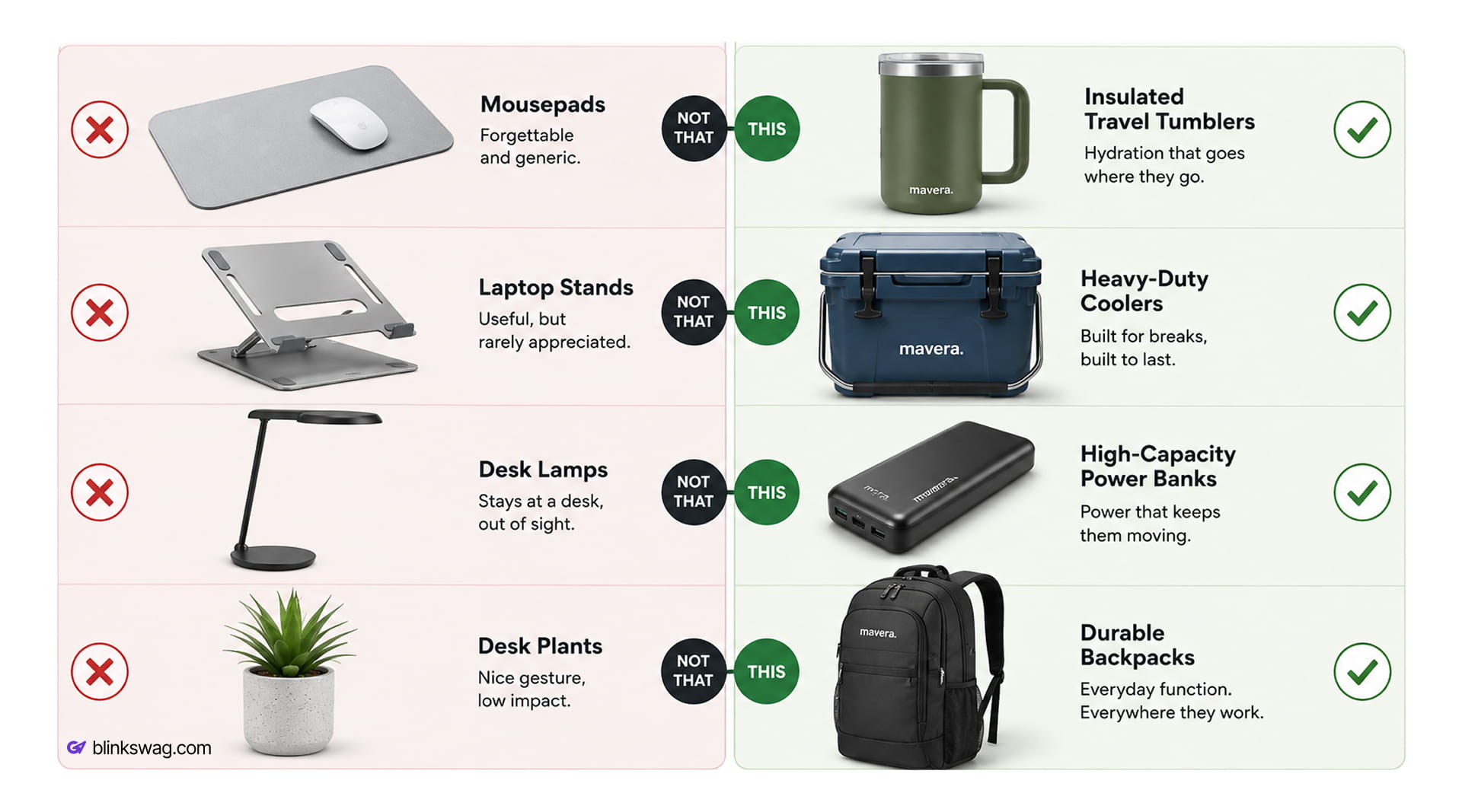
General employee gift lists often recommend:
- Laptop stands
- Mouse pads
- Desk lamps
- Desktop organizers
- Office plants
Those may be useful for office employees.
They are weaker default recommendations for someone who spends a shift:
- On a production floor
- In a warehouse
- In a vehicle
- Serving customers
- Maintaining facilities
- At a job site
- In transit
- Outdoors
The best frontline gift does not need a desk to make sense.
Labor Day gift ideas by work environment
The strongest gift category depends more on the employee’s work environment than on the Labor Day theme itself. Different operating conditions create different product, distribution, and accessibility requirements.
| Work environment | Strong gift direction | Avoid assuming |
| Warehouse/distribution | Drinkware, cooler, bag, flexible reward | Employees have desk space |
| Manufacturing | Personal drinkware, bag, apparel, choice | Job accessories are automatically safe |
| Drivers/delivery | Travel drinkware, personal bag, charging accessory | Electronics can be used while driving |
| Retail | Compact personal items, drinkware, and choice | Employees have storage |
| Hospitality | Drinkware, bag, flexible reward | Everyone works the same schedule |
| Healthcare | Break-time or off-shift merchandise, choice | Promotional items belong in clinical areas |
| Facilities/maintenance | Tools should automatically be gifts | |
| Field service | Portable merchandise, travel items | One climate fits every region |
| Multi-site workforce | Standardized gift or controlled choice | Headquarters reaches everyone |
| Night shift | Equivalent meal, gift, or reward access | Daytime events are sufficient |
Warehouse and distribution
Prioritize portability, personal utility, easy site distribution, and shift coverage.
Drivers and delivery employees
Travel drinkware, personal bags, and portable charging may be appropriate, but gift messaging should never encourage device use while driving.
Retail and hospitality
Compact merchandise or flexible rewards can be easier to manage because employees may have limited storage and rotating schedules.
Healthcare
Focus on break-time or off-shift use and avoid assuming that promotional items are appropriate in patient-care areas.
Field teams
Climate and location matter. A product suitable for one region may have little value in another.
The principle is simple:
Equivalent recognition does not require identical merchandise.
Specific BlinkSwag products for frontline appreciation
Specific products should be selected because they fit a defined application use case, not because they are expensive, rugged-looking, or prominent in a catalog.
The BlinkSwag catalog currently surfaces employee-appreciation products across drinkware, bags, apparel, technology, gifting, and other categories.
Here are several examples that can support different frontline programs:
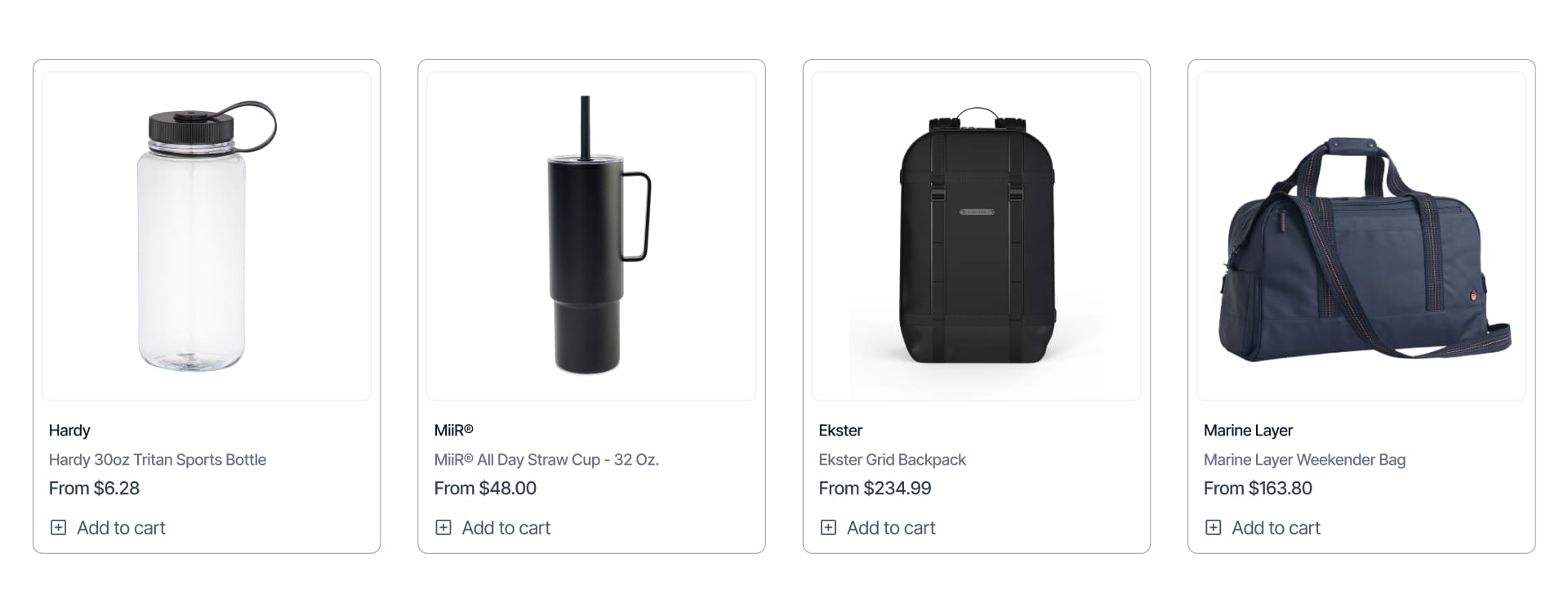
| Product | Potential Labor Day use |
| Hardy 30 oz. Tritan Sports Bottle | Broad, hydration-oriented appreciation |
| MiiR All Day Straw Cup, 32 oz. | Premium everyday drinkware |
| Ekster Grid Backpack | Select premium mobile or commuter programs |
| Marine Layer Weekender Bag | Travel and lifestyle recognition |
| Hydro Flask Wide Mouth 20 oz. Bottle | Premium personal hydration |
When planning your Labor Day campaign, always confirm product availability, decoration options, inventory, and final pricing directly on the product pages.
Everyday Hydration
The Hardy 30 oz. Tritan Sports Bottle works well for broad, hydration-oriented appreciation across larger teams, provided personal drinkware aligns with site policies.
Premium Drinkware
The MiiR All Day Straw Cup (32 oz.) and Hydro Flask Wide Mouth Bottle (20 oz.) fit smaller or higher-value programs aimed at providing fewer, better items for premium everyday personal hydration.
Travel and Lifestyle Bags
The Marine Layer Weekender Bag serves best as a personal lifestyle recognition statement rather than standard on-the-job equipment.
Premium Commuter Gear
The Ekster Grid Backpack is ideal for select premium mobile or commuter programs and milestone recognition, rather than functioning as a high-volume Labor Day giveaway.
The product rule is:
Match the product’s usefulness and value to the recognition model, rather than increasing the product count just to create a bigger gift.
What should not be presented as a Labor Day gift?
Required PPE, mandatory safety equipment, required uniforms, and other equipment employees need to perform their jobs should remain separate from Labor Day appreciation. A recognition gift should add something beyond the employer’s baseline safety and operational responsibilities.
OSHA requires employers to assess workplace hazards, select appropriate PPE where needed, and generally provide required PPE at no cost to employees, subject to specified exceptions.
This makes some common “worker gift” recommendations problematic.
Depending on the job, items such as:
- Protective gloves
- Safety glasses
- Hard hats
- Hearing protection
- Respiratory protection
- Fall-protection equipment
- Protective footwear
- Other safety equipment
may be part of the employer’s workplace-safety responsibilities rather than employee appreciation.
Avoid messaging such as:
Happy Labor Day. Here is the protective equipment you need for your shift.
Recognition should sit above the operational baseline.
The same principle applies beyond PPE.
A Labor Day appreciation gift should not substitute for:
- Compensation
- Safe working conditions
- Required training
- Required tools
- Adequate staffing
- Required uniforms
- Appropriate breaks
- Other employment obligations
The gift is recognition.
It is not a replacement for the conditions necessary to do the work.
Standard gift or employee choice?
A standardized Labor Day gift works well when employees have similar needs, environments, and work in similar roles; it becomes more valuable when roles, locations, climates, apparel sizes, or personal preferences differ. Many programs work best with a consistent recognition standard and controlled choice where fit varies.
Standardized gift works well when:
- Product utility is broad
- Employees work in similar conditions
- Sizing is not required
- Distribution is centralized
- The company wants a consistent presentation
Choice becomes stronger when:
- Apparel is involved
- Employees work across regions
- Roles differ substantially
- Work environments vary
- Personal preferences matter
- Distribution is decentralized
BlinkSwag Reward Links can support controlled reward choice by allowing organizations to set eligibility and budget while allowing recipients to make the final selection.
Decision guide
| Workforce condition | Strong starting model |
| One warehouse, similar roles | Standardized gift |
| Large manufacturing facility | Standard gift or limited choice |
| Multi-shift retail operation | Standard gift with shift-specific distribution |
| National driver workforce | Controlled recipient choice |
| Distributed field team | Choice-led recognition |
| Apparel program | Employee-selected size or style |
| International workforce | Regional selection or controlled choice |
| Premium milestone program | Curated individual choice |
Standardize where consistency creates value. Introduce choice where employee differences materially affect usefulness.
How do you recognize every shift fairly?
Shift equity means giving eligible employees comparable access to recognition regardless of whether they work days, evenings, nights, weekends, in the field, or at another operating location.
This is a BlinkSwag planning concept, not a legal or standardized HR definition.
Consider a common program:
Labor Day appreciation lunch at headquarters from noon to 2 PM.
That works for employees who are there at noon.
It may miss:
- Night shift
- Evening shift
- Drivers
- Field teams
- Weekend operations
- Regional sites
The problem is not the lunch.
The problem is assuming that day-shift access equals workforce-wide access.
Apply the equivalent-experience test
Ask:
Would the least visible eligible shift receive an appreciation experience comparable to the most visible shift?
| Day-shift experience | Possible equivalent |
| Catered lunch | Equivalent meal access for later shifts |
| Leadership visit | Shift-specific leadership recognition |
| Gift table at headquarters | Site distribution or direct fulfillment |
| Company email | Manager, mobile, or printed communication |
| Office event | Site-specific recognition moment |
| Physical gift | Same gift or comparable employee choice |
Do not require employees to:
- Visit headquarters during personal time
- Ask another employee to collect their gift
- Stay after a shift
- Use a communication system that they normally cannot access
- Discover recognition after the campaign has effectively ended
Recognition should reach the employee.
Labor Day recognition and workplace safety incentives
Companies can recognize positive safety participation, but incentive programs should not discourage employees from reporting injuries or illnesses. Recognition tied to hazard reporting, safety suggestions, training, preventive improvements, or participation in safety programs can avoid some of the problems associated with poorly designed injury-rate incentives.
OSHA states that incentive programs are not prohibited, but employers must not use them in ways that penalize or discourage workers from reporting work-related injuries or illnesses.
Positive recognition can focus on:
- Hazard identification
- Near-miss reporting
- Safety improvement suggestions
- Training participation
- Preventive-maintenance contributions
- Safety committee participation
- Process improvement
Use greater care with statements such as:
The team receives a prize if nobody reports an injury this month.
OSHA has clarified that rate-based incentive programs are not categorically prohibited, but they must not be implemented in a way that discourages reporting.
A useful principle is:
No employee should believe that reporting an injury will cost them or their teammates recognition.
Labor Day appreciation also does not need to revolve around safety statistics. Employers can recognize service, teamwork, quality, reliability, operational continuity, and other genuine contributions.
Are meals a good way to show appreciation for Labor Day?
Meals can work well for frontline appreciation when access is planned around the workforce’s actual shifts and locations. A catered lunch is only available to employees who cannot attend the daytime meal and have a comparable waiver.
Before planning food, confirm:
- Shift schedules
- Locations
- Mobile employees
- Dietary requirements
- Allergies
- Break access
- Food-storage limitations
- Alternatives for employees who cannot participate
A more equitable structure might be:
day shift → meal service
evening shift → equivalent meal access
night shift → equivalent meal access
field employees → accessible alternative
Food should support the appreciation message, not replace it.
A short manager or leadership acknowledgment explaining what the team contributed can make the experience substantially more meaningful than a meal appearing without context.
Multi-location and distributed frontline recognition
The fulfillment model should follow where employees actually work. Centralized distribution can work at one facility, while regional sites, drivers, field teams, remote operational employees, and international recipients may require site allocation, individual fulfillment, or recipient-choice workflows.
| Workforce model | Distribution approach |
| Single facility | Central on-site distribution |
| Multiple facilities | Site-level allocation |
| Retail branches | Location-level distribution |
| Drivers | Route-compatible or direct delivery |
| Field teams | Direct fulfillment or choice |
| Remote operational employees | Individual fulfillment |
| International teams | Destination-specific planning |
| Mixed workforce | Hybrid model |
For multi-site programs, build a simple allocation model:
location → employee count → shift count → quantity → distribution owner
BlinkSwag Swag Fulfillment supports merchandise storage, packing, order management, and distribution, while Global Shipping can support international merchandise programs.
The goal is not to force the same SKU into every country or facility.
Aim for consistent:
- Recognition intent
- Product quality
- Approximate value
- Timing
- Employee access
- Messaging
That can create comparable recognition even when the merchandise differs.
How should companies budget for Labor Day appreciation?
The most useful budgeting number is the total delivered program cost, not the merchandise price alone. Product cost is only one component of recognition when decoration, packaging, storage, fulfillment, shipping, site distribution, replacements, meals, or international delivery are involved.
Avoid arbitrary statements such as:
Every employer should spend $50 per employee.
A meaningful budget depends on:
- Workforce size
- Gift model
- Product selection
- Number of sites
- Shift structure
- Distribution method
- Individual delivery
- International destinations
- Meal or event costs
Planning formula
Total Labor Day Program Cost = Gifts + Decoration + Packaging + Kitting + Storage + Fulfillment + Shipping + Applicable Taxes or Duties + Replacements + Experience Costs
This is a planning formula, not a standardized accounting measure or a BlinkSwag quote.
Major cost drivers
| Program | Main cost drivers |
| Single-site gifting | Products and decoration |
| Multi-shift campaign | Distribution coordination |
| Multi-location workforce | Allocation and shipping |
| Apparel | Sizing, inventory, exchanges |
| Recipient choice | Reward value and redemption |
| Direct-to-home | Individual fulfillment |
| International | Destination and customs |
| Meal program | Shift and location coverage |
| Premium recognition | Product quality and smaller quantities |
The purpose of budgeting is not to find a universal “correct” spending.
It is the spending of spending to ensure the entire recognition experience can actually be delivered.
How should frontline Labor Day appreciation be measured?
A useful recognition scorecard measures whether eligible employees across shifts and locations actually received the intended experience. Ordering merchandise is not sufficient evidence that the recognition program worked.
The following are BlinkSwag planning metrics rather than standardized HR measures.
| Metric | Calculation |
| Recognition coverage | Employees reached ÷ eligible employees |
| Shift recognition coverage | Eligible workers reached across shifts ÷ eligible workers |
| Location coverage | Participating locations ÷ eligible locations |
| Successful delivery rate | Successful deliveries ÷ shipments |
| Reward redemption rate | Rewards redeemed ÷ rewards issued |
| Replacement rate | Replacement shipments ÷ original shipments |
| Unclaimed reward rate | Unclaimed rewards ÷ rewards issued |
| Cost per completed recognition | Total program cost ÷ employees successfully reached |
Measure experience as well as logistics
A campaign can achieve 100% shipment completion and still fail recognition.
For example:
- Night-shift gifts arrive late
- A secondary site receives leftovers
- Field employees cannot access the reward system
- Managers never explain why the team is being recognized
Ask employees:
- Did you receive the recognition?
- Was the timing appropriate?
- Was the gift useful?
- Was redemption easy?
- Was your shift or site included fairly?
- Would another reward category have been more useful?
Use those answers to improve the next campaign.
Labor Day Frontline Appreciation Checklist
Before launching the program, confirm:
Workforce
- Eligibility is defined.
- All shifts and locations are mapped.
- Mobile and field employees have a recognition path.
- The reason for recognition is clear.
Gift strategy
- Products are useful for the employee population.
- Required PPE and mandatory work equipment are excluded from the recognition layer.
- Workplace restrictions have been considered.
- Apparel sizing is confirmed where applicable.
- Recipient choice is available where one product will not fit everyone.
Equity and distribution
- Day, evening, overnight, and weekend teams have comparable access.
- Site-level quantities and owners are confirmed.
- Meals or events have alternatives for employees who cannot attend.
- Direct fulfillment is planned where local distribution will not work.
Measurement
- Recognition coverage will be tracked.
- Shift and location coverage will be reviewed.
- Failed deliveries and replacements will be recorded.
- Employee feedback will be collected.
Frequently Asked Questions
What are good Labor Day gifts for warehouse employees?
Useful options can include personal drinkware, coolers, bags, apparel, or flexible rewards. Employers should confirm workplace rules before assuming a personal product can be used in an operational area.
How do you recognize night-shift employees on Labor Day?
Design the program around the night shift rather than expecting night employees to participate in a daytime event. Comparable meals, gifts, leadership recognition, or accessible reward choices can provide a more equitable experience.
Can required PPE count as an employee appreciation gift?
Required PPE should remain separate from the Labor Day recognition layer. OSHA requires employers to assess workplace hazards and provide appropriate PPE where necessary, with employers responsible for payment for most required PPE, subject to specific exceptions.
Are gift cards or employee-choice rewards appropriate for frontline teams?
Yes, particularly when employees work across different locations, climates, shifts, or roles. Choice can challenge the assumption that a single physical product will be equally useful to everyone.
How do you recognize field employees who cannot attend a company event?
Use direct delivery, local distribution, mobile-accessible rewards, manager-delivered recognition, or another comparable experience that does not require employees to travel to headquarters.
How should companies handle Labor Day gifts across multiple locations?
Map eligible employees by location and shift, assign quantities or reward access to each site, designate a local distribution owner, and use direct fulfillment where centralized delivery would create gaps.
Final Recommendation
Labor Day employee appreciation should meet frontline and operational employees where they actually work. Recognize the contribution specifically, include every eligible shift and location, choose gifts with genuine personal utility, provide choice when employee needs differ, and keep recognition separate from required equipment and workplace safety obligations.
Use the SHIFT framework:
See the work → Honor the contribution → Include every shift → Fit the gift → Track fair delivery
Then build the program around:
frontline team → contribution → shift/location → recognition message → gift or choice → distribution → measurement
The most useful question is not simply:
What should we give employees for Labor Day?
It is:
How do we make sure the people doing the work actually feel recognized?
Planning Labor Day appreciation across multiple shifts or locations?
Start with:
employee count + locations + shift structure + work environments + recognition model + distribution requirements
BlinkSwag can support the physical merchandise, Reward Links, Swag Fulfillment, and Global Shipping layers needed to coordinate employee appreciation across distributed teams.
Editorial methodology and sources
This guide combines U.S. Department of Labor and OSHA guidance, independent workplace-recognition research, and BlinkSwag’s merchandise and fulfillment capabilities. Product suitability should always be confirmed against the employee population, work environment, site rules, and specific program requirements.