Employee recognition has a measurable relationship with retention when it is frequent, authentic, equitable, and personalized. Gallup and Workhuman tracked nearly 3,500 employees from 2022 to 2024 and found that well-recognized employees were 45% less likely to leave their organization after two years. The finding describes an association, not a guaranteed reduction in turnover.
Recognition and corporate gifting are connected, but they are not interchangeable.
Employee recognition communicates what a person contributed, why the contribution mattered, and how it supported a team, customer, value, or business objective. A gift, reward, experience, or branded product can give that recognition tangible value.
A corporate gift without a recognition context may be received as merchandise. The same gift, accompanied by a specific and sincere explanation, can become a reminder of the employee’s work and its impact.
This guide brings together the latest accessible employee recognition, rewards, employee gifting, promotional merchandise, and workplace data available in 2026. Each statistic is kept within its original population, geography, and research design.
Key employee recognition and corporate gifting statistics
| Statistic | What the evidence actually shows |
| Well-recognized employees were 45% less likely to leave after two years. | Gallup and Workhuman followed nearly 3,500 employees over 2022-2024. [ |
| Employees who received recognition that satisfied at least 4 quality pillars were 65% less likely to be seeking another job. | The comparison was with employees receiving lower-quality recognition. |
| Global employee engagement fell to 20% in 2025. | Gallup’s 2026 report included 141,444 employed respondents in its 2025 data. |
| Low engagement costs the global economy an estimated $10 trillion in lost productivity. | Gallup estimated the loss at approximately 9% of global GDP. |
| Employees who received manager feedback and recognition at least weekly reported 61% engagement, compared with 38% among those who received weekly feedback but less frequent recognition. | The finding separates recognition frequency from feedback frequency. |
| Employee satisfaction with recognition was 58% in WorldatWork’s 2026 State of Rewards study. | Employees dissatisfied with recognition were approximately 1.5 times more likely to report low intent to stay. |
| Employees with a very positive reward experience were 19 times more likely to recommend their organization as a great workplace. | Workhuman surveyed more than 2,500 workers in five countries. |
| Frequent reward redeemers reported 34% higher belonging than employees who never redeemed rewards. | The study defined frequent redemption as two or more redemptions per year. |
| Employees were 7 times more likely to stay another year when recognition helped build workplace relationships. | O.C. Tanner surveyed 4,243 people across ten countries. |
| Human-centered recognition for dispersed teams was associated with 44 times higher odds of great work. | This is an odds relationship, not a claim that employee output increased 44 times. |
| 39% of employees identified gift-card options as part of an enjoyable reward selection experience. | Only 10% selected the company logo merchandise as an important selection feature. |
| North American non-cash reward programs averaged $866 per participant, while European programs averaged €940. | IRF’s 2026 outlook covered employee, sales, and channel programs rather than just employee gifting. |
| 52.9% of surveyed UK organizations spent £50-£200 per employee annually on gifts. | Huggg surveyed 85 UK HR professionals, so this is a regional benchmark. |
| U.S. promotional-product distributor sales reached $27.1 billion in 2025. | The market includes employee gifting, marketing, events, business gifts, and other uses. |
| Sustainable products generated approximately $3.8 billion, or 14% of U.S. promotional-product sales. | The category measures distributor sales, not the verified environmental impact of every item. |
| 83% of surveyed U.S. consumers said receiving a promotional product made them feel appreciated. | The study surveyed consumers generally, not employees exclusively. |
What are employee recognition and corporate gifting?

Employee recognition acknowledges a person’s contribution, behavior, progress, or achievement. Corporate gifting provides a physical product, a digital reward, a gift card, an experience, or another item of value. Recognition is the message; the gift is a medium that can extend that message when it is relevant to the employee, contribution, and occasion.
For this article:
- Employee recognition explains what the employee did and why it was valued.
- Employee rewards add financial, tangible, symbolic, or experiential value.
- Employee gifting covers gifts for appreciation, onboarding, milestones, holidays, achievements, and other employment-related occasions.
- Corporate gifting is a broader category that can include employees, customers, partners, speakers, prospects, and other stakeholders.
- Branded merchandise includes products carrying an organization’s name, identity, design, message, or visual mark.
Workhuman similarly distinguish recognition from rewards. Its research describes recognition as a social signal about an employee’s contribution and a reward as the material expression intended to reinforce that appreciation.
BlinkSwag Recognition Message Framework
A recognition message should answer four questions:
- What did the employee do?
- Who benefited from the contribution?
- Why did the work matter?
- Which company value, team objective, or business result did it support?
A gift should be selected only after these questions are answered.
Organizations building a broader program can use BlinkSwag’s complete guide to employee recognition with swag to connect recognition occasions with suitable merchandise and fulfillment formats.
Employee engagement statistics
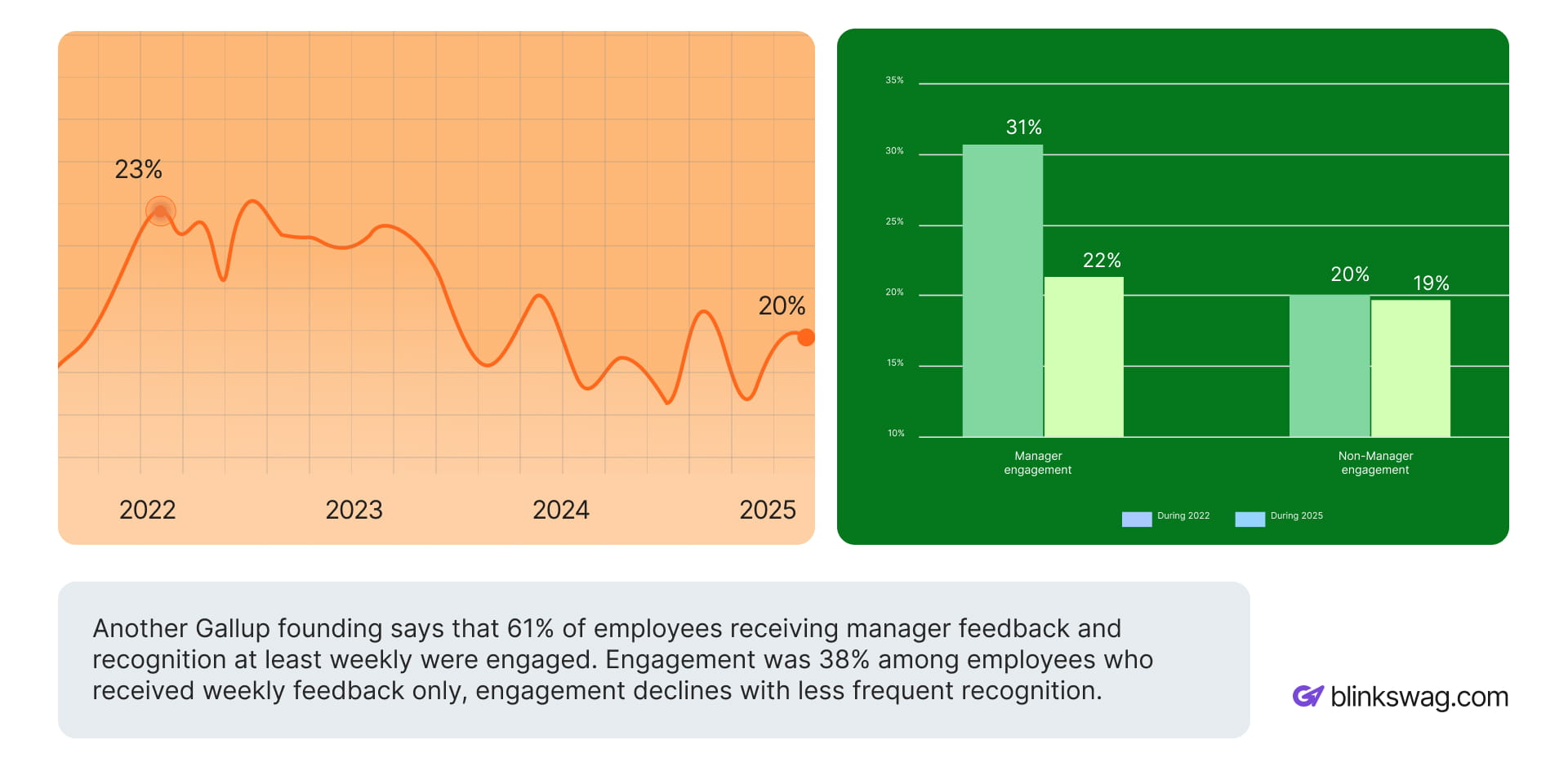
Employee engagement remained weak entering 2026. Gallup found that only 20% of employees worldwide were engaged in 2025, while manager engagement fell to 22%. Recognition cannot resolve every cause of disengagement, but frequent and specific recognition can strengthen an employee’s connection to the work, manager, team, and organization.
Gallup defines employee engagement as the psychological attachment employees have to their work, team, and employer. Global engagement declined from 23% in 2022 and 2023 to 20% in 2025. Gallup estimated that low engagement costs the global economy approximately $10 trillion in lost productivity.
Manager engagement declined from 31% in 2022 to 22% in 2025, while non-manager engagement was 19%.
Recognition programs should therefore operate in more than one direction:
- Manager to employee
- Peer to peer
- Executive to employee
- Employee to manager
- Customer to employee
- Cross-functional team recognition
Gallup and Workhuman found that 61% of employees receiving manager feedback and recognition at least weekly were engaged. Engagement was 38% among employees who received weekly feedback, but lower among those who received less frequent recognition.
Feedback helps employees understand performance. Recognition tells employees which contributions are visible and valued.
Employee recognition and retention statistics
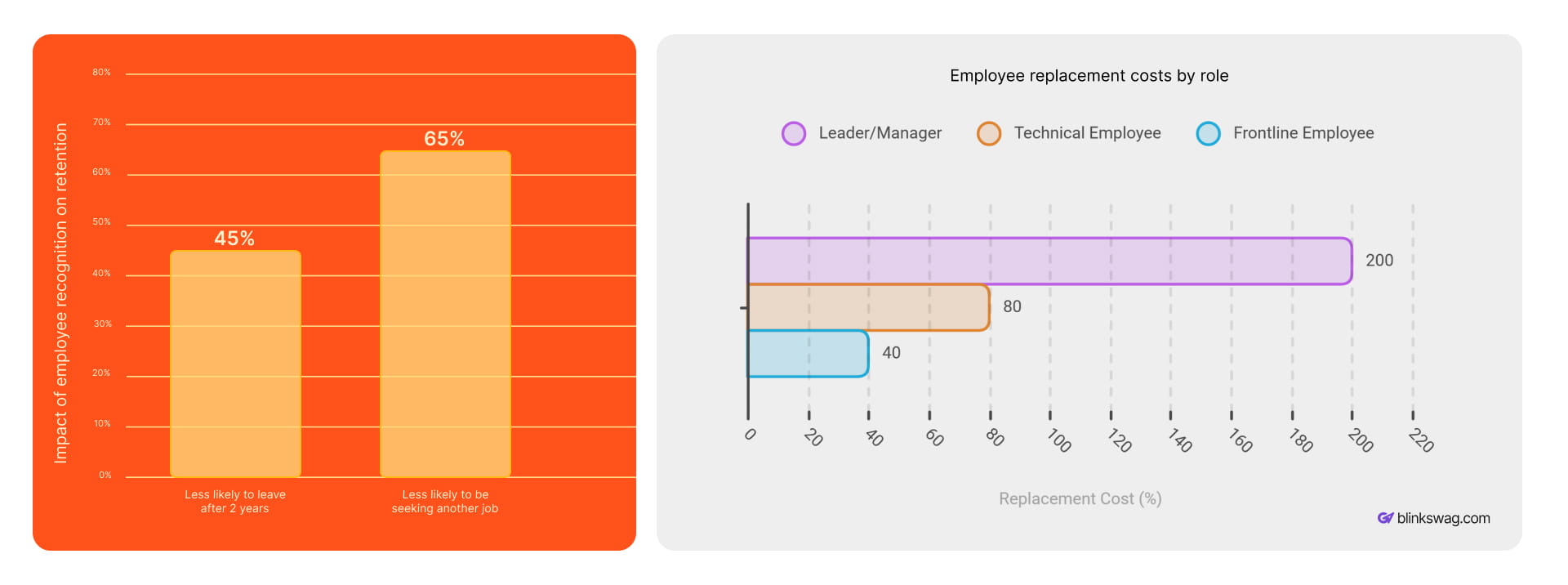
High-quality employee recognition has one of the clearest relationships with retention in the available evidence. Gallup and Workhuman found that well-recognized employees were 45% less likely to leave after two years, while employees receiving recognition that met four quality pillars were 65% less likely to be seeking another job.
The five recognition pillars assessed by Gallup and Workhuman were:
- Fulfilling
- Authentic
- Equitable
- Embedded in organizational culture
- Personalized
The research followed employees over time rather than relying only on a single survey about future intentions. That longitudinal design makes the 45% finding more useful than many widely repeated employee-recognition statistics.
The finding should not be rewritten as “recognition reduces turnover by 45%.” It shows that well-recognized employees in the study were 45% less likely to have changed organizations.
Gallup also estimates that replacing a leader or manager can cost approximately 200% of salary, replacing an employee in a technical role can cost 80%, and replacing a frontline employee can cost 40%.
WorldatWork’s 2026 State of Rewards provides additional evidence. Recognition satisfaction was 58%, and employees who were dissatisfied with recognition were approximately 1.5 times more likely to report low intent to stay. The study received 1,316 full responses between January and February 2026.
Recognition is not the only retention factor. Compensation, workload, management quality, career development, stability, flexibility, and job design also influence employees’ decisions to stay.
Employee rewards and gifting experience statistics
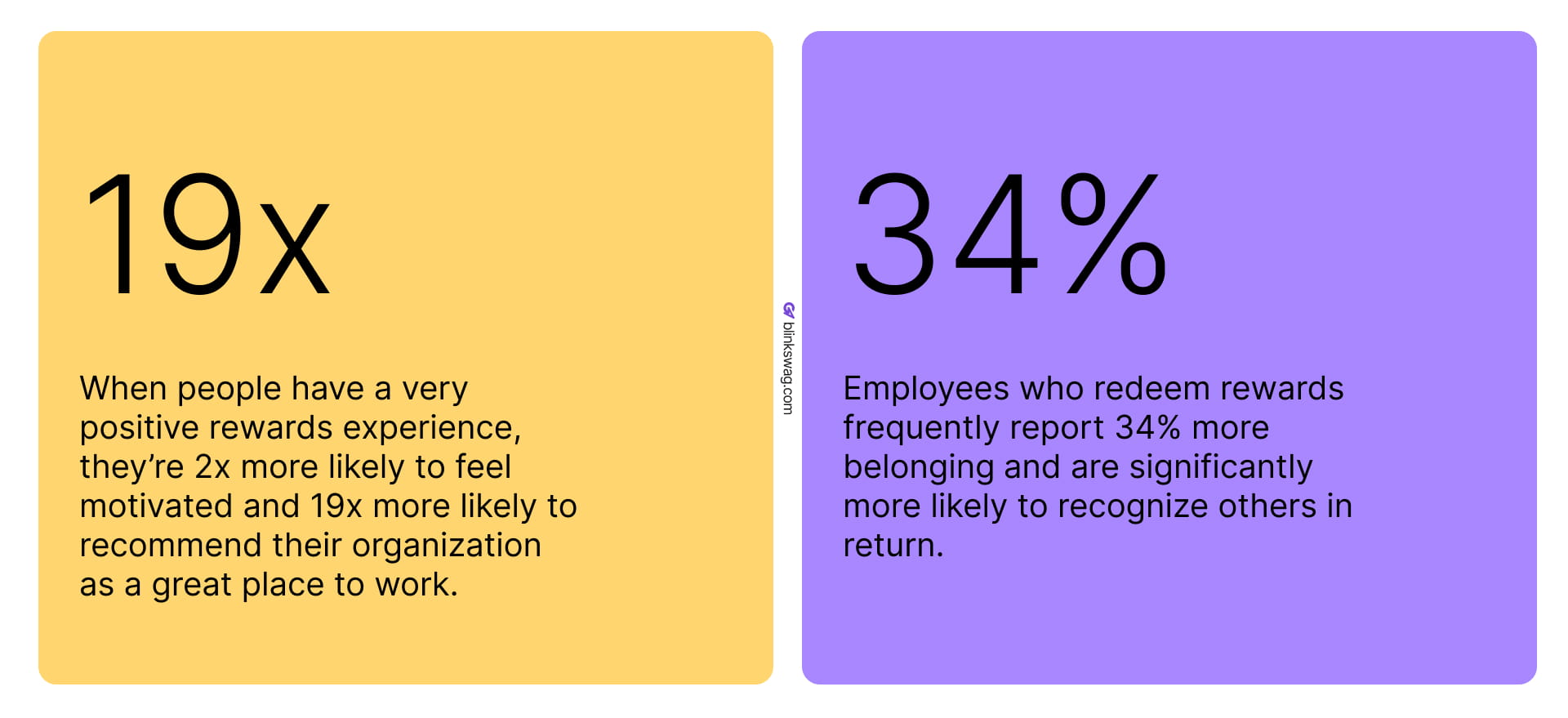
Employee reward outcomes depend on the overall experience, not just the product or the monetary amount. Workhuman found that employees with very positive reward experiences were 19 times more likely to recommend their organization, while frequent reward redeemers reported 34% higher belonging than employees who never redeemed rewards.
Workhuman surveyed more than 2,500 workers in the United States, the United Kingdom, Ireland, Canada, and Australia. It identified five characteristics of meaningful rewards:
- Tangible
- Connected
- Memorable
- Universal
- Personalized
Rewards with redeemable monetary value were associated with 21% higher engagement and 28% higher belonging.
The reward experience may lose value when:
- Employees cannot understand what points are worth.
- The product selection is irrelevant.
- The redemption process is difficult.
- Shipping costs appear unexpectedly.
- Regional options are limited.
- The reward arrives without an explanation.
- The employee would have preferred private recognition.
Workhuman found that 44% of employees valued a simple, mobile-friendly redemption process, 40% valued clear guidance on what their points could purchase, and 31% valued a shopping experience comparable with established online stores.
BlinkSwag’s Reward Points platform can support controlled employee choice while preserving program budgets, branding, and reporting requirements.
Recognition frequency and program adoption statistics
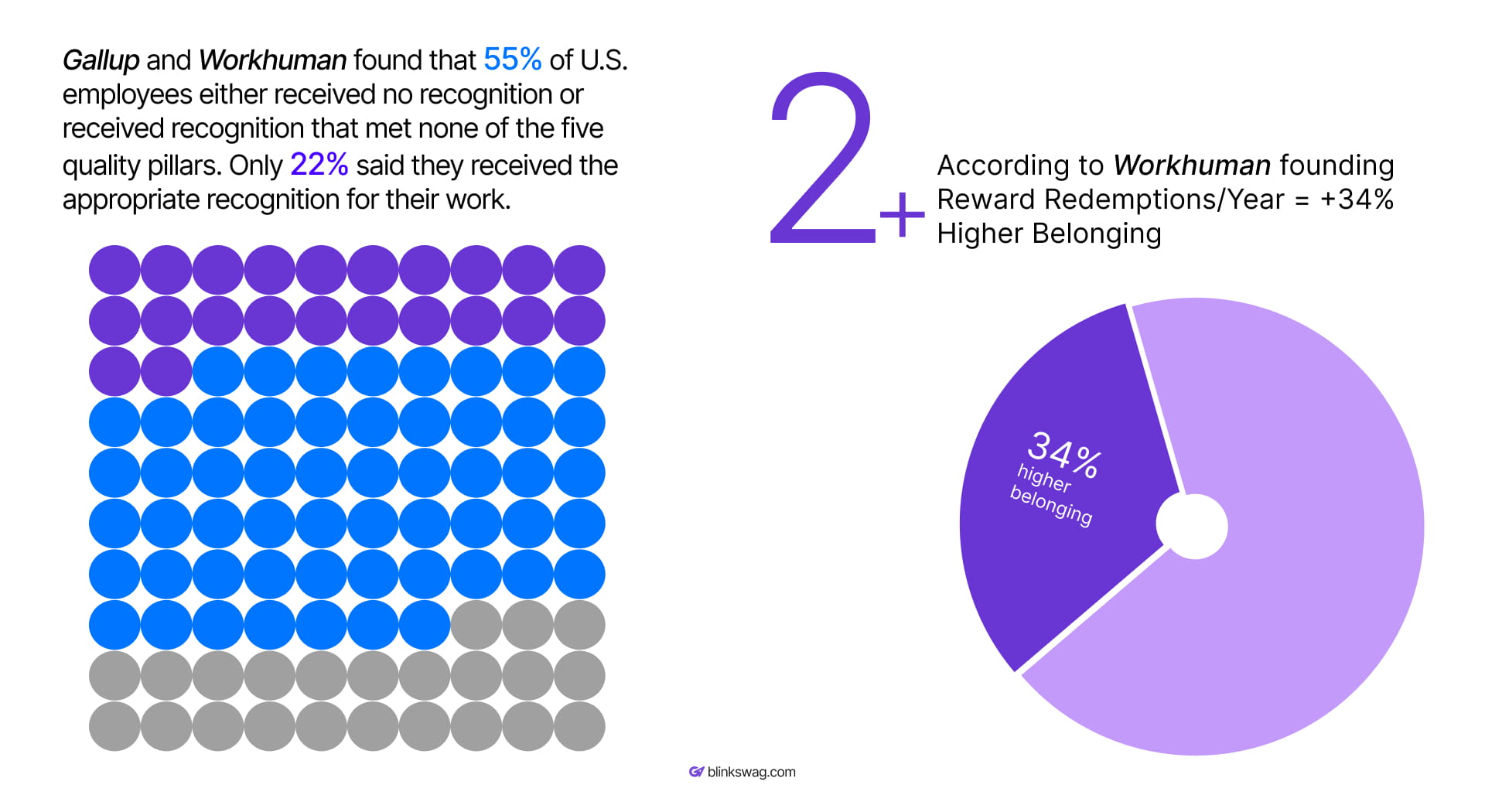
No current primary study provides a reliable, universal estimate of the percentage of employers operating formal recognition programs in 2026. Available studies define programs differently and often rely on older or vendor-sponsored samples. More useful current evidence shows that only 22% of employees receive the right amount of recognition, while recognition quality and frequency remain inconsistent.
Gallup and Workhuman found that 55% of U.S. employees either received no recognition or received recognition that met none of the five quality pillars. Only 22% said they received the appropriate recognition for their work.
This evidence suggests that the presence of a recognition initiative is a weak indicator of success. A company may have a program, while employees still experience recognition as infrequent, generic, unfair, or disconnected from their work.
Recognition should also occur more frequently than expensive gifting.
| Recognition level | Suggested use |
| Everyday appreciation | A specific verbal or written acknowledgment when meaningful work occurs |
| Peer recognition | Ongoing colleague-to-colleague acknowledgment |
| Manager recognition | Weekly or as contributions occur |
| Project recognition | At important milestones or completion |
| Service recognition | At meaningful tenure points |
| Seasonal appreciation | At planned company-wide occasions |
| Exceptional achievement | When a result warrants a proportionate reward |
Workhuman found that employees who redeemed rewards 2 or more times per year reported 34% higher belonging than those who never redeemed. This is an observed association, not proof that two redemptions are an ideal universal threshold.
Personalization and employee gift preference statistics
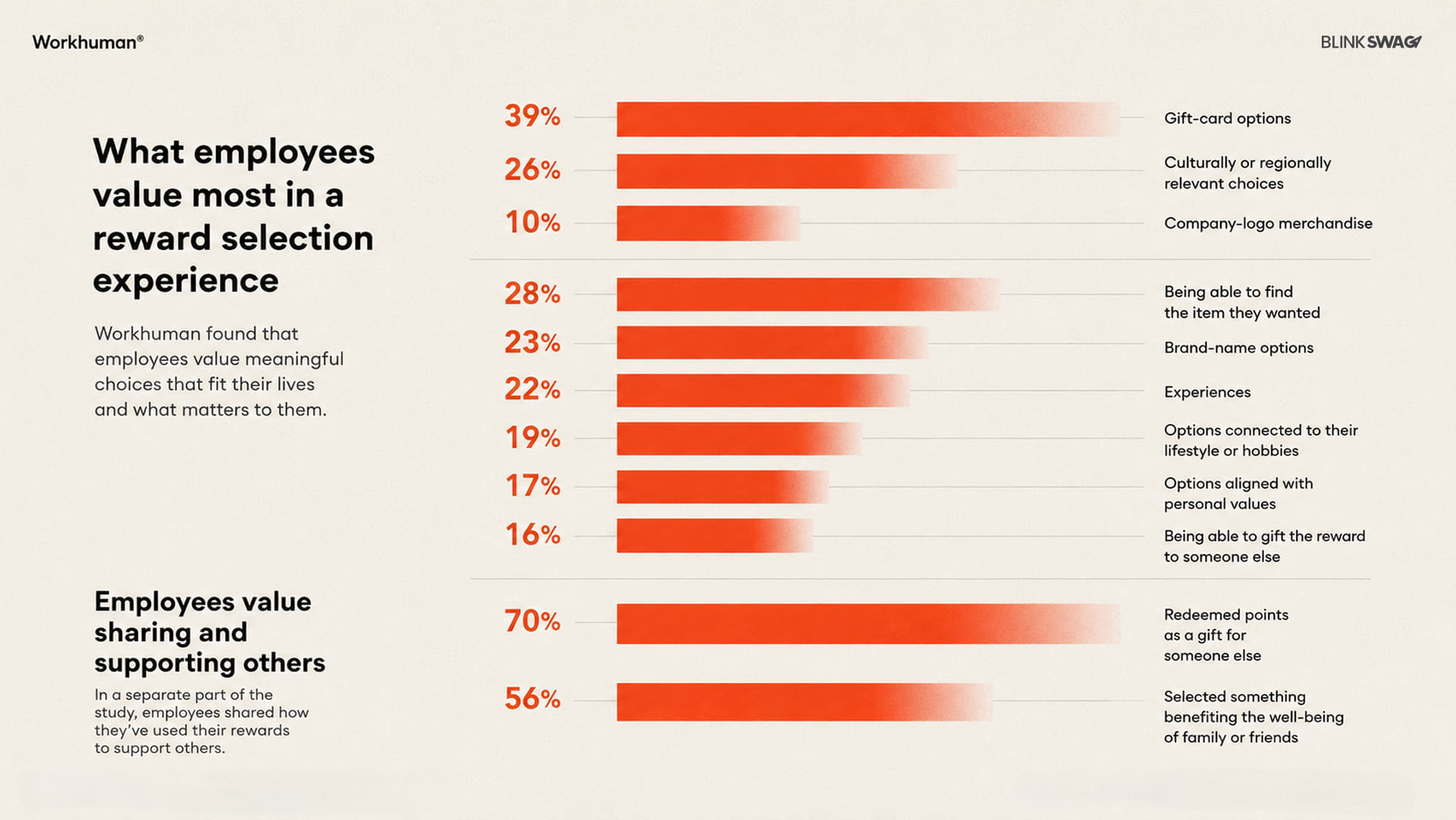
Personalized employee gifting means matching rewards to the recipient’s needs, culture, region, values, or interests. Workhuman found that 39% of employees valued gift-card options in an enjoyable reward selection experience, while 26% valued culturally or regionally relevant choices, and only 10% selected company-logo merchandise as an important feature.
The findings do not mean employees reject branded products. They show that a company logo, by itself, is a relatively weak reason for choosing a reward.
Product quality, usefulness, brand familiarity, regional relevance, and personal choice may matter more.
Workhuman also found:
- 28% valued being able to find the item they wanted.
- 23% valued brand-name options.
- 22% valued experiences.
- 19% valued options connected to their lifestyle or hobbies.
- 17% valued options aligned with personal values.
- 16% valued being able to gift the reward to someone else.
In a separate part of the study, 70% of employees had redeemed points as a gift for someone else, while 56% had selected something benefiting the well-being of family or friends.
A useful preference survey can collect:
- Public or private recognition preference
- Gift card, merchandise, experience, or charitable option preference
- Apparel sizing
- Product categories of interest
- Dietary restrictions
- Accessibility requirements
- Cultural considerations
- Country and regional availability
- Delivery preferences
- Products the employee does not want
Organizations comparing reward formats can review BlinkSwag’s guide to gift cards and cash rewards for employee recognition.
Employee gifting budget statistics
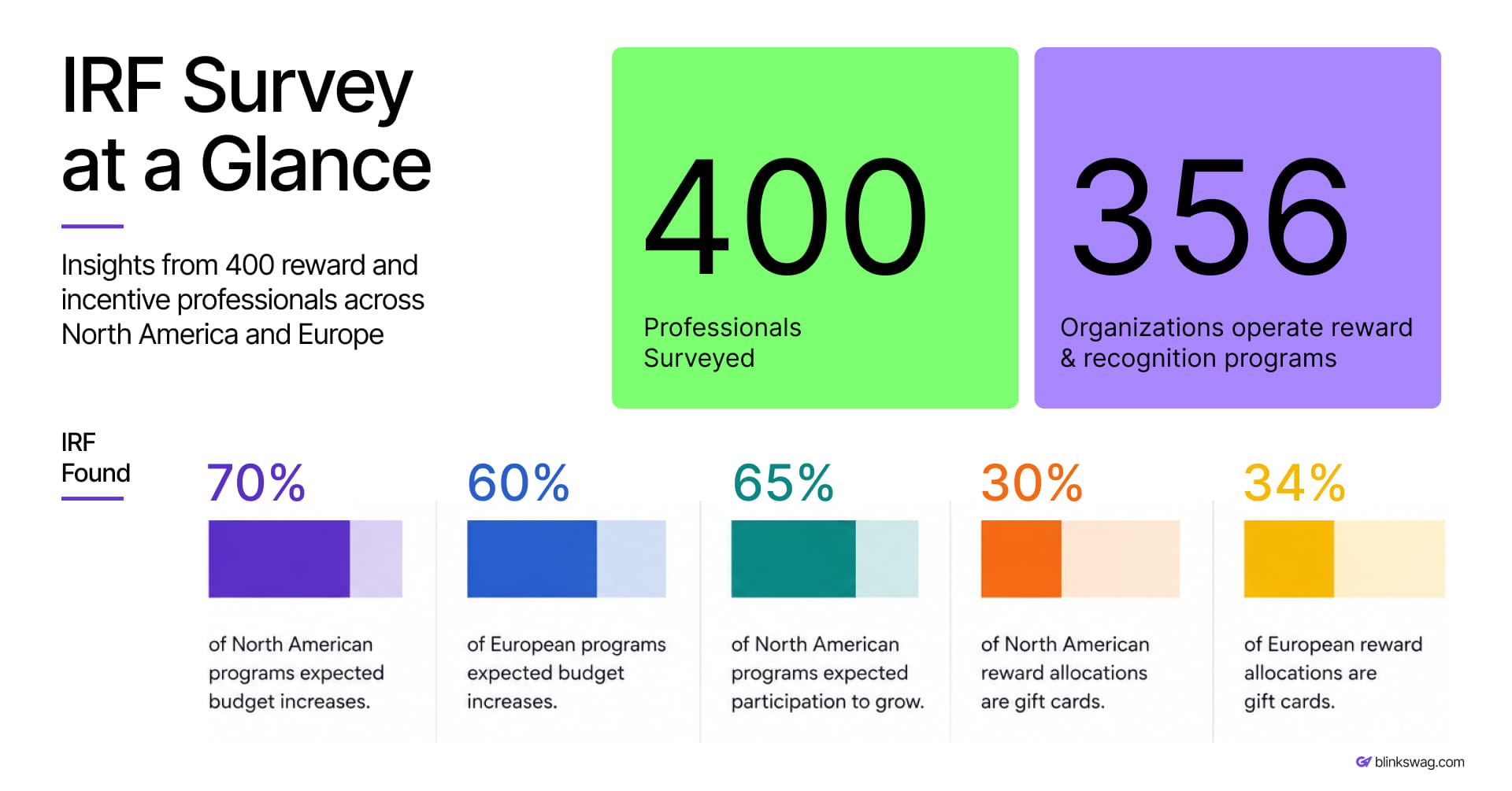
There is no universal employee-gifting budget. IRF’s 2026 outlook reported average annual non-cash reward spending of $866 per participant in North America and €940 in Europe across employee, sales, and channel programs. A separate UK survey found that 52.9% of organizations spent £50 to £200 per employee annually.
IRF collected responses from 400 reward and incentive professionals in North America and Europe. Of the represented organizations, 356 operated employee reward and recognition programs.
The $866 and €940 figures cover multiple program types. They should not be presented as recommended employee-gift budgets.
IRF also found:
- Just over 70% of North American programs expected budget increases.
- Approximately 60% of European programs expected increases.
- Sixty-five percent of North American programs expected participation to grow.
- Gift cards represented 30% of North American and 34% of European reward allocations.
Huggg’s smaller UK survey of 85 HR professionals found that 52.9% spent between £50 and £200 per employee annually, while 23.5% spent less than £50. Budget constraints were the most frequently reported gifting challenge.
A budget should account for more than product cost:
| Cost category | Planning requirement |
| Product | Item or reward value |
| Decoration | Embroidery, printing, engraving, or personalization |
| Packaging | Boxes, inserts, cards, and protective materials |
| Storage | Inventory and warehousing |
| Fulfillment | Picking, packing, and administration |
| Shipping | Domestic and international delivery |
| Duties and taxes | Cross-border expenses |
| Technology | Platform, integration, and reporting costs |
| Contingency | Replacements, address errors, and rush orders |
BlinkSwag’s employee onboarding platform can support budgeting for new-hire kits, storage, automation, and global delivery.
Remote and distributed employee recognition statistics
Remote employee recognition must make contributions visible without creating unequal access or unwanted public attention. O.C. Tanner reported 44 times higher odds of great work among dispersed teams receiving human-centered recognition. The finding is an odds relationship and does not mean that recognition increased employee output by 44 times.
O.C. Tanner also found that employees were seven times more likely to stay another year when recognition strengthened workplace relationships.
Distributed programs require additional operational controls:
- Private address collection
- Regional product availability
- International shipping
- Customs and duties
- Local language support
- Employee sizing
- Cultural gifting considerations
- Time-zone coordination
- Delivery tracking
- Failed-delivery management
A remote recognition sequence should connect the message with the delivery:
- The contribution is identified.
- The manager, colleague, or executive delivers the recognition.
- The employee receives an appropriate reward choice.
- Shipping information is collected privately.
- Delivery is tracked.
- The employee can provide feedback without being expected to praise the gift publicly.
BlinkSwag’s guides to remote onboarding kits and hybrid work swag kits provide additional planning guidance.
Corporate gifting and branded merchandise market statistics
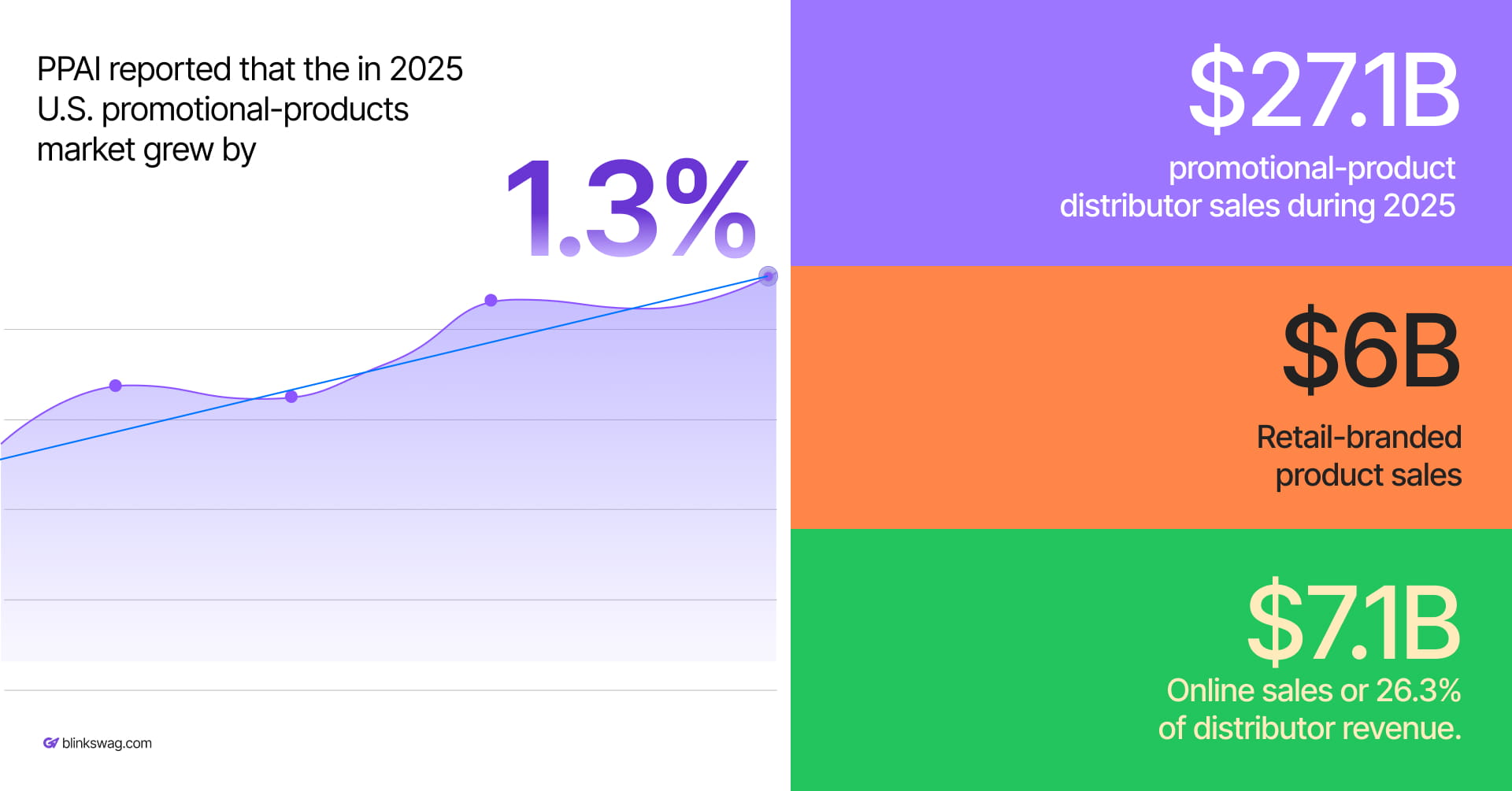
No single market-size estimate accurately reflects employee corporate gifting, as published estimates often combine employee rewards, customer gifts, gift cards, promotional merchandise, incentives, and event gifting. PPAI’s most auditable U.S. branded-merchandise benchmark is $27.1 billion in promotional-product distributor sales during 2025.
PPAI reported that the U.S. promotional-products market grew by 1.3% in 2025. Retail-branded product sales totaled an estimated $6 billion, while online sales reached $7.1 billion, representing 26.3% of distributor sales.
These figures include more than employee gifting. Promotional products may support:
- Employee recognition
- Customer appreciation
- Marketing campaigns
- Events
- Recruitment
- Sales incentives
- Awards
- Dealer and channel programs
PPAI’s consumer research found that 83% of more than 5,000 surveyed U.S. consumers felt appreciated after receiving a promotional product. 65% said they were very likely to keep a branded product for at least 6 months.
Seventy-three percent said they used branded bottles or tumblers daily. Durability, design, and material quality influenced whether products were retained.
These consumer findings are useful for product selection, but they do not prove that merchandise improves employee engagement or retention.
10. Sustainable corporate gifting statistics
Sustainable corporate gifting is now a standard promotional-product category rather than a small specialty segment. PPAI estimated that sustainable products accounted for $3.8 billion in sales and 14% of U.S. promotional-product distributor sales in 2025. The category total does not reflect the environmental performance of every included product.
Sustainability claims should be evaluated through evidence rather than product labels alone.
Procurement questions should include:
- What percentage of the product contains recycled material?
- Is the certification independently verifiable?
- Is the item durable?
- Is the employee likely to use it?
- How much packaging is required?
- Where was the item manufactured?
- Can it be repaired or reused?
- What happens at the end of its useful life?
PPAI found that 49% of surveyed consumers said a brand’s environmental commitment influenced perceived trustworthiness, while 68% identified recycled or reusable materials as their leading sustainability preference.
A durable item that is repeatedly used may be a more responsible choice than a product carrying a sustainability label but offering little practical value.
11. Recognition technology and company-store statistics
Recognition technology improves access only when employees and managers use it consistently. O.C. Tanner found that nearly 40% of employees did not regularly use their available recognition tools. In contrast, employees were twice as likely to use a platform when they observed colleagues participating consistently. Social adoption matters alongside technical availability.
A recognition platform can support:
- Peer recognition
- Manager awards
- Reward catalogs
- Budget controls
- Employee choice
- Address collection
- Automated milestones
- Inventory management
- Global fulfillment
- Reporting
- Approval workflows
- HR-system integrations
Technology should reduce administrative work without replacing the human judgment required to explain why someone deserves recognition.
Workhuman found that 44% of employees valued a mobile-friendly redemption process and 40% wanted clear guidance about the purchasing value of their points.
A company store should therefore be evaluated through operational and employee-experience questions.
| Operational question | Employee-experience question |
| Can the department control budgets? | Does the employee understand why they were recognized? |
| Can addresses be collected privately? | Can the employee choose private or public acknowledgment? |
| Can regional inventory be managed? | Are locally relevant choices available? |
| Can milestones be automated? | Does the message remain personal and specific? |
| Can redemption be tracked? | Is the process accessible and simple? |
| Can reporting be exported? | Is recognition distributed fairly? |
BlinkSwag’s guide to swag stores for HR teams explains how stores can support employee choice, distribution, and inventory control.
12. How to measure recognition and corporate gifting ROI
Recognition and gifting ROI should be measured through participation, equity, employee experience, operational performance, and workforce outcomes. Gift volume does not prove that employees felt valued, while a change in turnover cannot automatically be attributed to recognition. Measurement should connect program activity with employee feedback while preserving causal limits.
Huggg’s 2026 survey illustrates the measurement gap. Among 85 UK HR professionals, 65.9% believed gifting positively affected retention, but only 2.1% had measured a retention improvement, and 1.6% formally tracked gifting ROI.
The sample is small and UK-specific. These figures should not be presented as global employer benchmarks.
Participation metrics
- Percentage of employees receiving recognition
- Percentage giving recognition
- Manager participation
- Peer participation
- Reward redemption
- Repeat program use
Equity metrics
- Recognition by the department
- Recognition by location
- Recognition by employment type
- Recognition by role level
- Recognition by work arrangement
- Distribution of reward values
- Concentration among repeat recipients
Employee-experience metrics
- Recognition authenticity
- Message specificity
- Reward relevance
- Choice satisfaction
- Redemption ease
- Delivery satisfaction
- Public or private preference match
Operational metrics
- Average fulfillment time
- First-attempt delivery success
- Cost per delivered reward
- Shipping cost by region
- Return and replacement rate
- Unredeemed value
- HR administration time
Workforce outcomes
- Engagement
- Belonging
- Employee advocacy
- Intent to stay
- Voluntary turnover
- Manager effectiveness
- Absence
- Qualitative feedback
Recognition is only one part of the employee experience. Compensation, career opportunity, leadership, workload, flexibility, job design, and organizational stability should remain part of the analysis.
Employee recognition and gifting by occasion
| Occasion | Recognition objective | Suitable approach | Common failure |
| Onboarding | Establish belonging and preparedness | Role-relevant welcome kit with a personal message | Treating merchandise as a substitute for onboarding |
| Project completion | Connect the effort to an outcome | Team experience, gift choice, or project-related item | Recognizing only visible contributors |
| Work anniversary | Acknowledge contribution over time | Personal message, symbolic item, and choice | Sending the same generic item at every milestone |
| Promotion | Recognize growth and responsibility | Personalized award or premium work-related gift | Focusing only on the new title |
| Performance achievement | Reinforce a result or behavior | Reward proportionate to the contribution | Making recognition feel like delayed compensation |
| Employee referral | Thank the employee for supporting recruitment | Defined reward, points, or gift | Delayed or inconsistent fulfillment |
| Remote appreciation | Improve visibility and connection | Delivered a reward plus a recognition message | Sending an unexplained package |
| Holiday gifting | Express broad appreciation | Inclusive, choice-based program | Assuming every employee celebrates the same occasion |
| Retirement | Honor career history and relationships | Story-based keepsake and colleague messages | Reducing a career to a standard plaque |
| Customer praise | Connect external feedback to employee impact | Share the message and add internal recognition | Keeping praise within management |
BlinkSwag Occasion-to-Reward Planning Model
- Define the contribution or occasion.
- Write the recognition message.
- Select the appropriate presenter.
- Decide whether a tangible reward adds value.
- Set a proportionate budget.
- Review employee preferences and restrictions.
- Curate the reward or choice set.
- Coordinate recognition and delivery.
- Measure the employee experience.
- Use the findings to improve the next recognition moment.
Frequently asked questions
What percentage of employees are engaged in 2026?
Gallup’s State of the Global Workplace 2026 report found that 20% of employees worldwide were engaged in 2025. The 2025 dataset included 141,444 employed respondents across more than 140 countries and territories.
Does employee recognition reduce turnover?
Gallup and Workhuman found that well-recognized employees were 45% less likely to change organizations within 2 years. The results show a longitudinal relationship, not a guaranteed reduction in turnover for every employer.
How often should employees be recognized?
Recognition should occur when meaningful contributions, behaviors, achievements, or milestones happen. Gallup found 61% engagement among employees who receive manager feedback and recognition at least weekly, compared with 38% among employees who receive weekly feedback but less frequent recognition.
How much should companies spend on employee gifts?
There is no universal budget. IRF reported average non-cash reward spending of $866 per participant in North America and €940 in Europe across several incentive-program types. A smaller UK employee-gifting survey found that 52.9% spent £50 to £200 per employee annually.
Do employees prefer gift cards or merchandise?
Workhuman found that 39% of surveyed employees considered gift-card options part of an enjoyable reward selection experience. Preferences varied across value, product availability, cultural relevance, brand names, experiences, personal interests, and other factors. The study does not establish that gift cards are universally preferred over merchandise.
Are branded employee gifts effective?
Branded gifts can reinforce recognition when the product is useful, relevant, well-made, and connected to a specific message. PPAI found that 65% of surveyed consumers were very likely to keep a branded product for at least six months, but the research was not employee-specific.
Are sustainable corporate gifts becoming more common?
PPAI estimated that sustainable products accounted for $3.8 billion in sales and 14% of U.S. promotional-product distributor sales in 2025. The category is commercially established, but individual environmental claims still require verification.
How should recognition ROI be measured?
Measure participation, equity, employee experience, delivery performance, redemption, belonging, advocacy, intent to stay, and turnover. Evaluate trends over time, but do not assume that recognition caused every change in a workforce outcome.
Research methodology and limitations
This guide combines global employee surveys, longitudinal retention research, reward-experience research, recognition-provider studies, incentive-industry benchmarks, promotional-product market estimates, and consumer merchandise research. These sources measure different populations and outcomes, so their statistics should not be combined into a single universal benchmark for gifting, recognition, or ROI.
The principal sources are:
- Gallup’s 2026 global report is based on 141,444 employed respondents in its 2025 data.
- Gallup and Workhuman’s longitudinal research followed nearly 3,500 employees from 2022 to 2024.
- Workhuman’s survey of more than 2,500 workers in five countries.
- O.C. Tanner’s survey of 4,243 people in ten countries, supplemented by U.S. focus groups.
- WorldatWork’s 1,316-response survey was conducted in January and February 2026.
- IRF’s survey of 400 reward-program professionals in North America and Europe.
- PPAI’s U.S. distributor-sales estimate and survey of more than 5,000 U.S. consumers.
- Huggg’s survey of 85 UK HR professionals across more than 80 organizations.
Odds ratios, likelihood comparisons, and survey associations are not guarantees of universal performance.
Build recognition around the contribution
A corporate gift should answer three questions:
- Why is this employee being recognized?
- Why is this reward appropriate for the person and occasion?
- How will the message and reward be delivered without unnecessary friction?
BlinkSwag helps HR, People Operations, procurement, and internal communications teams develop employee appreciation programs, onboarding kits, milestone rewards, employee-choice programs, and distributed branded merchandise campaigns.
The product should support the recognition story. It should not be expected to create that story on its own.