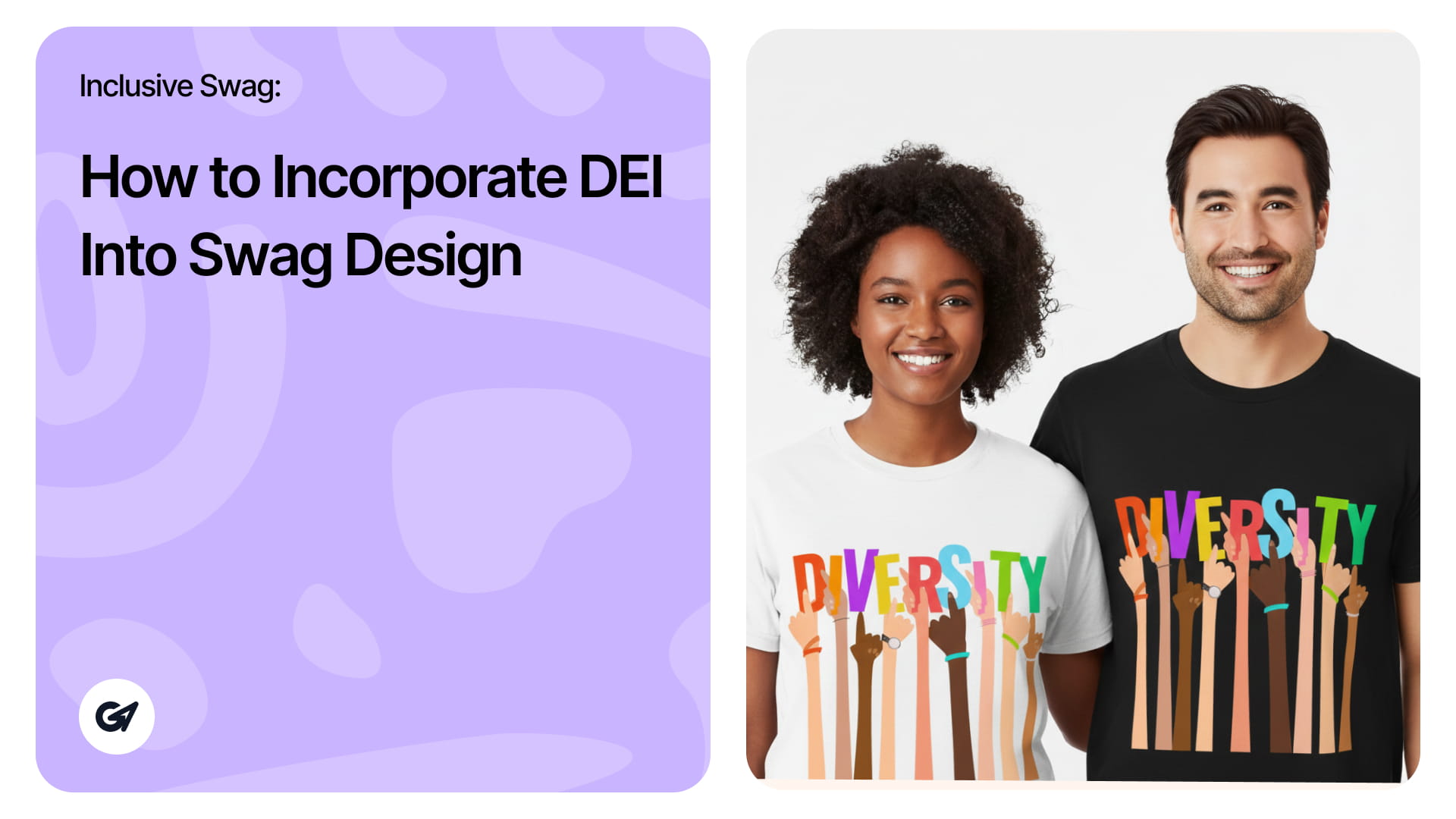
Why DEI-Optimized Swag Matters
Swag is not decorative. It is operational.
Every branded hoodie, onboarding kit, Pride item, or event giveaway communicates who a company designs for, who it considers, and whose input shaped the outcome.
When an inclusive review is missing, swag can unintentionally:
- Exclude employees through limited sizing
- Create accessibility barriers through low contrast or poor readability
- Use cultural symbolism without context or partnership
- Undermine DEI commitments through misaligned supplier choices
The result is not just awkward messaging. It can be:
- Internal trust erosion
- Public backlash
- Expensive recalls and redesigns
- Legal exposure in extreme cases
Preventing these outcomes requires structure, not good intentions.
Supplier diversity, accessibility standards, and ERG co-creation are measurable levers within procurement. They transform inclusive swag from a symbolic gesture into documented governance.
At BlinkSwag, we treat inclusive swag as infrastructure. Not a seasonal campaign. Not a marketing add-on. A repeatable system.
What Is DEI in Swag Design?
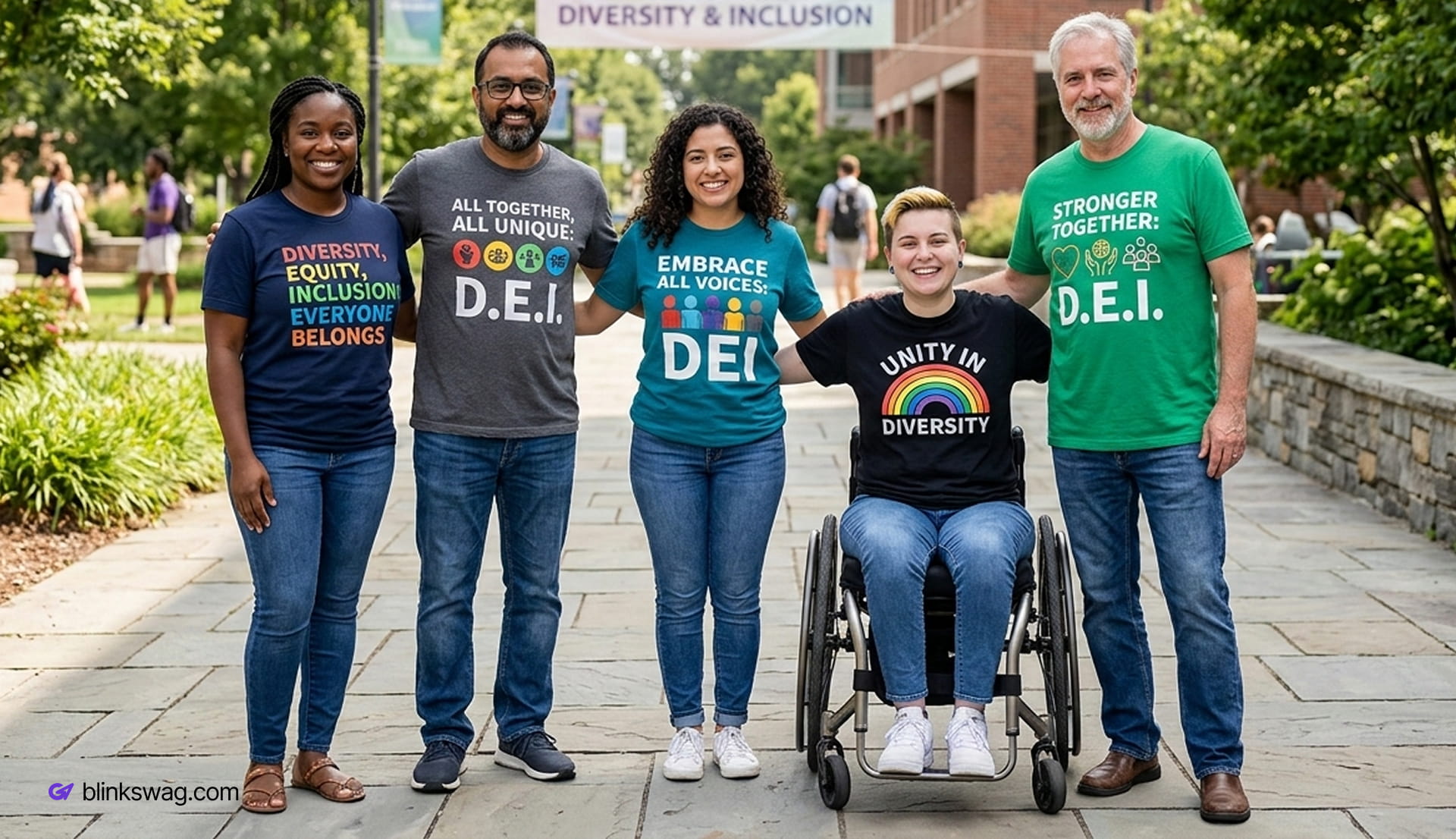
DEI in swag design means creating branded merchandise that represents all employees through accessible products, equitable supplier partnerships, and culturally sensitive design.
In practice, this requires:
- Inclusive sizing standards
- WCAG-informed legibility benchmarks
- Documented ERG co-creation
- Supplier diversity verification
- Severity-based review gates
- Measurable engagement tracking
If swag cannot be defended publicly, operationally, and culturally, it should not ship.
This guide outlines how to build a defensible system.
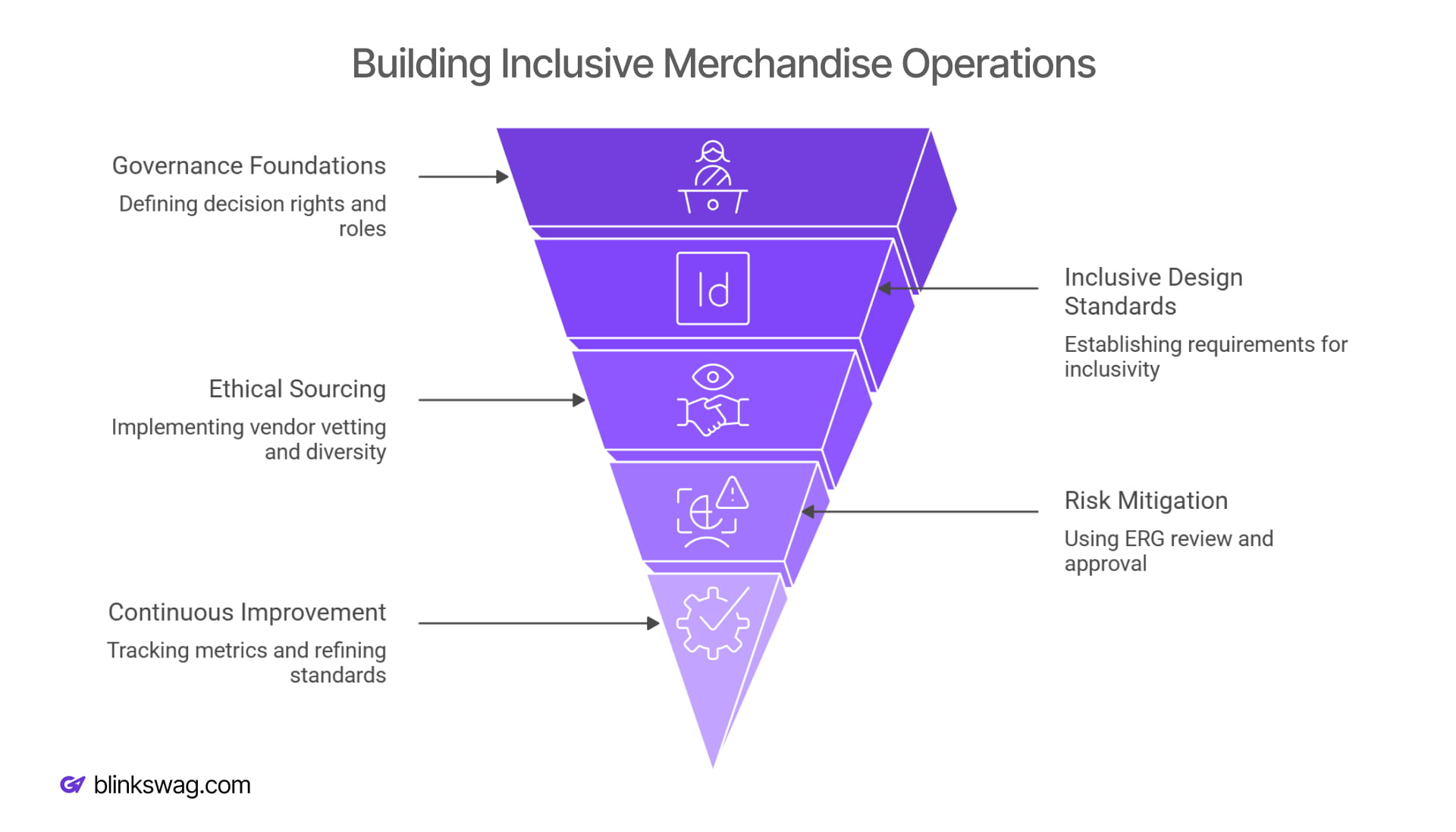
The 5-Layer Inclusive Merchandise Operating System
Most organizations approach inclusive swag backwards. They start with aesthetics, then add review late in the process.
That is where risk lives.
BlinkSwag recommends a layered governance model that embeds inclusion upstream.
Layer 1: Governance Foundations
Define decision rights, stakeholder roles, review gates, and approval authority before design begins.
Layer 2: Inclusive Design Standards
Establish measurable requirements for sizing, accessibility, readability, cultural sensitivity, and sustainability.
Layer 3: Ethical Sourcing & Supplier Diversity
Implement structured vendor vetting and certification verification within procurement workflows.
Layer 4: Risk Mitigation & Crisis Readiness
Use severity-based ERG review and documented stoplight approval before production.
Layer 5: Measurement & Continuous Improvement
Track redemption, satisfaction, supplier diversity spend, and incident rates to refine standards over time.
Each layer builds on the previous one.
Governance enables standards.
Standards inform sourcing.
Sourcing requires risk gates.
Measurement closes the loop.
This layered approach is what separates performative swag from defensible swag.
RACI: Roles Across the 5 Layers
| Activity | Procurement | ERGs | Legal | Design | DEI Officer | Executive Sponsor |
| Layer 1: Governance Setup | R | C | C | C | A | I |
| Layer 2: Design Standards | C | C | I | R | A | I |
| Layer 3: Supplier Vetting | R | C | I | I | A | I |
| Layer 4: Risk Review | I | C | R | C | A | I |
| Layer 5: Measurement | R | C | I | I | A | I |
R = Responsible
A = Accountable
C = Consulted
I = Informed
Clear ownership prevents late-stage confusion.
Download the BlinkSwag DEI Swag Implementation Toolkit
To operationalize this framework immediately, BlinkSwag provides three production-ready governance tools:
- Vendor Vetting Scorecard (Excel with auto-calculation)
- Pre-Launch Gate Checklist (fillable PDF with stoplight model)
Use them in sequence:
- Audit your current program using the Requirements Table
- Evaluate vendors using the Scorecard
- Run the Pre-Launch Checklist before production
Download the Complete BlinkSwag Toolkit
Includes:
- Vendor Vetting Scorecard (Excel)
- Pre-Launch Gate Checklist (PDF)
[Download Complete Toolkit]
DEI Swag Requirements Table
Inclusive swag must start with standards. Not opinions.
The following requirements table defines minimum operational expectations.
| Requirement | Why It Matters | Minimum Standard | How to Test | Who Approves |
| Sizing Inclusivity | Standard ranges exclude a measurable portion of employees | XS–5XL minimum; proportional fit adjustments | Pre-order survey: <5% unable to find size | Procurement + ERG |
| Visual Accessibility | Low contrast excludes visually impaired employees | WCAG-informed contrast targets (4.5:1 text, 3:1 graphics) | Contrast checker tools | Design + Accessibility lead |
| Cultural Sensitivity | Appropriation creates reputational and legal risk | No sacred symbols without community partnership | ERG severity review | ERG panel |
| Supplier Diversity | Aligns economic equity with DEI commitments | 15%+ swag spend with certified diverse suppliers where feasible | Procurement dashboard tracking | Procurement + DEI Officer |
| Sustainable Sourcing | Environmental justice intersects with inclusion | GOTS or GRS certified materials, where applicable | Certification verification | Sustainability + Procurement |
| Readability | Cognitive accessibility improves clarity | 8th-grade readability target | Readability tools | Design + HR |
These standards are designed to be embedded into procurement policy, not referenced casually.
Sample Procurement Policy Language (Copy and Adapt)
All branded merchandise purchases above $[threshold] must meet our inclusive design requirements:
- Apparel sizing spans XS to 5XL minimum with proportional fit options.
- Visual designs follow WCAG-informed contrast benchmarks and avoid stereotypes.
- Vendors must provide a current diversity certification or documented rationale.
- Materials should meet recognized sustainability certifications where feasible.
- ERG review must be completed with no unresolved high-severity concerns.
Exceptions require executive approval and documented justification.
Vendor Vetting Scorecard
Inclusive design fails if supplier selection contradicts your values.
A hoodie made by a vendor with no transparency around ownership, labor practices, or environmental claims weakens every DEI statement attached to it.
Supplier diversity is not a marketing add-on. It is a procurement decision.
The purpose of the Vendor Vetting Scorecard is to:
- Standardize supplier evaluation
- Document certification verification
- Reduce reputational risk
- Compare price and non-price factors objectively.
What Is Supplier Diversity in Swag Procurement?
Supplier diversity means intentionally sourcing from businesses owned by historically underrepresented groups, typically verified through recognized certifications.
Common certifications include:
- WBENC – Women-owned business certification
- NMSDC – Minority Business Enterprise certification
- NGLCC – LGBTQ+-owned business certification
- Disability: IN – Disability-Owned Business Enterprise
- B Corporation – Verified social and environmental standards.
Material certifications may include:
- GOTS – Organic textile standard
- GRS – Recycled material verification
- Fair Trade – Labor standards
- OEKO-TEX – Textile safety compliance
Certification confirms eligibility. It does not replace quality evaluation.
That is why structured scoring matters.
Artifact: Vendor Vetting Scorecard
| Criteria | Weight | Evaluation Method | Green Flag | Red Flag |
| Diversity Certification | 25% | Verified in the issuing body directory | Current certification validated | Expired or unverifiable claims |
| Labor Practices | 20% | Third-party audit review | Transparent wage documentation | No audit trail |
| Environmental Standards | 15% | GOTS/GRS validation | Third-party certified materials | Greenwashing language |
| Accessibility Expertise | 15% | Portfolio review | Demonstrated inclusive sizing | No accessibility examples |
| Cultural Competency | 15% | Team diversity + training documentation | Documented inclusive processes | Stereotypical portfolio work |
| Pricing Transparency | 10% | Itemized quote clarity | Clear total cost structure | Hidden fees or vague estimates |
Scoring Guidance
90–100: Preferred Vendor
75–89: Approved with Monitoring
Below 75: Improvement Plan Required
Why This Matters for Risk Mitigation
Organizations frequently discover misalignment only after a public incident.
Structured vendor vetting:
- Aligns DEI and procurement policies
- Reduces backlash probability
- Protects brand integrity
- Provides documentation if scrutiny occurs
BlinkSwag integrates this scoring directly into procurement workflows, making vendor evaluation repeatable, not subjective.
📊 Download the Vendor Vetting Scorecard (Excel)
Includes weighted auto-calculation and documentation fields.
Pre-Launch Gate Checklist
Even strong standards fail without a final gate.
The Pre-Launch Checklist ensures no campaign proceeds without structured approval.
Stoplight Model for Production Decisions
A clear launch rule prevents ambiguity:
- 🟢 Green: Approved
- 🟡 Yellow: Approved with documented mitigation
- 🔴 Red: Halt production
Artifact: Pre-Launch Gate Checklist
| Gate | Requirement | Status | Notes |
| Cultural Sensitivity | ERG review complete | 🟢 🟡 🔴 | Severity rating documented |
| Legal Compliance | Trademark and privacy cleared | 🟢 🟡 🔴 | Counsel review confirmed |
| Accessibility | WCAG-informed benchmarks verified | 🟢 🟡 🔴 | Contrast tested |
| Supplier Ethics | Certification verified | 🟢 🟡 🔴 | Expiration dates confirmed |
| Crisis Readiness | Response team identified | 🟢 🟡 🔴 | Escalation documented |
Launch Authority Rule:
Any unresolved high-severity concern results in a production halt.
This protects teams from rushed decisions under timeline pressure.
📄 Download the Fillable Gate Checklist (PDF)
Layer 1: Governance Foundations
Inclusive swag begins before design begins.
Governance requires:
- Clear RACI ownership
- Defined review checkpoints
- Budget allocation alignment
- Timeline planning
Engage ERGs at the briefing stage, not the approval stage.
ERG involvement should be structured as co-creation when identity-based themes are present.
Compensate participation where appropriate. Document all feedback with severity ratings.
Layer 2: Inclusive Design Standards
Inclusive Sizing Standard for Corporate Apparel
Inclusive swag sizing spans XS through 5XL minimum, ideally extending to 6XL+, with proportional adjustments rather than simple scaling. Offer a gender-neutral cut or equivalent size ranges across fits. Aim for fewer than 5% of employees to be unable to find an appropriate size.
Visual Accessibility Benchmarks
WCAG was developed for digital environments, but its contrast standards provide reliable guidance for physical merchandise.
Adopt WCAG-informed contrast targets:
- 4.5:1 for body text
- 3:1 for graphics and large text
Test designs in grayscale and with contrast analyzers before production.
Accessibility improves clarity for everyone.
Cultural Context as Review Prompt
Color meaning varies by region and context. Avoid rigid assumptions.
Instead:
- Validate with regional ERG members
- Avoid sacred symbols without partnership.
- Ensure representation aligns with the company connection.
When in doubt, do not ship.
Layer 3: Ethical Sourcing and Supplier Diversity
Supplier diversity should be measurable.
Track:
- Percentage of swag spend with certified diverse suppliers.
- Certification renewal compliance
- Vendor incident reports
- Sustainability verification
Procurement dashboards should reflect these metrics quarterly.
This creates defensible alignment between values and action.
Layer 4: Risk Mitigation and Crisis Management
Inclusive swag mistakes spread quickly in digital environments.
Prevention requires:
- Severity-based ERG review
- Legal checkpoint integration
- Documented sign-off
- Crisis protocol readiness
Severity Model
🔴 High Severity
Appropriation risk, exclusion, or legal exposure. Halt production.
🟡 Medium Severity
Messaging clarity issues or minor inclusivity gaps. Mitigation required.
🟢 Low Severity
Preference-based feedback. Monitor.
Documentation protects both employees and leadership.
24-Hour Crisis Response Model
Hour 0–4: Pause distribution and assess
Hour 4–12: Consult ERGs and issue holding statement
Hours 12–24: Public accountability and corrective plan
Week 1–4: Transparent remediation and updates
Speed and transparency determine trust recovery.
Layer 5: Measurement and Continuous Improvement
Swag programs should generate measurable data.
KPI Dashboard
| Metric | Target | Measurement |
| Redemption Rate | 65%+ | Distribution tracking |
| Satisfaction (NPS) | 50+ | Post-delivery survey |
| Supplier Diversity Spend | 15–25% | Procurement dashboard |
| Size Inclusivity | <5% unable to find size | Survey analysis |
| Cultural Incidents | 0 high-severity | Feedback monitoring |
Measurement prevents performative cycles.
BlinkSwag integrates distribution tracking, so engagement data is available campaign-by-campaign.
Decision Trees
Should This Swag Design Ship?
- Has the ERG review occurred?
- Are any high-severity concerns unresolved?
- Do visuals meet WCAG-informed legibility standards?
- Is supplier verification documented?
If any answer fails, halt production.
Should This Item Be Personalized?
- Does personalization increase usefulness?
- Can minimal data collection be used?
- Is the privacy review complete?
If not, redesign the approach.
Frequently Asked Questions
What makes swag inclusive?
Inclusive swag accommodates body diversity, accessibility needs, cultural context, and supplier equity. It integrates governance and measurement rather than relying on symbolic representation.
What makes swag inclusive for employees with disabilities?
Accessible typography, sufficient contrast, inclusive sizing, tactile considerations where relevant, and readable messaging ensure usability. Testing before production is critical.
How do you source sustainable and diverse suppliers simultaneously?
Use a weighted vendor scorecard that evaluates diversity certification and environmental standards together. Avoid treating ESG and DEI as separate initiatives.
How long does it take to implement a DEI swag program?
A comprehensive governance setup typically takes 3 to 6 months. Rushed timelines increase risk.
What are the most significant risks in DEI swag?
Tokenism, cultural appropriation, limited sizing, supplier misalignment, and lack of measurement.
Conclusion
Inclusive swag is not about themed merchandise.
It is about documented governance, measurable procurement alignment, accessibility standards, and risk mitigation protocols.
When inclusion becomes embedded in procurement policy and review gates, swag stops being symbolic and starts being structural.
Start with the Requirements Table.
Apply the Vendor Scorecard.
Run the Gate Checklist before production.