An inclusive Women’s Equality Day gifting campaign begins with purpose, not merchandise. Recognize women’s contributions without assuming preferences based on gender, give recipients appropriate choice, verify supplier and donation claims, and connect any gift to a broader recognition, learning, mentoring, development, or community initiative.
Women’s Equality Day is observed in the United States on August 26, the date the 19th Amendment was certified in 1920. The amendment prohibited the denial of voting rights based on sex, but the milestone did not remove every barrier to voting for every woman. National Park Service and National Archives materials document both the amendment’s significance and the continuing barriers that remained afterward.
For employers, that history calls for more than a themed promotional giveaway.
A gift can support recognition.
It should not be presented as proof that a workplace has achieved equality.
A strong campaign should first answer:
- What are we recognizing?
- Who is being highlighted?
- Who can participate?
- How will material-reward eligibility be determined?
- Should recipients have product choice?
- Is supplier diversity part of the objective?
- Will the campaign include learning, mentoring, development, volunteering, or giving?
- What happens after August 26?
Only after those decisions are clear should merchandise be selected.
What does Women’s Equality Day recognize?
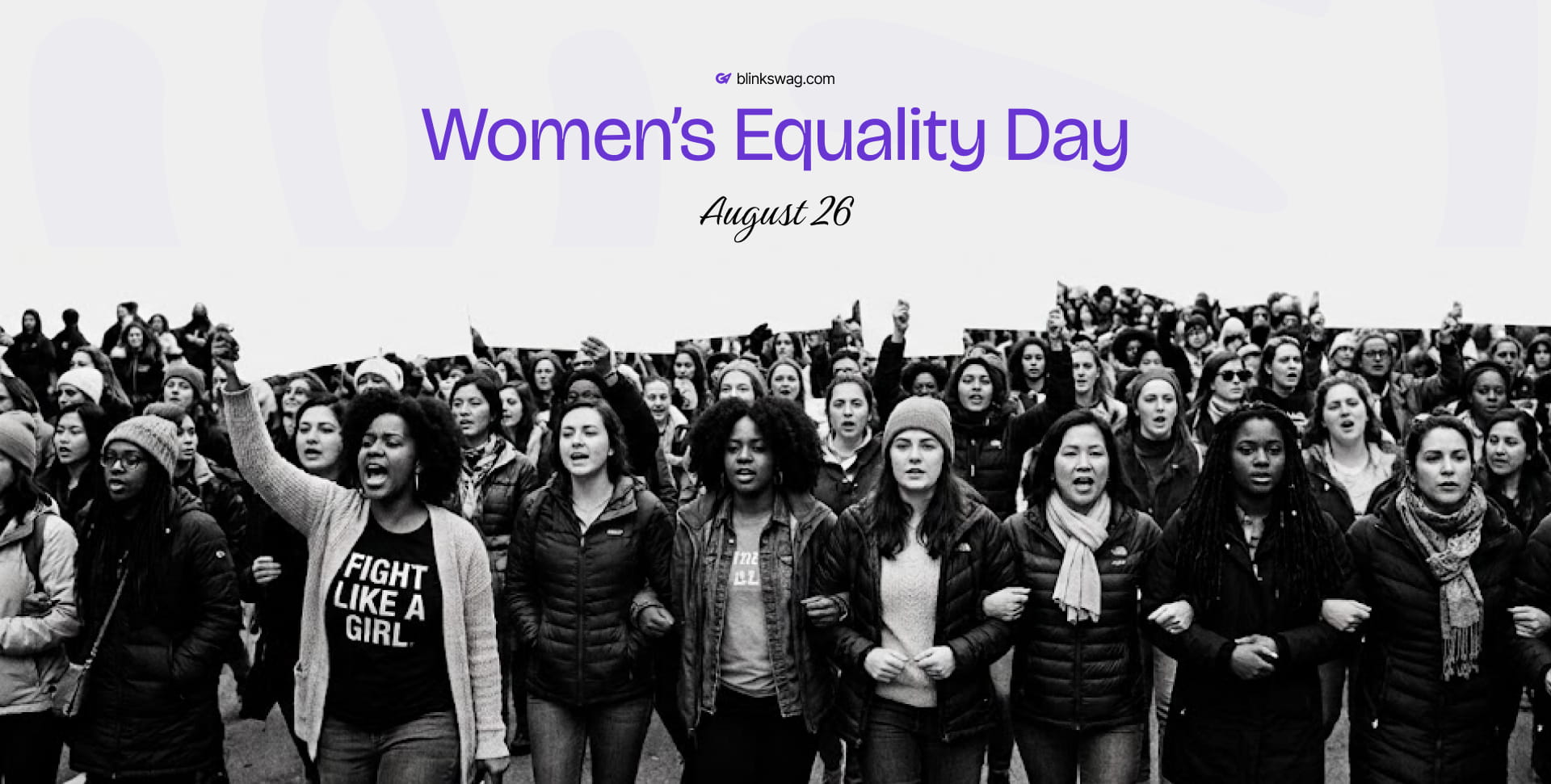
Women’s Equality Day marks the August 26, 1920 certification of the 19th Amendment to the U.S. Constitution. The amendment prohibited voting discrimination based on sex, but discriminatory laws and other barriers continued to prevent many women from voting equally afterward. The date represents a major milestone rather than the completion of equality.
The 19th Amendment was ratified after Tennessee became the 36th state needed to meet the constitutional threshold, and it was certified on August 26, 1920.
Historical accuracy matters in corporate messaging.
Avoid reducing the occasion to:
“The day all women received the right to vote.”
A more accurate formulation is:
Women’s Equality Day commemorates the certification of the 19th Amendment, a major milestone in expanding women’s voting rights and in the longer history of equality in the United States.
National Park Service materials specifically note that the 19th Amendment did not guarantee equal voting access for all after its ratification.
What makes a Women’s Equality Day gifting campaign inclusive?
An inclusive campaign recognizes women without assuming that women share the same interests, colors, products, sizes, lifestyles, or preferences. Product usefulness, accessibility, recipient context, location, choice, campaign purpose, and individual needs should guide gift selection rather than gender stereotypes.
Instead of building the program like this:
gender → assumed preference → product
build it like this:
purpose → recipient context → appropriate choice → product
That changes the conversation from:
“What gifts do women like?”
to:
“What form of recognition fits this campaign and these recipients?”
Review these inclusion factors.
- Product usefulness
- Quality
- Accessibility
- Apparel sizing
- Product choice
- Remote participation
- International availability
- Dietary requirements
- Delivery location
- Branding level
- Personalization
- Supplier selection
- Campaign message
BlinkSwag’s current inclusive-merchandise guidance similarly emphasizes inclusive sizing, representation, accessibility, and structured supplier review when building merchandise programs.
Inclusive does not mean identical.
An identical product can create different experiences.
For example:
- One apparel size system may not suit everyone.
- One product may not be practical across climates.
- Food can create dietary conflicts.
- A strongly gender-coded product may not reflect individual preferences.
- Remote employees may require different fulfillment.
- International availability may vary.
A consistent recognition approach can therefore be more useful than forcing one identical physical item on every recipient.
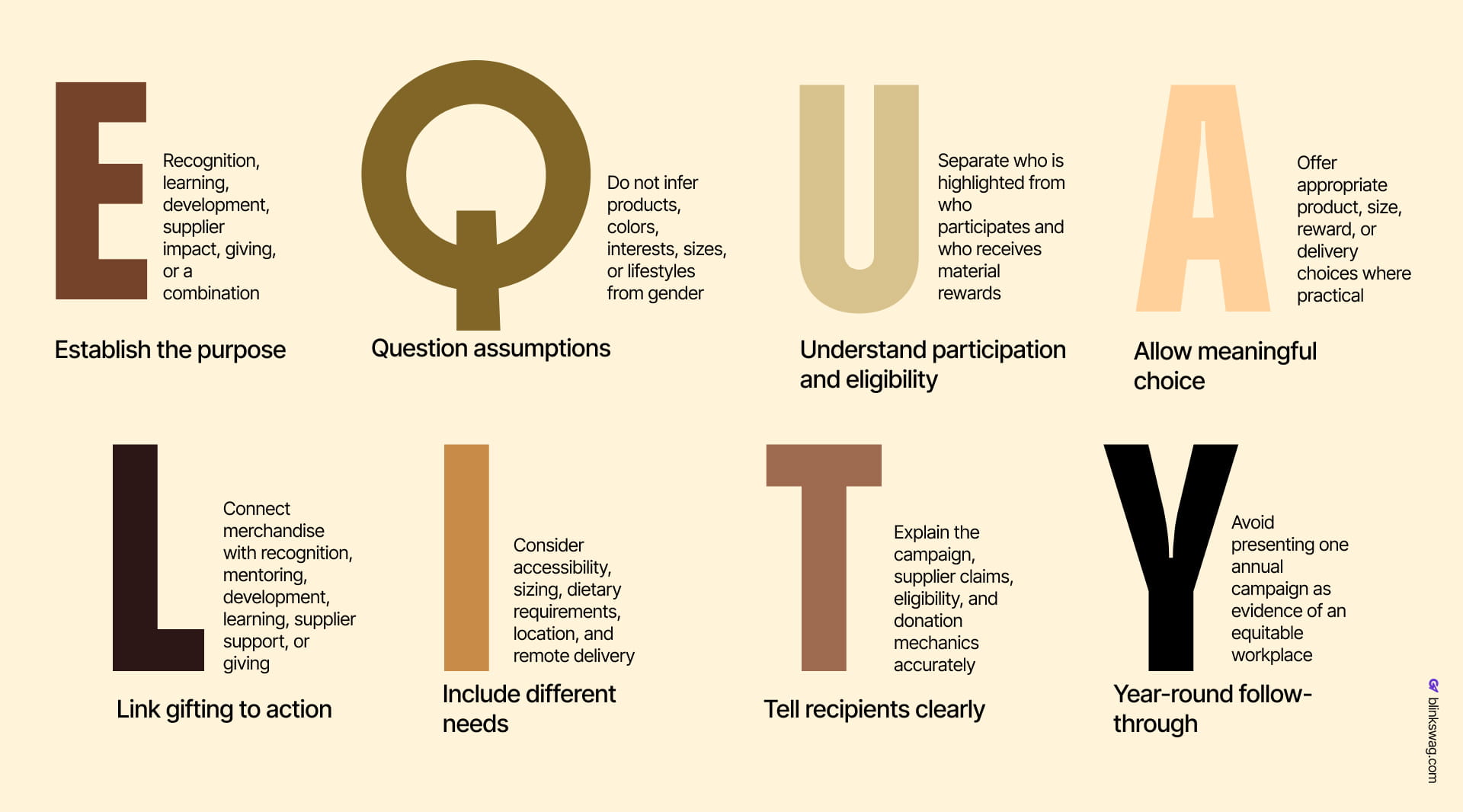
Use the EQUALITY Campaign Framework
The EQUALITY Campaign Framework helps organizations build Women’s Equality Day programs around purpose, eligibility, choice, inclusion, transparency, and follow-through. It treats merchandise as a single component of recognition rather than as evidence that an organization has achieved workplace equality.
This is a BlinkSwag editorial planning framework, not an industry or legal standard.
| Step | Campaign decision |
| E: Establish the purpose | Recognition, learning, development, supplier impact, giving, or a combination |
| Q: Question assumptions | Do not infer products, colors, interests, sizes, or lifestyles from gender |
| U: Understand participation and eligibility | Separate who is highlighted from who participates and who receives material rewards |
| A: Allow meaningful choice | Offer appropriate product, size, reward, or delivery choices where practical |
| L: Link gifting to action | Connect merchandise with recognition, mentoring, development, learning, supplier support, or giving |
| I: Include different needs | Consider accessibility, sizing, dietary requirements, location, and remote delivery |
| T: Tell recipients clearly | Explain the campaign, supplier claims, eligibility, and donation mechanics accurately |
| Y: Year-round follow-through | Avoid presenting one annual campaign as evidence of an equitable workplace |
E: Establish the purpose
Decide what the organization is trying to accomplish before selecting gifts.
Possible goals include:
- Recognizing employee contributions
- Highlighting mentors
- Increasing visibility for achievements
- Supporting professional development
- Launching a mentoring initiative
- Supporting qualified women-owned suppliers
- Supporting an approved nonprofit
- Creating an educational opportunity
- Strengthening an existing recognition program
A campaign can combine several objectives, but the purpose should remain understandable.
Q: Question assumptions
Ask why a particular product is being considered.
Is it because the recipient is likely to use it?
Or because someone assumes women will like it?
Beauty products, flowers, jewelry, candles, spa items, and fashion accessories are not automatically inappropriate. They become poor default recommendations when gender alone is being used as evidence of preference.
U: Understand participation and eligibility
Separate the three questions:
- Who is the campaign highlighting?
- Who can participate in the program?
- Who is eligible for a tangible reward or employee benefit?
These questions are not interchangeable.
Women’s achievements can be centered on employee stories, panels, awards, leadership visibility, mentoring, and other recognition activities without automatically making sex the eligibility criterion for a material employee benefit.
Employers should review HR and legal requirements before limiting tangible employee rewards based on sex. The EEOC states that Title VII prohibits employment discrimination based on sex and warns that DEI-related programs can be unlawful when employment actions are motivated by a protected characteristic.
A: Allow meaningful choice
Choice can include:
- Product
- Apparel size
- Approved reward
- Gift card
- Store credit
- Delivery location
- An appropriate alternative
BlinkSwag’s Reward Links feature allows organizations to send personalized rewards while controlling recipients’ budgets. Its redemption workflow can include merchandise and gift-card options.
L: Link gifting to action
A gift may accompany:
- Contribution-specific recognition
- Mentoring
- Sponsorship
- Leadership visibility
- Professional development
- Learning
- Supplier-diversity sourcing
- A charitable initiative
- Volunteer participation
The merchandise should reinforce the activity rather than substitute for it.
I: Include different needs
Review:
- Sizing
- Accessibility
- Dietary requirements
- Location
- Remote participation
- International availability
- Technology requirements
- Delivery restrictions
T: Tell recipients clearly
If the campaign includes a:
- women-owned supplier
- certified supplier
- nonprofit
- company donation
- donation match
- percentage-based contribution
state exactly what the claim means.
Avoid vague impact language.
Y: Year-round follow-through
Do not frame one August 26 campaign as proof of the organization’s complete workplace culture.
Where appropriate, connect the campaign to a program that runs year-round.
Who should receive a Women’s Equality Day gift?
Organizations should distinguish recognition from material employee benefits. Women’s achievements can be centered through stories, awards, panels, mentoring, and contribution-specific recognition. At the same time, employers should review HR and legal requirements before limiting tangible rewards or benefits based on sex. Eligibility rules should be intentional, documented, and appropriate to the program.
The safest structure is not necessarily:
Women receive merchandise; everyone else does not.
Instead, design each campaign component separately.
| Campaign element | Possible structure |
| Historical content | Women-centered |
| Employee stories | Women-centered with permission |
| Leadership panel | Women-centered speakers, broader participation |
| Contribution recognition | Based on documented contribution or nomination criteria |
| Mentoring initiative | Based on defined program criteria |
| Employee event | Organization-wide where appropriate |
| Material reward | Use neutral eligibility rules unless HR/legal review supports another structure |
| Supplier initiative | Procurement-based |
| Company donation | Company-funded |
| Voluntary giving | Open according to campaign rules |
EEOC guidance specifically identifies employee benefits and other terms or privileges of employment as areas where sex discrimination is prohibited.
Separate recognition from participation
A company might structure the day like this:
Historical focus: Women’s Equality Day
Recognition: Women’s achievements and contributions
Learning session: Open to the organization
Mentoring initiative: Based on program eligibility
Merchandise: Distributed according to approved neutral criteria
Supplier program: Procurement-led
Giving initiative: Voluntary or company-funded
This approach preserves the purpose of the observance while reducing the risk of making merchandise eligibility itself the centerpiece.
This section provides general campaign-planning information, not legal advice.
Should the campaign focus on gifts or workplace action?
A Women’s Equality Day gift should support a meaningful campaign rather than substitute for recognition or workplace action. Merchandise can make appreciation tangible, but companies should avoid claiming that a gift creates equality, eliminates bias, improves advancement, or proves organizational commitment.
A campaign can combine several layers.
Recognition + gift
Recognize a specific contribution and accompany the recognition with an appropriate reward.
Recognition + development
Connect the occasion with:
- mentoring
- sponsorship
- professional development
- leadership visibility
- learning opportunities
Recognition + supplier impact
Use qualified women-owned suppliers where appropriate and where ownership or certification can be verified.
Recognition + giving
Add a:
- company donation
- employee fundraiser
- matching program
- volunteer opportunity
When it fits the organization and campaign.
The anti-tokenism test
Ask:
If the merchandise disappeared, would the campaign still have a clear purpose?
If the answer is no, the campaign may depend too heavily on swag.
A stronger model is:
recognition + gift + action + follow-through
For example:
Recognition: highlight mentors who made a documented contribution
Gift: provide a reward through approved eligibility criteria
Action: open the next mentoring cohort
Follow-through: measure participation later in the year
Transferable lesson from International Women’s Day
Women’s Equality Day and International Women’s Day are separate observances and should not be treated as interchangeable.
One useful transferable idea comes from International Women’s Day’s 2026 Give To Gain campaign, which frames support more broadly than merchandise through mentoring, training, visibility, knowledge, resources, advocacy, funding, and donations. Its supplier initiative also promotes women-owned businesses.
For Women’s Equality Day, the practical lesson is simple:
Think beyond the item being shipped.
This is inspiration for campaign design, not official guidance for Women’s Equality Day.
How can companies avoid gender stereotypes when selecting gifts?
Companies can avoid gender stereotypes by selecting products based on usefulness, quality, recipient preferences, accessibility, location, and campaign purpose. Professional merchandise, practical technology, quality drinkware, bags, journals, and flexible rewards can suit diverse recipients without relying on assumptions about what women should want.
Avoid starting with stereotypical categories.
Do not assume:
- Women want pink merchandise
- Women prefer jewelry
- Women want spa products
- Women prefer flowers
- Women want beauty products
- Women want fashion accessories
Any of these may suit an individual.
They should not be treated as universal preferences.
Start with the use case
| Campaign need | Better product direction |
| Professional utility | Journals, pens, work bags, tech accessories |
| Everyday use | Drinkware, backpacks, chargers |
| Flexible recognition | Reward Links, gift cards, and approved store credit |
| Career development | Books or learning-related rewards |
| Remote workforce | Easily shipped products or digital choice |
| Executive recognition | Premium professional merchandise |
| Event participation | Practical shared merchandise |
| Personalized recognition | Product plus contribution-specific message |
The key principle is:
Select for the person and the purpose, not for a gender stereotype.
Should companies use one standard gift or recipient choice?
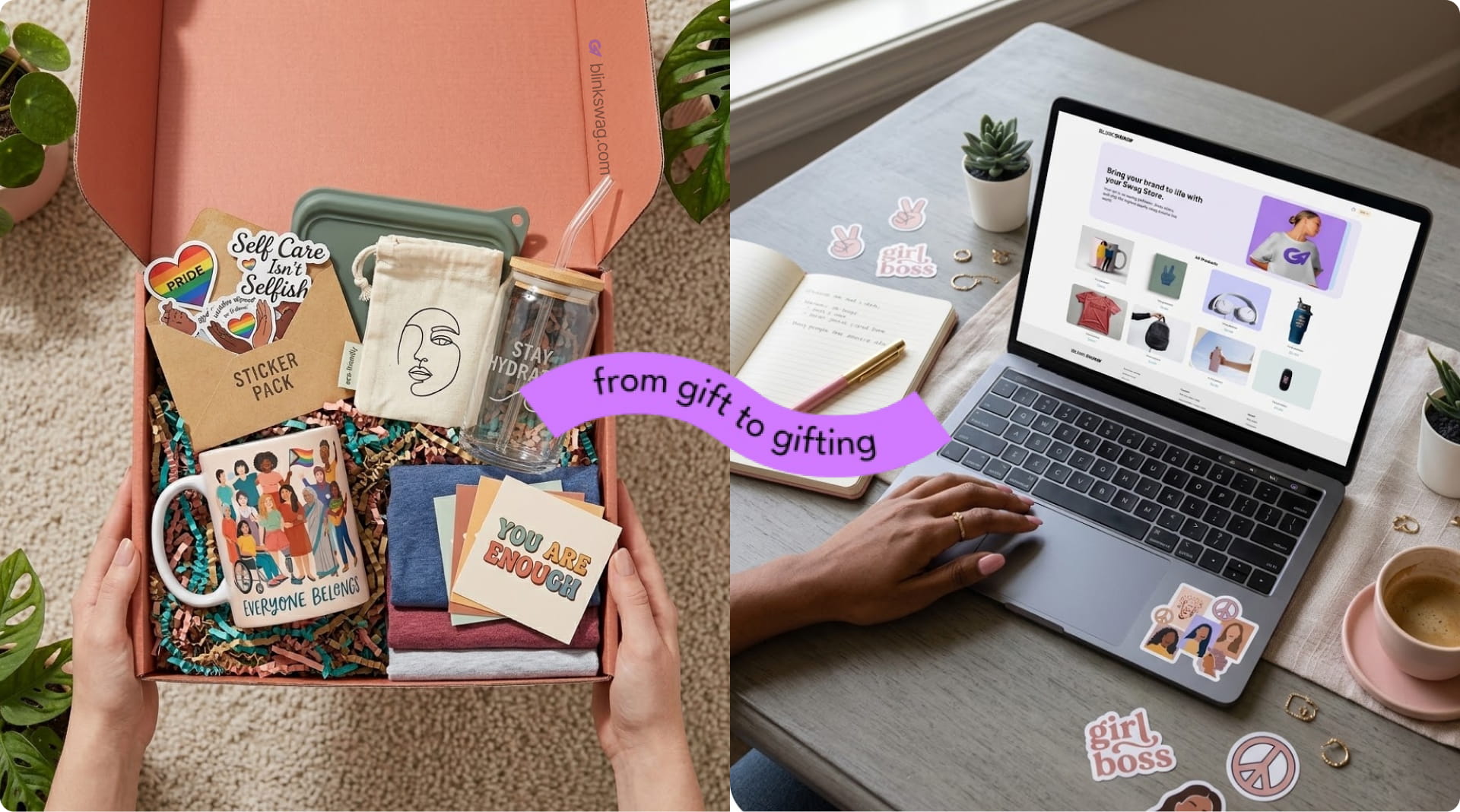
A standard gift can work when product fit is broad and operational simplicity matters. Recipient choice is stronger when sizes, locations, preferences, accessibility requirements, or product needs differ. Choice can reduce assumptions while still allowing the company to maintain a controlled catalog and consistent recognition budget.
| Model | Advantage | Main risk |
| Standard gift | Simple procurement | The product may not fit everyone |
| Limited catalog | Choice within control | Requires catalog setup |
| Reward Link | Flexible choice within budget | Some rewards may go unclaimed |
| Gift card | Broad flexibility | May feel impersonal without context |
| Reward Store | Ongoing choice | Requires program management |
| Hybrid | Different methods for different contexts | More administration |
Use a standard gift when:
- Product usefulness is broad.
- Sizing is not required.
- The audience has similar delivery conditions.
- Branding is appropriate.
- Inventory is reliable.
Use recipient choice when:
- Apparel sizes vary.
- Product preferences are unknown.
- Recipients are geographically distributed.
- Accessibility needs vary.
- The company wants to reduce unused inventory.
BlinkSwag’s Reward Store supports customizable company stores, point distribution, employee groups, product and gift-card redemption, and reporting.
Equal value does not require identical products.
A company may provide the same approved recognition value while allowing different product selections.
That separates:
consistent budget
from:
identical merchandise
Should companies source from women-owned businesses?
Women-owned supplier sourcing can add a meaningful procurement component when ownership is verified, and the supplier meets standard requirements for product quality, price, accessibility, availability, and delivery. Supplier diversity should complement recipient suitability rather than replace normal purchasing requirements.
Women-owned and certified women-owned are not necessarily the same
WBENC states that its certification validates that a business is at least 51% owned, controlled, operated, and managed by a woman or women, and that certification involves a formal vetting process.
The U.S. Small Business Administration operates a separate federal Women-Owned Small Business certification program with its own eligibility and certification requirements.
Therefore:
Supplier ownership and formal certification should not be treated as interchangeable claims.
Three sourcing models
Recipient-first sourcing
Choose products based primarily on:
- usefulness
- quality
- budget
- accessibility
- availability
- delivery
Supplier ownership is a secondary factor.
Supplier-impact sourcing
Make verified women-owned sourcing one of the program objectives.
Use this model when:
- Supplier status is verified
- Procurement requirements are satisfied
- The product quality is suitable
- delivery requirements can be met
Hybrid sourcing
Include suitable products from verified women-owned suppliers inside a broader approved catalog while allowing recipient choice.
This can balance:
- supplier impact
- recipient autonomy
- product quality
- operational feasibility
Procurement rule
Do not describe a supplier as:
- women-owned
- WBENC-certified
- WOSB-certified
- minority-owned
- LGBTQ+ owned
- another certified ownership category
unless the claim can be verified through an appropriate source.
BlinkSwag’s inclusive-merchandise guidance also recommends structured supplier vetting rather than relying on assumptions or surface-level branding claims.
How can a campaign include a give-back component?
A give-back component can extend the campaign beyond merchandise through a company donation, a matching contribution, an employee fundraiser, a volunteer activity, or other documented support. Giving is optional. When a campaign mentions a nonprofit or donation, the exact mechanism should be stated clearly rather than described through vague impact language.
This is a BlinkSwag editorial give-back framework, not an official Women’s Equality Day standard.
Fixed corporate donation
Example:
Our company is contributing $10,000 to [organization].
Donation per participant
Example:
The company will contribute $20 for each qualifying campaign participation, up to $10,000.
State the cap.
Matching program
Disclose:
- Match rate
- Maximum match
- Eligible organizations
- Program deadline
Employee-selected cause
Allow employees to select among vetted organizations when the company’s program supports that approach.
Volunteer participation
Options may include:
- Team volunteering
- Skills-based volunteering
- Approved paid volunteer time
Be precise
Avoid:
A portion of the proceeds supports women.
Prefer:
The company will donate 5% of campaign sales, up to $20,000.
or:
The company is making a separate $15,000 donation.
Do not combine merchandise spending and charitable giving into one undefined “impact” figure.
What are good Women’s Equality Day gifts?
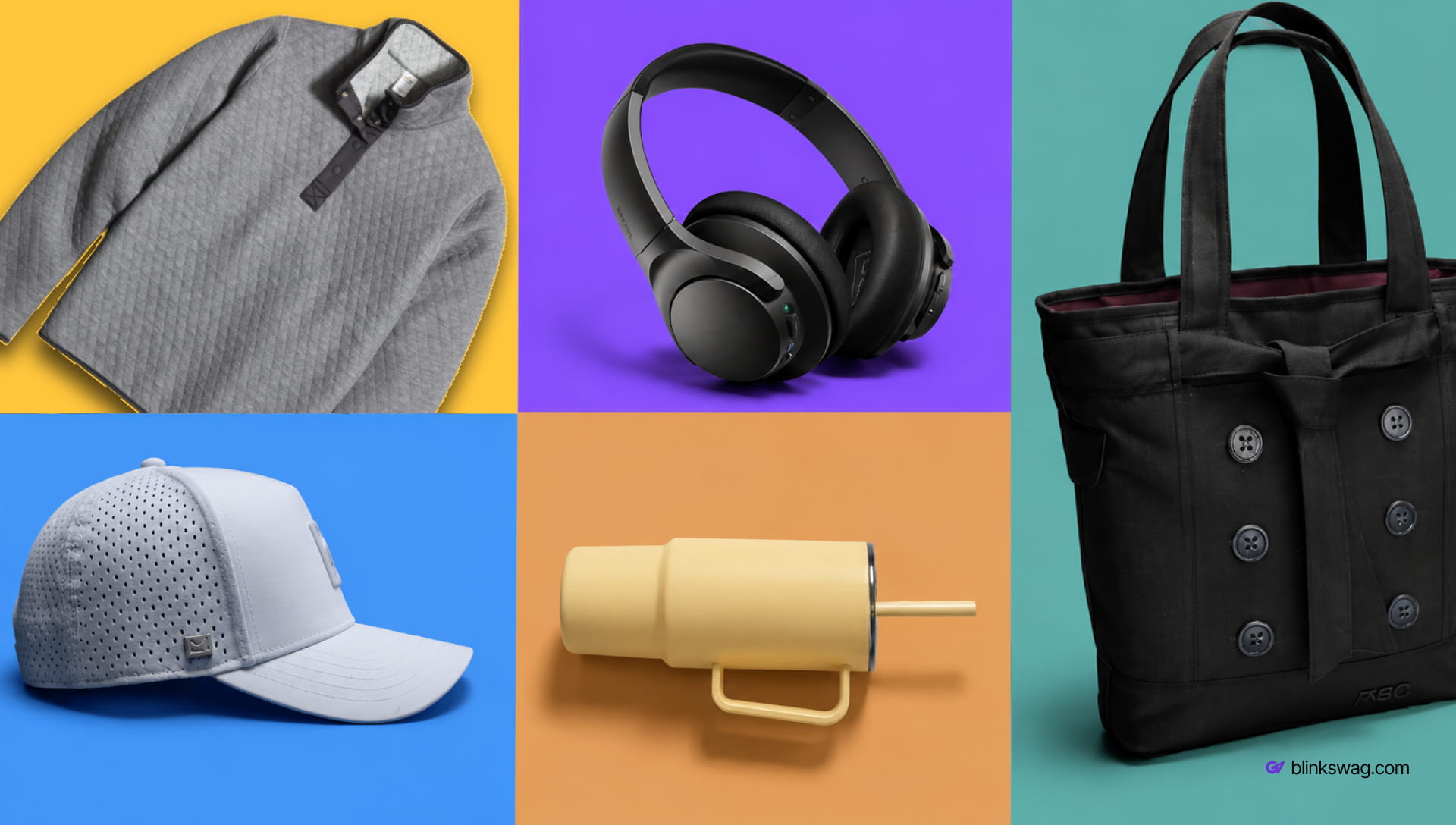
Good Women’s Equality Day gifts are practical, high-quality, appropriate for the recipient, and aligned with the campaign objective. Useful product categories include professional notebooks, work bags, technology, drinkware, travel accessories, recipient-choice rewards, and other merchandise selected for usefulness rather than for gender stereotypes.
The live BlinkSwag catalog currently includes options across multiple price levels.
Selected live BlinkSwag examples
| Product | Starting price | Why can it fit |
| Port Authority® Eco Blend Canvas Tote | $3.59 | Broad everyday utility |
| Vasco 32oz Stainless Steel Bottle | $9.63 | Practical wellness and everyday hydration |
| Port Authority® Crush Ripstop Backpack | $11.75 | Functional everyday carry for work and travel |
| Wireless Phone Charging Pad 2.0 | $15.00 | Useful everyday tech for a modern workspace |
| Ekster Finder Tag | $38.99 | Thoughtful everyday utility for keeping essentials easy to find |
| Brooks Brothers® Women’s Cotton Stretch V-Neck Sweater | $67.07 | Polished, versatile style for work and everyday wear |
| Terra Thread Fairtrade Notebook | $17.98 | Thoughtful tool for ideas, planning, and personal reflection |
| CORKCICLE® Stemless Wine Cup – 12 Oz | $29.70 | Stylish self-care gift for relaxing and unwinding |
Prices above are displayed starting prices observed in the BlinkSwag catalog on August 24, 2026. Quantity, decoration, minimums, inventory, shipping availability, taxes, and final program cost should be confirmed before purchase.
Do not treat the table as “products women like”
These products appear because they serve campaign use cases such as:
- professional utility
- everyday use
- travel
- technology
- recipient flexibility
not because gender predicts preference.
How should Women’s Equality Day messages be written?
Women’s Equality Day messaging should explain what is being recognized, acknowledge specific contributions where possible, and avoid generic empowerment clichés or unsupported claims about the company’s workplace culture. Good copy tells recipients why the campaign exists and what the organization is actually doing.
Avoid generic messaging
Examples that can feel disconnected from actual recognition include:
- “Here’s to strong women.”
- “Girl power.”
- “Women can do anything.”
- “Because women deserve something special.”
The problem is not positivity.
The problem is a lack of specificity.
Better employee recognition message
Thank you for the expertise, perspective, and contributions you bring to our team. Women’s Equality Day allows us to recognize the work and achievements of women across our organization and to continue supporting meaningful recognition throughout the year.
Contribution-specific message
We’re recognizing your leadership on the customer experience initiative and the support you’ve provided across the team. Thank you for the expertise and consistency you bring to your work.
Mentor-recognition message
Thank you for investing your experience and time in helping colleagues develop. We’re recognizing the contribution you’ve made through mentoring and the support you provide throughout the year.
Company-wide message
Women’s Equality Day allows us to recognize women’s contributions across our organization and reflect on how recognition, visibility, development, and opportunity are supported throughout the year.
Recipient-choice message
As part of this recognition program, you can choose an approved reward that works for you. Use your personalized link to review the available options within the program budget.
Supplier-impact message
Use only after verification:
This campaign includes selected products sourced from verified women-owned suppliers as part of our supplier-diversity program.
How can companies avoid making the campaign feel performative?
A campaign is more credible when merchandise supports an existing recognition, learning, development, supplier, or community objective. Companies should not use swag as evidence that they have achieved equality or solved workplace disparities. The campaign should communicate what it actually does, who it recognizes, and what continues afterward.
Ask eight questions.
| Check | Question |
| Purpose | What are we recognizing? |
| Eligibility | Are the program criteria appropriate and documented? |
| Choice | Are we assuming recipient preferences? |
| Message | Are we recognizing a real contribution? |
| Supplier | Can sourcing claims be verified? |
| Action | Is the program connected to anything beyond merchandise? |
| Giving | Is the donation mechanism transparent? |
| Follow-through | What happens after August 26? |
Warning signs
A campaign can feel performative when:
- Products rely on gender stereotypes.
- Merchandise has no connection to the stated objective.
- Broad workplace-equality claims are made without evidence.
- Donation language is vague.
- Supplier claims cannot be verified.
- Employee stories are published without permission.
- The company presents one annual activity as proof of its culture.
- Recognition disappears immediately after the campaign.
How should remote and international teams be included?
Remote and international employees should receive a reasonably equivalent recognition experience, even when the exact merchandise differs by region. Companies should consider location, product availability, delivery, customs compliance, sizing, accessibility, and digital alternatives before committing to one global product.
Remote-team planning
Confirm:
- Delivery preference
- Address-submission process
- Product availability
- Apparel size where relevant
- Shipment tracking
- Replacement process
- Digital alternative
International planning
A global program may require different merchandise because:
- Inventory differs by region.
- Shipping requirements vary.
- Product restrictions differ.
- Customs may apply.
- Apparel sizing systems can differ.
BlinkSwag’s fulfillment service states that it supports storage, inventory management, packing, and worldwide delivery.
BlinkSwag’s Reward Points feature also states that remote and geographically dispersed teams can access reward stores and redeem points from different locations.
Confirm destination-specific product and delivery requirements before launch.
How should companies budget for the campaign?
A Women’s Equality Day campaign budget should include more than merchandise. Companies should account for products, decoration, packaging, fulfillment, shipping, taxes or duties, replacements, and any separate costs for events, learning, development, or charitable programs. Donation spending should remain separate from merchandise spending.
Campaign cost model
Total Campaign Cost = Merchandise + Decoration + Packaging + Fulfillment + Shipping + Taxes or Duties + Replacements + Separate Program Costs
BlinkSwag editorial planning formula. This is not an accounting standard or industry benchmark.
Separate program costs might include:
- Speaker fees
- Training
- Professional development
- Event production
- Donations
- Matching contributions
- Learning resources
Consistent value versus identical products
A recipient-choice campaign might allow:
- Recipient A to select a backpack
- Recipient B to choose drinkware
- Recipient C to select another approved reward
while all remain within the same approved budget.
BlinkSwag Reward Links are designed to let organizations control reward budgets while giving recipients options.
What should procurement and privacy teams review?
Procurement should verify products, suppliers, certification claims, pricing, decoration, accessibility, inventory, and delivery. Privacy teams should limit the unnecessary collection of residential addresses and other recipient data. Supplier-diversity goals and gifting convenience do not replace normal procurement, security, or data-governance controls.
Procurement checklist
Verify:
- SKU
- Starting price
- Quantity
- MOQ where applicable
- Decoration
- Production requirements
- Inventory
- Packaging
- Size range
- Accessibility
- Shipping
- Supplier ownership
- Certification status
Supplier verification
Record the relevant evidence when certification matters.
For example:
- WBENC certification
- SBA WOSB certification
- Another approved certifier used by the organization
WBENC certification includes a formal review rather than relying on marketing claims alone.
Recipient-data minimization
Collect only what the gifting workflow actually requires, such as:
- Name
- Business email
- Delivery address
- Product selection
- Apparel size where necessary
- Carrier-required contact information
The FTC advises businesses to know what personal information they hold, keep only what they need, protect retained information, dispose of information that is no longer necessary, and plan for security incidents.
BlinkSwag can reduce internal address handling through CRM integration and recipient-specific Reward Links and redemption workflows, but each organization remains responsible for applying its own privacy, security, retention, and compliance requirements.
How should campaign performance be measured?
Women’s Equality Day gifting should be measured through operational and participation metrics rather than claims that the merchandise created workplace equality. Useful measures include reward acceptance, redemption, successful delivery, recipient feedback, supplier-spend data, program participation, and follow-through on linked mentoring, development, learning, or giving initiatives.
Core gifting metrics
| Metric | Calculation |
| Acceptance rate | Accepted gifts ÷ gifts offered |
| Redemption rate | Redeemed rewards ÷ rewards issued |
| Successful delivery rate | Successful deliveries ÷ shipments |
| Cost per successful delivery | Gifting cost ÷ successful deliveries |
| Unclaimed rate | Unclaimed rewards ÷ rewards issued |
| Replacement rate | Replacement shipments ÷ original shipments |
These are BlinkSwag editorial measurement formulas, not universal HR or accounting standards.
Participation measures
Track metrics relevant to the actual campaign:
- Recognition submissions
- Program participation
- Learning attendance
- Mentoring enrollment
- Volunteer participation
- Recipient feedback
Supplier-impact measures
When supplier diversity is part of the objective, track:
- Verified spend
- Number of qualified suppliers
- Products sourced
- Certification status
Giving measures
Track separately:
- Company donation
- Employee donations
- Company match
- Total contribution
- Participation
Do not combine merchandise spend and charitable contributions into one vague “impact” number.
Avoid unsupported outcome claims
Do not report that gifting:
- eliminated bias
- improved equality
- caused promotions
- increased retention
- improved pay equity
unless the organization has evidence sufficient to support that specific conclusion.
What mistakes should companies avoid?
The biggest Women’s Equality Day gifting mistakes are starting with stereotypes, using sex as an unreviewed material-benefit eligibility rule, treating merchandise as the entire campaign, making unsupported equality claims, using unverifiable supplier labels, hiding donation mechanics, excluding remote employees, and failing to define what happens after August 26.
Mistake 1: Starting with “gifts for women”
Better: Start with campaign purpose and recipient context.
Mistake 2: Defaulting to stereotypically feminine merchandise
Better: Select products for usefulness or provide a controlled choice.
Mistake 3: Assuming women-only material rewards are automatically appropriate
Better: Separate women-centered recognition from reward eligibility and review employment-law and HR requirements.
Mistake 4: Treating an identical gift as the only definition of fairness
Better: Consider a consistent value with controlled recipient choice.
Mistake 5: Treating merchandise as the campaign
Better: Connect it with recognition, learning, development, supplier impact, or giving.
Mistake 6: Making unsupported equality claims
Better: Describe exactly what the campaign does.
Mistake 7: Using unverified supplier claims
Better: Check ownership and certification evidence.
Mistake 8: Using vague donation language
Better: State the amount, percentage, match, or cap.
Mistake 9: Ignoring distributed teams
Better: Design for office, remote, and international recipients from the start.
Mistake 10: Forgetting follow-through
Better: Connect August 26 with an appropriate ongoing program where relevant.
Women’s Equality Day campaign checklist
A complete campaign should confirm purpose, eligibility, participation, product strategy, recipient choice, sourcing, messaging, compliance, budget, fulfillment, privacy, measurement, and follow-through before merchandise is ordered.
Purpose
- Define the campaign objective.
- Identify what is being recognized.
- Separate recognition from merchandise.
- Identify related learning, mentoring, development, supplier, or giving activity.
Eligibility and participation
- Define who is highlighted.
- Define who participates.
- Define tangible-reward eligibility.
- Review HR and legal requirements.
- Document eligibility criteria.
Products
- Select by usefulness and campaign fit.
- Avoid gender assumptions.
- Confirm accessibility.
- Confirm sizing.
- Check quality.
- Review branding.
- Confirm availability.
Supplier sourcing
- Verify ownership claims.
- Verify certification where relevant.
- Maintain ordinary procurement standards.
- Confirm price and delivery capability.
Giving
- Identify the recipient organization.
- Define the donation mechanism.
- State amount, rate, or cap.
- Keep donation reporting separate from merchandise spend.
Messaging
- Explain what is being recognized.
- Avoid generic clichés.
- Avoid unsupported workplace-equality claims.
- Describe sourcing and giving accurately.
- Obtain permission for employee stories.
Fulfillment and privacy
- Confirm recipient data requirements.
- Minimize unnecessary data collection.
- Validate addresses.
- Confirm products and sizes.
- Fulfill and track deliveries.
- Plan replacements.
Measurement
- Track acceptance.
- Track redemption.
- Track delivery.
- Track participation.
- Track verified supplier spend where relevant.
- Track donations separately.
- Gather feedback.
- Define follow-through.
Frequently asked questions
What is an inclusive Women’s Equality Day gifting campaign?
An inclusive campaign recognizes women’s contributions while avoiding assumptions about product preferences based on gender. It considers campaign purpose, recipient context, appropriate eligibility rules, meaningful choice, accessibility, supplier verification, transparent messaging, and follow-through.
Should only women employees receive Women’s Equality Day gifts?
Employers should be careful about using sex as an eligibility criterion for tangible employee rewards or benefits. Women’s contributions can be centered through recognition and programming, while material-reward eligibility should be reviewed with HR or legal counsel where protected characteristics affect eligibility.
Should every recipient receive the same gift?
No. A company can maintain a consistent recognition budget while offering controlled product choice when sizes, preferences, locations, or accessibility needs differ.
What gifts should companies avoid?
Avoid products selected solely because they are stereotypically associated with women. An individual may like flowers, jewelry, beauty products, or spa products, but gender alone should not be used as evidence that the entire audience wants those items.
Should companies use women-owned suppliers?
They can when supplier diversity fits the campaign and supplier ownership is verified. Certification systems such as WBENC and the SBA WOSB program have specific requirements, so certification claims should be checked rather than assumed.
Can companies use gift cards?
Gift cards can provide recipient flexibility, but employers should review their own payroll, tax, procurement, and employee-benefit policies before using them.
How should remote employees be included?
Design the campaign for distributed participation from the beginning. Use shippable products, recipient choice, regionally available merchandise, or digital alternatives while aiming for a reasonably consistent recognition experience.
Should the campaign include a donation?
A donation is optional. If one is included, state exactly how the contribution works, including the amount, percentage, match, or cap.
How should residential addresses be handled?
Collect only the information necessary for fulfillment, restrict access appropriately, apply retention and security policies, and use recipient-controlled address submission when it fits the workflow. FTC guidance recommends retaining only the personal information a business needs and protecting the data it retains.
Final recommendation
The strongest Women’s Equality Day gifting campaigns recognize women’s achievements without turning gender into a product preference or an unreviewed employee-benefit eligibility rule. Start with purpose, separate recognition from participation and material rewards, offer appropriate choice, verify supplier claims, communicate giving transparently, and connect merchandise with meaningful action.
Use the EQUALITY sequence:
→ Establish the purpose
→ Question assumptions
→ Understand participation and eligibility.
→ Allow meaningful choice
→ Link gifting to action
→ Include different needs
→ Tell recipients clearly
→ Year-round follow-through
That creates a campaign architecture built around:
purpose → recognition → eligibility → choice → sourcing → action → message → fulfillment → measurement
rather than:
occasion → stereotype → product → logo → shipment
BlinkSwag can support the operational side of this model through Reward Links, Reward Points, branded Reward Stores, inventory management, company swag stores, and global fulfillment.
Use recipient choice when a single product cannot effectively serve everyone in the campaign. BlinkSwag Reward Links and branded Reward Stores can help organizations control budgets while allowing recipients to choose from approved rewards.
Planning Women’s Equality Day recognition for a distributed workforce? Start with your campaign purpose, eligibility rules, audience, budget, product requirements, and fulfillment needs. Then use BlinkSwag to coordinate approved merchandise, rewards, inventory, and delivery without making the merchandise carry the entire meaning of the campaign.